

An acquirer has closed the account, settlement has stopped, and somewhere in the termination correspondence there is a reference to MATCH. A MATCH record is an entry in a card-scheme database that acquirers consult when they onboard merchants. It is not a court order, a trading ban, or a general prohibition on receiving money.
Quick answer: Accepting payments while on the MATCH list is possible, but nothing about it is automatic. A listing makes obtaining another Mastercard merchant account substantially harder, because every acquirer has to check the database before signing a merchant. What happens next depends on why the record was filed, whether it is accurate, the acquiring appetite for the business model, the jurisdiction, and the payment methods considered.
What the MATCH list actually is
MATCH, formally MATCH Pro, is the Mastercard Alert To Control High-risk (Merchants) system. Mastercard’s Security Rules and Procedures, Merchant Edition describes it as a mandatory system for Mastercard acquirers, giving an authorised user the opportunity to review “enhanced or incremental risk information” before entering into a merchant agreement.
Two roles matter. Acquirers add and maintain the records and are responsible for their accuracy. Mastercard stores them and makes them available to other acquirers running an enquiry.
What does being on the MATCH list mean? It means a previous acquirer terminated the merchant relationship and filed a record, carrying a reason code, that other acquirers see when they screen the business or its principal owner during onboarding. Mastercard positions that as an input to the new acquirer’s own independent risk determination, not an automatic decline. “Blacklist” is the common shorthand for the result, and it is imprecise: the rules tell an acquirer to look, not to refuse.
Does every termination lead to a MATCH listing?
No. Termination on its own is not the trigger. The obligation arises when the acquiring relationship is being terminated and the acquirer has reason to believe that one of the conditions in the reason-code table exists. Accounts also close for commercial reasons, portfolio changes, dormancy or a bank exiting a sector, and those closures carry no listing obligation.
Where it does apply, the acquirer must add the record within five calendar days of the earliest of three events: its decision to terminate, its receipt of notice from the merchant, or the point at which it becomes aware of an issue meeting one of the reason codes.
The current edition of the manual sets out ten reason codes available to acquirers:
- 01 Account Data Compromise
- 03 Transaction Laundering
- 04 Excessive Chargebacks
- 05 Excessive Fraud
- 06 Coercion
- 08 Mastercard Questionable Merchant Audit Program
- 10 Violation of Standards
- 12 PCI Data Security Standard Noncompliance
- 13 Illegal Transactions
- 14 Identity Theft
Older summaries online list fourteen codes, including entries absent from the current table. Check any code cited in a termination notice against the current manual.
How long does a MATCH listing last?
Five years. The rules state that records remain on the system for five years, at which point they are purged automatically. Mastercard’s MATCH Pro privacy notice puts the same retention in plainer terms, describing listings as automatically deleted after five years.
Expiry and correction are separate mechanisms, and conflating them is the most common misunderstanding. The clock does not shorten because a dispute ratio improved, a chargeback was later won, or the business has since traded without incident.
Who can remove a MATCH record
Can a merchant remove itself from MATCH? Not directly, and not by applying to Mastercard in the general case. Mastercard may remove a listing in two defined situations: where the filing acquirer reports it was added in error, and where a reason code 12 listing (PCI DSS noncompliance) is followed by the merchant becoming compliant.
That request goes to Mastercard in writing on the acquirer’s letterhead, with an attestation of compliance and a validation certificate from a Mastercard certified forensic examiner. If the acquirer is unwilling or unable to submit it, the merchant may submit it directly.
Everything else runs through the filing acquirer. A merchant may contact it to request removal, giving the current or previous merchant name and address, the principal owner’s name, and the website URL where applicable. The acquirer must respond within 30 calendar days.
Mastercard also states that there is no requirement for a listed merchant to engage legal counsel to request removal. MATCH Pro is provided to financial institutions rather than merchants, so there is no merchant-facing lookup, and the reason code has to come from the termination notice or the acquirer. Niftipay cannot remove or amend another acquirer’s record, and nor can any other provider.
Can you get another merchant account while on MATCH?
Possibly, depending on the listing reason, acquiring appetite, jurisdiction, business model and the provider’s assessment. There is no guaranteed approval, and any provider promising one is describing something the scheme rules do not support. Acquirers query the database before signing, so a listing will surface; what varies is the weight it carries against the rest of the file.
A provider assessing a terminated merchant will usually want to understand:
- why the previous acquiring relationship ended
- the MATCH reason code, where the merchant knows it
- the business model, the products or services, and how they are delivered
- ownership and KYB documentation
- the website and checkout flow, and whether published policies match what the business does
- processing history and statements from the previous provider
- dispute and fraud history, and what has been corrected since
- jurisdictions, currencies and settlement corridors
Much of that overlaps with an ordinary high-risk merchant account assessment, and the preparation that shortens a normal high-risk payment gateway approval applies here too. The difference is that the file opens with an unexplained gap, and the merchant’s account of what happened becomes part of the evidence.
What to do in the first weeks after a termination
Most of the work that changes an outcome happens before any new application is submitted.
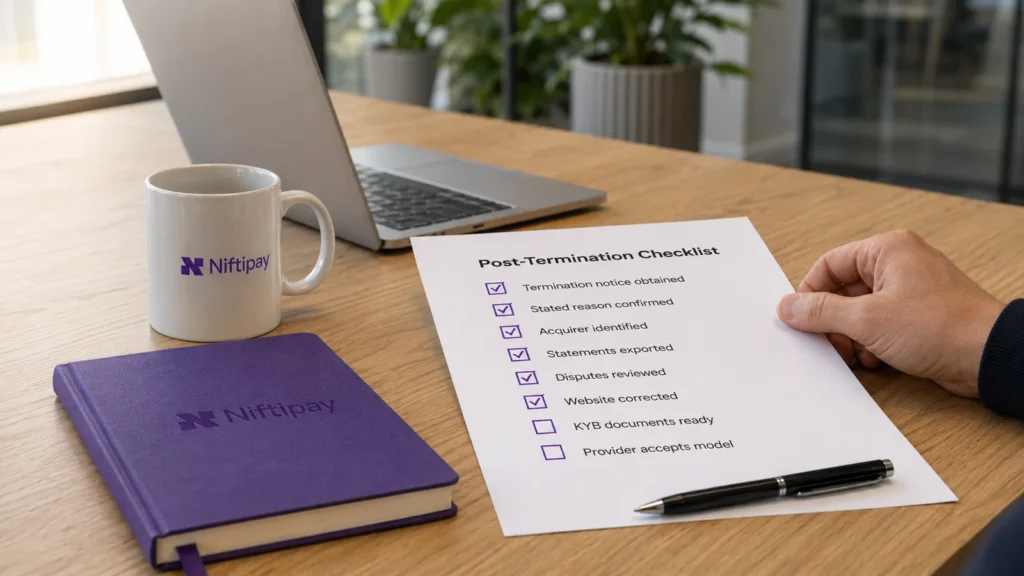
- Obtain the termination notice in writing. A verbal explanation is not a record.
- Check whether MATCH is mentioned. Some notices name it and a reason code; many do not.
- Identify the acquiring institution. The provider on the invoice is not always the acquirer that filed the record.
- Establish the stated reason and ask the acquirer directly if the notice is vague.
- Preserve statements and processing records. Access to a closed portal ends quickly, so export first.
- Review the underlying issue where it relates to disputes, fraud or compliance, including how chargeback representment was handled at the time.
- Correct what contributed to it. Descriptor accuracy, refund and cancellation policies, delivery evidence and site content are all fixable.
- Prepare accurate KYB documentation using the same compliance checklist a new provider will work from.
- Be transparent with future providers. An undisclosed listing that surfaces during screening is a credibility problem on top of the original issue.
- Confirm a provider accepts the business model before applying.
The application checklist covers the documents. What changes after a termination is the need to explain a gap.
Which payment options can still be considered
Does MATCH mean a business cannot accept any payments? No. MATCH Pro governs access to Mastercard acquiring. It is not a general prohibition on operating a business or receiving money by every other method.
A listed merchant should still not assume another provider or rail will accept them automatically. Every provider applies its own KYB, risk assessment, jurisdiction rules and business-model restrictions, and any of those can produce a decline independently of MATCH.
Where card payments are constrained, some merchants look at crypto and stablecoin payments as a different rail. Because blockchain payments do not use the Mastercard acquiring rail, MATCH does not operate as the transaction-screening mechanism for those payments. That does not remove the merchant’s compliance, KYB or provider-approval requirements, and it is not a route around card-network controls. Whether it fits depends on the business model, the jurisdiction and whether customers will pay that way.
MATCH listing compared with high-risk classification
These two are routinely confused, and they behave differently.
| Area | High-risk classification | MATCH listing |
|---|---|---|
| What it represents | A provider’s judgement about a sector or exposure profile | A record filed by an acquirer against a merchant it terminated, stored by Mastercard |
| Trigger | Sector, product, delivery model, dispute exposure and jurisdiction | Termination where the acquirer believes a listed reason-code condition exists |
| Effect on underwriting | Changes documentation, controls and terms; still an ordinary decision | Acquirers must query the database before signing; a hit feeds their risk determination |
| Processing impossible? | No, though fewer providers are willing | No, but approval is materially harder and never guaranteed |
| Can the merchant change the signals? | Yes, over time: dispute ratios, fraud controls, refund policy, delivery evidence | Not directly. It records a past termination; correction goes via the filing acquirer |
| Who controls it? | Each provider, on its own criteria. There is no central register | The filing acquirer. Mastercard stores it, removes it in defined cases, purges it after five years |
How Niftipay works with merchants after a processing problem
Niftipay reviews applications individually, based on the merchant’s business model, jurisdiction, processing history and compliance profile. A previous account termination or a MATCH listing should be disclosed accurately during the application process rather than left to surface later. Niftipay supports card and crypto payment options for eligible merchants, but availability depends on the approved setup, and approval is not guaranteed.
MATCH list FAQs
What does being on the Mastercard MATCH list mean?
A previous acquirer terminated the merchant relationship and filed a record with a reason code in MATCH Pro. Other acquirers see it when they screen the business or its owner during onboarding, and treat it as one input to their own assessment.
How long does a MATCH listing last?
Five years. Records remain on the MATCH Pro system for five years and are then purged automatically. The period does not shorten if performance improves afterwards.
Can a merchant remove itself from MATCH?
Not by applying to Mastercard in the general case. A merchant can ask the acquirer that filed the record to remove it, and that acquirer must respond within 30 calendar days. Mastercard removes listings reported by the filing acquirer as added in error, and reason code 12 listings followed by verified PCI DSS compliance.
Can you get another merchant account after being placed on MATCH?
Possibly, depending on the listing reason, the business model, the jurisdiction and the provider’s own assessment. Acquirers must check the database before signing, so the listing will be visible. No provider can guarantee approval.
Should you tell a new payment processor that you are on MATCH?
Yes. Acquirers query the database during onboarding, so a listing is likely to appear regardless. Disclosing it, with an accurate account of what happened and what has changed, is treated very differently from one discovered after the fact.