

Getting approved for payment processing is one of the biggest friction points for high-risk merchants. In many cases, the delay is not only about the industry itself, but about how the business is presented during underwriting.
A weak website, inconsistent business information, or missing documents can slow down high-risk payment gateway approval even when the business is legitimate. On the other hand, merchants who prepare properly often move much faster.
This guide explains what providers review, what usually causes delays, and what you can do to improve your approval speed from day one.
Why High-Risk Payment Gateway Approval Takes Longer
High-risk onboarding is usually more detailed than standard payment setup. Providers need to understand not only what you sell, but also how your business handles refunds, disputes, fulfillment, and customer support.
That is why high-risk payment gateway approval often takes longer: underwriting needs more clarity before making a decision.
The most common delays come from:
- missing or outdated documents,
- unclear website policies,
- inconsistent company details,
- unrealistic volume projections,
- and applying to a provider that does not fit your vertical.
What are payment gateway approval requirements?
Payment gateway approval requirements are the company, ownership, website, operational, financial and compliance details a provider uses to assess whether it can support a merchant’s payment activity. They are not a single document or an automated check, but a picture of the business assembled from several sources and reviewed together.
Depending on the provider and the business model, that review may involve:
- Business verification of the registered legal entity.
- Beneficial ownership verification of the people who ultimately control the company.
- Website review to confirm the site reflects the declared activity.
- Product or service assessment against supported categories.
- Transaction expectations, including volumes, values, countries and currencies.
- Fulfilment and refund arrangements, including delivery timing.
- Customer acquisition methods and how the business markets itself.
- Risk and compliance checks appropriate to the sector.
- Settlement configuration, covering currencies and payout arrangements.
Requirements vary by business model. A domestic single-product store has a different review profile from a cross-border marketplace collecting payments for other sellers.
What Providers Review Before Approval
To move faster, it helps to know what underwriting is actually checking during high-risk payment gateway approval.
Most providers will review:
- your legal business details and ownership,
- your website and checkout flow,
- your products or services,
- expected monthly volume and average ticket size,
- target countries and billing model,
- and your refund, fraud, and chargeback controls.
The goal is not just to approve the account, but to assess whether your payment activity is manageable over time.
The payment glossary defines the underwriting vocabulary used in this section, including merchant category code, rolling reserve and chargeback.
How to Speed Up High-Risk Payment Gateway Approval
The fastest way to improve high-risk payment gateway approval is simple: reduce back-and-forth with underwriting.
Merchants who get approved faster usually do three things well:
- prepare documents before applying,
- align business information across all materials,
- and make their website underwriting-ready.
It sounds basic, but this is where most delays start.
Prepare Your Business Information Before You Apply
Before submitting any application, make sure your key business data is consistent everywhere.
This includes:
- legal company name,
- business address,
- ownership details,
- website domain,
- support email and phone,
- banking details,
- and operating model (one-time, subscription, cross-border, etc.).
Consistent information helps underwriting move faster and improves high-risk payment gateway approval by reducing clarification requests.
Make Your Website Underwriting-Ready
A professional-looking site is not enough. For high-risk payment gateway approval, your website needs to be clear from an underwriting perspective.
Your site should show:
- what you sell,
- how customers pay,
- contact information,
- Terms & Conditions,
- Privacy Policy,
- Refund / cancellation policy,
- shipping or delivery details (if applicable).
If underwriters cannot quickly understand your business, they will ask more questions—and every question adds time. Underwriters will also look at how your business manages disputes, so having clear processes in place matters—especially if you are already working on chargeback prevention strategies for high-risk industries.
Submit a Clean Document Pack Upfront
One of the biggest time-wasters in high-risk payment gateway approval is sending documents one by one after each request.
A better approach is to prepare a complete onboarding pack before applying. Depending on the provider and vertical, this may include:
- company registration documents,
- owner ID,
- proof of address,
- bank confirmation or statement,
- processing history (if available),
- and licenses (if required).
Use current files, clear scans, and organized filenames. Small details like this can speed up review more than most merchants expect.
Be Realistic About Volumes and Risk
Trying to look bigger or lower-risk than you really are can hurt high-risk payment gateway approval.
Underwriters prefer clear, realistic numbers:
- expected monthly volume,
- average order value,
- top countries,
- refund expectations,
- and whether billing is recurring or one-time.
A credible profile usually performs better than an overly optimistic one.
Show Your Risk Controls Early
Providers want to see how you manage operational risk. If you explain this early, high-risk payment gateway approval tends to move more smoothly.
Be ready to describe:
- fraud prevention checks,
- refund handling process,
- customer support response times,
- chargeback reduction steps,
- and billing descriptor clarity.
This shows the provider that your business is prepared to process payments responsibly. Chargeback exposure remains one of the key operational signals in high-risk underwriting, so merchants that improve dispute prevention usually move through reviews more smoothly.

Choose the Right Provider for Your Vertical
A common mistake is applying broadly instead of applying strategically. Many delays happen because the provider is simply not a fit.
Before applying, confirm the provider supports your:
- industry,
- target markets,
- transaction type (one-time or subscription),
- and settlement needs.
Provider fit is one of the fastest ways to improve high-risk payment gateway approval without changing anything else in your business.
What Slows Approval Even When the Business Is Legitimate
Many legitimate merchants get delayed for avoidable reasons. The pattern is usually the same: the business is real, but the application package is incomplete or hard to review quickly.
Typical issues include unfinished websites, mismatched company details, weak policy pages, low-quality files, and slow replies to underwriting questions.
These issues do not always cause rejection, but they often slow high-risk payment gateway approval and create unnecessary friction.
Unclear processing history or unrealistic projections
A payment provider also wants to understand how the business has processed payments in the past and what it expects to process in the future.
If a merchant has no prior history, that does not automatically prevent approval, but it does increase uncertainty. If the business does have prior history but provides incomplete statements, inconsistent volumes, or unrealistic future forecasts, the underwriter may pause to reassess the risk.
This is especially common when online merchants project large monthly volumes without enough operational proof behind them. Ambitious growth is not a problem in itself, but if the numbers look disconnected from the business’s current stage, traffic profile, or fulfilment capability, delays become more likely.
This is another practical reason why high-risk payment approvals get delayed. Underwriters want confidence that transaction volume, average ticket size, refund exposure, and customer acquisition patterns all make sense together. If those pieces do not align, the file often moves into deeper review.
Chargeback exposure remains one of the biggest red flags
If there is one issue that consistently shapes why high-risk payment approvals get delayed, it is chargeback exposure.
From the provider’s perspective, chargebacks signal more than just customer dissatisfaction. They can point to poor fulfilment, unclear billing, weak support, misleading advertising, fraud vulnerability, or unstable customer expectations. In high-risk sectors, even a modest pattern of disputes can make an underwriter much more cautious.
This matters even more for businesses in industries where disputes already tend to run higher. Subscription models, nutraceuticals, adult, coaching, digital goods, dating, and certain cross-border offers are all reviewed more closely because the provider knows that customer complaints can escalate quickly when expectations are not managed well.
That is why merchants should not treat dispute prevention as something to solve after approval. If a business already shows signs of exposure, the provider may delay the application while reviewing the merchant’s policies, support flow, descriptors, billing logic, and refund handling. A stronger strategy for reducing chargebacks in high-risk industries can directly improve how the business is perceived during underwriting.
Business model complexity can slow down the review
Not all high-risk businesses are delayed for the same reason. Sometimes the issue is simply complexity.
A merchant may operate across several countries, sell through multiple traffic sources, combine one-time and recurring billing, use affiliate-driven acquisition, or run an offer that changes depending on customer segment. None of that automatically makes the business unacceptable, but it can make it harder for an underwriter to form a fast and confident assessment.
This is particularly relevant for merchants with layered models such as lead generation plus fulfilment, subscription plus upsells, or a hybrid business that combines digital access with physical products. The more moving parts involved, the greater the need for explanation and documentation.
In these cases, why high-risk payment approvals get delayed often comes down to the provider needing a fuller picture. They want to know exactly how the sale happens, when the customer is charged, when fulfilment occurs, what happens in the event of cancellation, and where disputes are most likely to arise.
A business with a complex model can still be approved successfully, but only when that complexity is explained clearly rather than left for the underwriter to interpret alone.
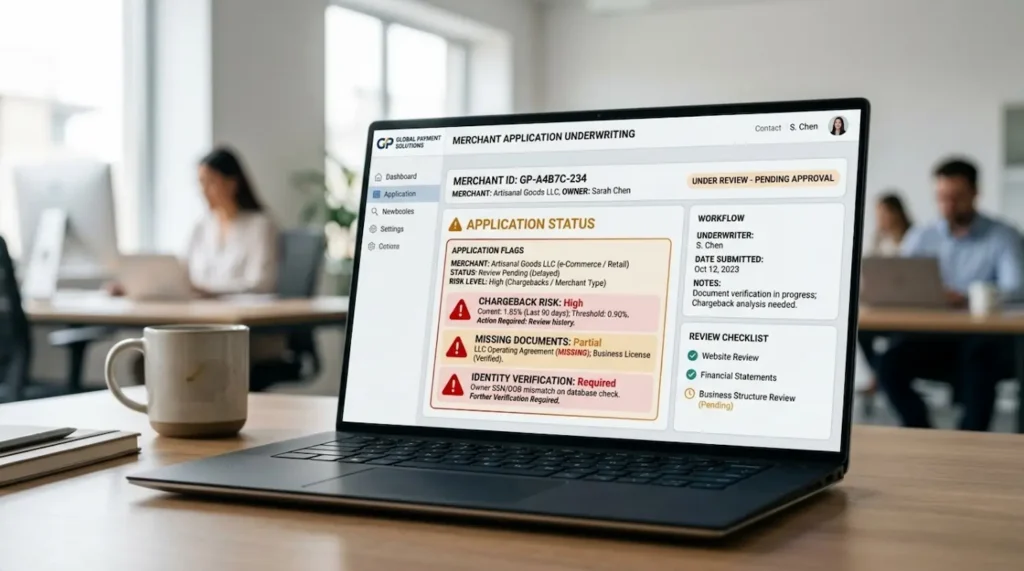
Before You Apply, Think Like an Underwriter
Before submitting your application, review your business the way a provider will.
Check whether your website clearly explains what you sell and how customers are billed. Make sure your documents are complete and your company information matches across every file and form. Prepare realistic volume expectations and be ready to explain your fraud, refund, and chargeback controls.
Merchants who prepare their documents, website, and risk controls in advance usually move faster through underwriting—and the same preparation also helps with reserves and chargeback performance over time, especially if you are already working on how to reduce chargebacks in high-risk industries.
That preparation makes high-risk payment gateway approval more predictable—and usually much faster.
High-risk payment gateway approval FAQs
How long does payment gateway approval take?
For a complete application, high-risk review is usually measured in days rather than weeks. Niftipay normally reviews applications within two to five business days once the required information has been received. Complex business models, or requests for additional documentation, take longer. No provider guarantees approval, and every application is assessed individually against the products sold, the markets served and the compliance profile.
What can delay a high-risk merchant approval?
Five causes account for most delays: missing or outdated documents, company details that do not match across files and forms, unclear or absent website policies, volume projections with no history behind them, and applying to a provider that does not cover your vertical. Chargeback exposure is the single factor that most often makes an underwriter slow down, because it points at fulfilment, billing clarity and support quality at the same time.
Why do providers review a merchant’s website?
The website is the clearest evidence of what is actually being sold and how customers are billed. Underwriters check that products and pricing are visible, that billing cadence and cancellation are explained, that contact details work, and that terms, privacy and refund policies are published and consistent with the checkout. Anything they cannot confirm quickly becomes a follow-up question, and every question adds time to the decision.
Does processing history affect approval?
Yes. Prior statements let an underwriter assess real volumes, refund behaviour and dispute ratios instead of estimating them. Having no history does not prevent approval, but it does increase uncertainty. The combinations that cause a reassessment are incomplete statements, volumes that move inconsistently between months, and forecasts set far above anything the business has demonstrated operationally.
Can an incomplete KYB application delay approval?
Yes, and it is the most common single cause. Verification cannot conclude while a document, an ownership detail or an identity check is outstanding, so the file waits rather than being declined. Submitting a complete pack up front, including every shareholder holding 25% or more, avoids the request-and-wait cycle. Our high-risk merchant account application checklist lists what to gather, and KYB requirements for high-risk payment gateways explains what the provider reviews once it arrives.