
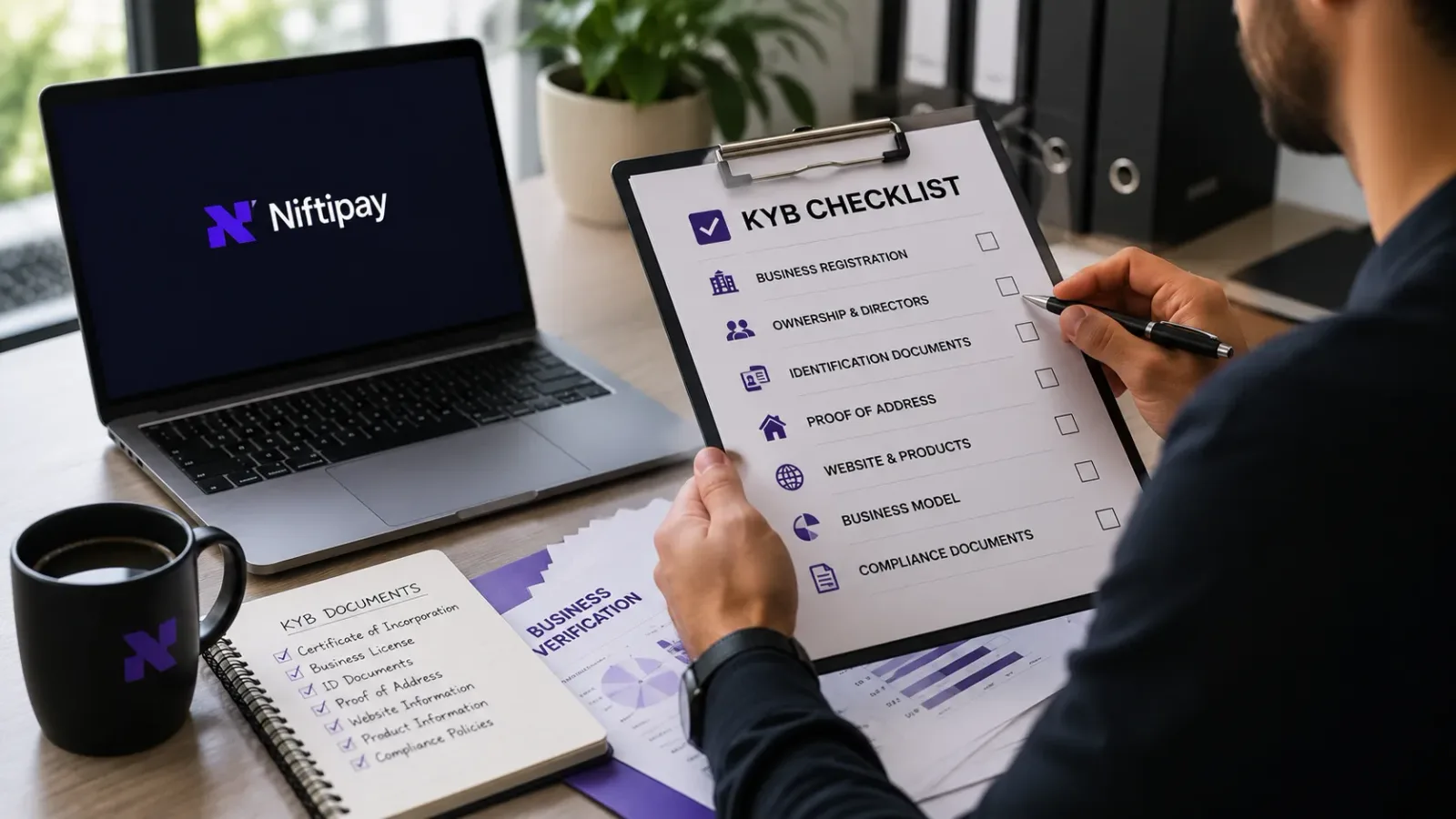
Before a payment gateway lets you process a single transaction, it has to confirm your business is real, legitimate and safe to work with. That is what the KYB requirements for payment gateway onboarding exist to do. For high-risk merchants the checks go deeper, but they are not there to catch you out — they exist to protect both sides, and being ready for them makes qualification far smoother.
This guide explains what KYB is, why high-risk businesses face extra scrutiny, which documents you are likely to need, and how good preparation keeps your onboarding moving. None of it guarantees approval, but all of it helps you avoid the delays that catch merchants out.
What KYB means in payment processing
KYB stands for Know Your Business. It is the process a payment provider uses to verify a company before opening an account — the business equivalent of the Know Your Customer checks banks run on individuals.
In plain terms, KYB answers three questions: is this a genuine registered company, who really owns and controls it, and does what it sells match what it says? Providers confirm this against official records and the documents you supply, following the same know your customer principles used across regulated finance.
Why high-risk merchants need additional checks
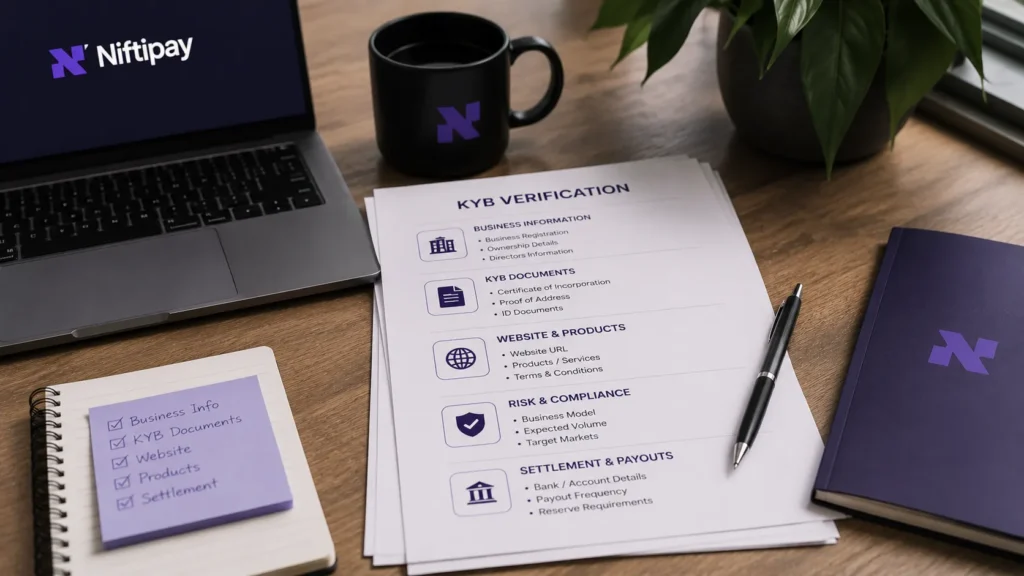
KYB for high-risk merchants is more detailed because there is more at stake. A provider taking on a high-risk account is accepting greater exposure, so it looks more closely before saying yes.
Several factors raise the level of checks:
- Risk profile — your history of disputes, refunds and prior account terminations.
- Chargebacks — sectors with higher dispute rates draw closer review.
- Product category — what you sell and the rules that apply to it.
- Geography — where you operate and where your customers are based.
- Payment methods — card, crypto and stablecoin flows each add considerations.
- Compliance review — whether your policies and controls meet expectations.
The stronger and clearer your answers to each, the more straightforward the review tends to be.
Common documents requested during verification
The exact list varies by provider and sector, but most payment gateway compliance documents fall into a familiar set. Preparing scanned copies in advance is the single fastest way to move through the merchant verification process.
- Business registration — incorporation certificate or equivalent.
- Ownership details — shareholders and ultimate beneficial owners.
- Director ID — identity documents for directors and owners.
- Proof of address — for the business and, where required, its owners.
- Website details — a live URL showing your products or services.
- Product or service information — a clear description of what you sell.
- Relevant compliance documents — licences and policies such as AML procedures where they apply.
If you have already worked through our payment gateway onboarding checklist, most of this will already be to hand.
Product, website and business model review
KYB is not only about paperwork. The provider also reviews what you sell and how, because business verification for a payment processor includes checking that your public-facing operation matches your application.
Expect your website to be treated as evidence. Reviewers typically look for:
- A live, working site with clear pricing and products or services.
- A visible refund and cancellation policy.
- Terms and conditions and a privacy policy.
- Delivery or service information with realistic timelines.
- Accessible customer support and contact details.
If you are adding payments to an existing store, our guide to a payment gateway for existing websites shows what a review-ready checkout looks like.
How KYB requirements for a payment gateway affect approval and activation
Complete, accurate documents are the biggest lever you control. They will not guarantee approval — no provider can promise that — but they remove the most common reasons a review stalls.
When your KYB pack is clear and consistent, the provider can verify you faster and move you to activation sooner. When documents are missing, out of date or contradict your website, each gap triggers a follow-up request and adds days to the process. The same information also shapes your commercial terms, as we explain in high-risk payment gateway pricing.
How to avoid onboarding delays
Most delays come from small, avoidable gaps. Run through this checklist before you start qualification:
- Gather all KYB documents as clear, legible scans.
- Check that company details match your official registration exactly.
- Confirm director and ownership information is current.
- Make sure your website is live with visible policy pages.
- Align your stated business model with what your site shows.
- Have realistic volume, market and payment method details ready.
- Prepare bank or payout details for settlement.
- Know your technical setup route — plugin, API or custom integration.
For the technical side, our high-risk WooCommerce payment gateway and iGaming payment gateway integration guides show how plugin and API routes work in practice.
Verification and access control are two halves of the same operational question. The security page sets out the account controls, API credential handling and webhook controls that apply once a merchant is verified and live.
How Niftipay supports merchant verification
Niftipay is payment infrastructure for businesses that already have a sales channel and need card, crypto and stablecoin payment options through one structured layer. Verification is a step on the way to processing, not a barrier for its own sake.
The path is simple: create your account, submit your KYB and compliance documents, connect your plugin or API, and configure processing around your markets, methods and settlement needs. Clear preparation on your side is what keeps each step moving. Meeting the KYB requirements for payment gateway onboarding early is the surest way to reach activation without avoidable delays.
KYB requirements for payment gateways FAQs
What are KYB requirements for a payment gateway?
KYB requirements for a payment gateway are the checks and documents a provider uses to verify your business before opening an account. They typically include business registration, ownership and director details, identity documents, proof of address, website and product information, and any relevant compliance policies.
Why do high-risk merchants need KYB checks?
High-risk merchants carry more dispute, fraud and regulatory exposure, so providers verify them more closely to manage that risk. The checks confirm the business is genuine, understand who controls it, and assess whether the product, market and model are ones the provider can support.
What payment gateway compliance documents are usually required?
Commonly business registration documents, ownership and shareholding information, director ID, proof of address, a live website with policy pages, product or service details, and licences or AML policies where the sector requires them. The exact list varies by provider and business type.
How long does the merchant verification process take?
It depends on the provider, the sector and how complete your documents are. A clear, consistent KYB pack can be verified quickly, while missing or contradictory information adds follow-up requests and extends the timeline, sometimes by several days.
Can incomplete KYB documents delay payment gateway approval?
Yes. Incomplete, outdated or inconsistent documents are the most common cause of onboarding delays, because each gap triggers a request for more information. Preparing a complete, accurate set up front is the most reliable way to keep approval and activation on track, though it never guarantees approval.