
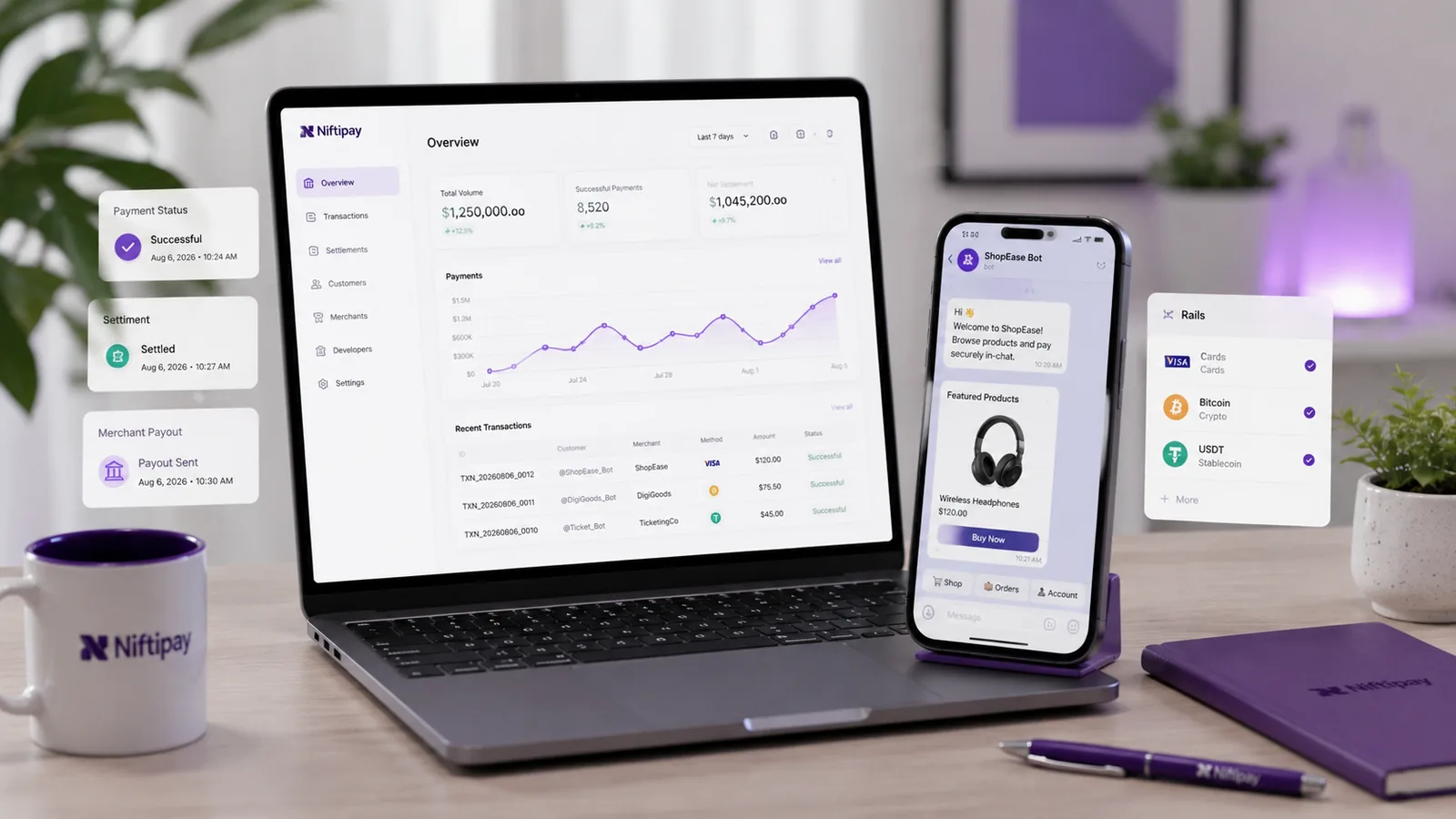
A Telegram payment gateway is the payment infrastructure behind a Telegram bot or channel-based storefront. It creates the payment request, processes it on a card or crypto rail, reports the transaction status back to the merchant’s order flow, and settles funds to the merchant. It does not build the bot, host the catalogue or manage the conversation.
That separation is the practical point. Merchants asking about payments for Telegram usually have the sales channel working already; what they lack is a payment layer that fits a flow with no conventional cart page. Niftipay operates in that second layer, supplying supported card, crypto and stablecoin acceptance to commerce experiences that already exist.
What Is a Telegram Payment Gateway?
The term describes a payment provider connected to a bot-based sales flow. It is not a Telegram product. Telegram supplies the messaging platform and the Bot API; it is not the merchant’s acquirer or processor. Telegram’s own bot payments documentation describes a native framework that routes to third-party providers — a separate arrangement from connecting an independent gateway to your own commerce layer.
Whichever route a merchant takes, the payment layer owns four things:
- Payment initiation — a request for a specific amount and currency, created when the buyer commits.
- Payment completion — a checkout the buyer can pay through, processed on the relevant rail.
- Transaction status — a machine-readable state such as pending, approved, failed or settled.
- Order synchronisation — that state returned to the commerce system, so the bot releases goods only after funds clear.
That split is what makes a conversational sale auditable. The bot records what was agreed; the gateway records what was paid.
How Payments Work in a Telegram Bot Commerce Flow
The general shape of a bot-commerce payment, whichever provider sits behind it:
- The customer chooses a product inside the Telegram bot.
- The commerce layer sets the amount, currency and order reference.
- A payment request is created with the payment infrastructure.
- The customer receives a way to pay — hosted checkout, a payment link or a crypto QR code.
- The card or crypto payment is completed in that environment.
- The gateway resolves the transaction status once the payment is authorised or confirmed.
- A webhook notifies the merchant’s system, which updates the order.
- The bot confirms the order and fulfilment proceeds.
- Funds move through settlement to the merchant payout arrangement.
Two steps cause most of the trouble. Bot flows rarely host their own card fields, so payment has to happen in an environment the provider controls; and if the status never reaches the order system reliably, someone confirms payments by hand. Niftipay supports hosted checkout, payment links and crypto QR flows, with transaction status in the merchant dashboard and connectable to existing workflows through webhooks.
Card, Crypto and Stablecoin Payments for Telegram Commerce
Buyers in bot channels do not all pay the same way, and the rails behave differently past the checkout button. The table compares their operational role rather than ranking them.
| Payment rail | How it can be presented in a bot flow | What determines completion | Operational notes |
|---|---|---|---|
| Cards | Hosted checkout page, or a payment link shared in the conversation | Authorisation by the issuer, with additional authentication where required | Refunds and chargebacks apply; acceptance follows the approved merchant setup |
| Crypto | Hosted checkout, payment link or QR-based payment | Confirmation of the transfer on the relevant network | Asset and network support vary; the buyer needs a wallet and the correct chain |
| Stablecoins | The same crypto flows — USDT and USDC sit within the supported crypto options | Confirmation of the transfer on the relevant network | Priced against a fiat unit, removing some of the quoting friction of volatile assets |
Supporting more than one rail matters operationally: buyers who cannot use one method tend to abandon rather than switch, and running a card acquirer, a crypto processor and a stablecoin tool separately means three dashboards and three reconciliation jobs.
What any individual merchant gets is not universal. The card, crypto and stablecoin payment options enabled on an account follow the approved merchant setup, and as of 2026 Niftipay lists BTC, ETH, SOL, LTC, XRP, USDT and USDC among supported crypto assets. Confirm the exact list, and the terms attached to it, during qualification.
Using a Crypto Payment Gateway for a Telegram Bot
Choosing a crypto payment gateway for a Telegram bot comes down to three behaviours, each of which affects the bot logic rather than only the finance team.
Initiation. A crypto payment request fixes an amount, an asset and a network, then produces a payment address or QR code. The quoted amount is usually valid for a defined window only, so the bot needs to handle expiry rather than leave a stale request in the conversation.
Confirmation. The payment is complete when the network confirms the transfer, not when the buyer says they have sent it. That gap is the most common source of disputes in bot commerce, which is why the flow should wait for the provider’s status rather than a screenshot. Underpayments, overpayments and transfers on the wrong chain each need a defined response.
Status and settlement. Once confirmed, the status has to reach the commerce layer so the order moves on automatically; our guide to tracking payment status covers how those states are modelled. Receiving crypto and holding it are separate decisions: how funds are settled, in which currency and on what timetable depends on the commercial terms agreed for the account.
What a Telegram Payment Gateway Needs to Handle
Capabilities worth testing rather than reading about:
- Payment initiation on demand, not tied to a fixed storefront URL.
- Machine-readable payment status the bot can act on unaided.
- Card, crypto and stablecoin support through one acceptance layer.
- A provider-controlled checkout, so card data never touches the bot or its server.
- Webhooks delivering events into the order or fulfilment workflow.
- An integration path that fits the stack — a documented API, or a commerce layer that has done the work.
- Refund handling, including how it differs by rail.
- Security controls over credentials, permissions and event verification.
- Predictable payment settlement and merchant payouts, with visibility at each step.
- Reconciliation detail sufficient to close the books without manual matching.
- Technical support during scoping, not only after go-live.
The broader version, covering bot commerce beyond Telegram, is in our guide to payment infrastructure for bot commerce.
Telegram Payment Gateway Integration: APIs, Checkout and Webhooks
Connecting payment infrastructure to an existing commerce layer follows a consistent pattern: the commerce system asks the provider to create a payment, hands the buyer a way to pay, then listens for the result. Niftipay’s payment integration options include a REST API for custom platforms, hosted checkout, payment links and crypto QR flows, with API-key authentication issued after approval. There are no platform SDKs. For Telegram specifically there is no standalone Niftipay plugin — bot-based projects connect through Trapyfy, covered below.
The return path is what teams underestimate. Webhooks are how the payment layer tells the commerce layer that something happened, and a flow relying on polling or on the customer’s word will eventually release goods it should not have. An endpoint that accepts any incoming request is equally a liability: a forged event marks an unpaid order as paid. Niftipay provides verifiable webhooks so merchants can validate incoming events, and our guide to payment gateway webhooks covers which ones to track before going live.
Security Considerations for Telegram Bot Payments
A bot integration widens the surface a merchant has to protect: the bot token, the server running it and the payment credentials sit in the same operational chain.
- API credentials — Niftipay API keys can be revoked, rotated and permission-scoped; limit each key to what it needs.
- Credential access — keep keys and the bot token out of source control, shared chats and the bot’s logs.
- Webhook verification — validate every incoming event before it updates an order.
- Account security — two-factor authentication is available for merchant accounts and required when authorising withdrawals.
- Card data scope — approved card payments are completed in a hosted environment and Niftipay does not store complete card details within its own platform, keeping that data off the bot’s infrastructure.
Security here is shared: the provider secures the payment environment, the merchant secures the systems and people around it. The full set of API and webhook security controls is on the Niftipay security page.
How Trapyfy and Niftipay Fit Into Telegram Commerce
Trapyfy handles the commerce experience: the Telegram storefront, the catalogue, the conversation and the order flow the customer sees. Niftipay handles the payment infrastructure behind it: supported card and crypto acceptance, transaction status and settlement. Telegram and bot-based commerce projects connect through Trapyfy rather than through a standalone Niftipay plugin.
The merchant keeps the sales channel and the customer relationship either way. Neither product replaces the other, and neither replaces Telegram. Which payment methods appear in the flow depends on the approved Niftipay merchant setup, so “can my bot take cards” is answered during qualification, not at integration time.
What to Check Before Choosing a Payment Gateway for Telegram
Most of this is commercial rather than technical, and all of it is easier to establish before integration than after.
- Payment methods you need, and which the provider can enable for your category.
- Merchant eligibility — whether your business type is supported at all.
- Target markets, currencies and any restrictions attached to them.
- Integration model — direct API, an existing commerce layer, or a mix.
- Transaction status visibility in the dashboard and through the API.
- Webhook support — which events are delivered, and how they are verified.
- Settlement structure — currency, cadence and reporting.
- Payout arrangement — where funds land, and what triggers a payout.
- Refunds — how they work per rail, and what is not reversible.
- Security controls — credentials, permissions, 2FA, withdrawal protection.
- Technical support — who you can reach during integration.
- KYB requirements — the documentation to prepare, and the expected timeline.
Two answers are worth getting early: which payment methods would be enabled for your account, and what the settlement terms would be. Both depend on the approved merchant setup, and both are harder to renegotiate once the bot is live.
Telegram Payment Gateway FAQs
What is a Telegram payment gateway?
It is the payment infrastructure connected to a Telegram bot or channel-based storefront. It creates the payment request, processes the card or crypto payment, reports the transaction status back to the order flow, and settles funds to the merchant. Telegram provides the messaging platform and bot framework; the gateway is a separate provider.
Can a Telegram bot accept card payments?
A bot flow can direct the customer to a hosted checkout page or payment link where an approved card payment is completed, then continue once the status is returned. Card acceptance is not automatic: the methods enabled for a business depend on the approved merchant setup, confirmed through qualification and KYB.
Can Telegram bots accept crypto payments?
Yes, where the merchant’s provider supports it. The bot presents a hosted checkout, payment link or QR code, the customer pays from their own wallet, and the payment is complete once the transfer is confirmed on the relevant network. Supported assets and networks vary by provider and approved account.
How does a payment gateway connect to a Telegram bot?
Through the commerce layer rather than the messaging app. The commerce system creates a payment request with the provider, gives the customer a way to pay, and listens for webhooks reporting the result. With Niftipay, Telegram and bot-based commerce projects connect through Trapyfy rather than a standalone plugin.
Do merchants need an API to accept payments through Telegram commerce?
Not always. A merchant using an existing commerce layer inherits that integration and does not build against the API directly. A custom bot or platform does need an API integration, using credentials issued after approval. Either way the payment experience is hosted, so the bot never handles card details.