
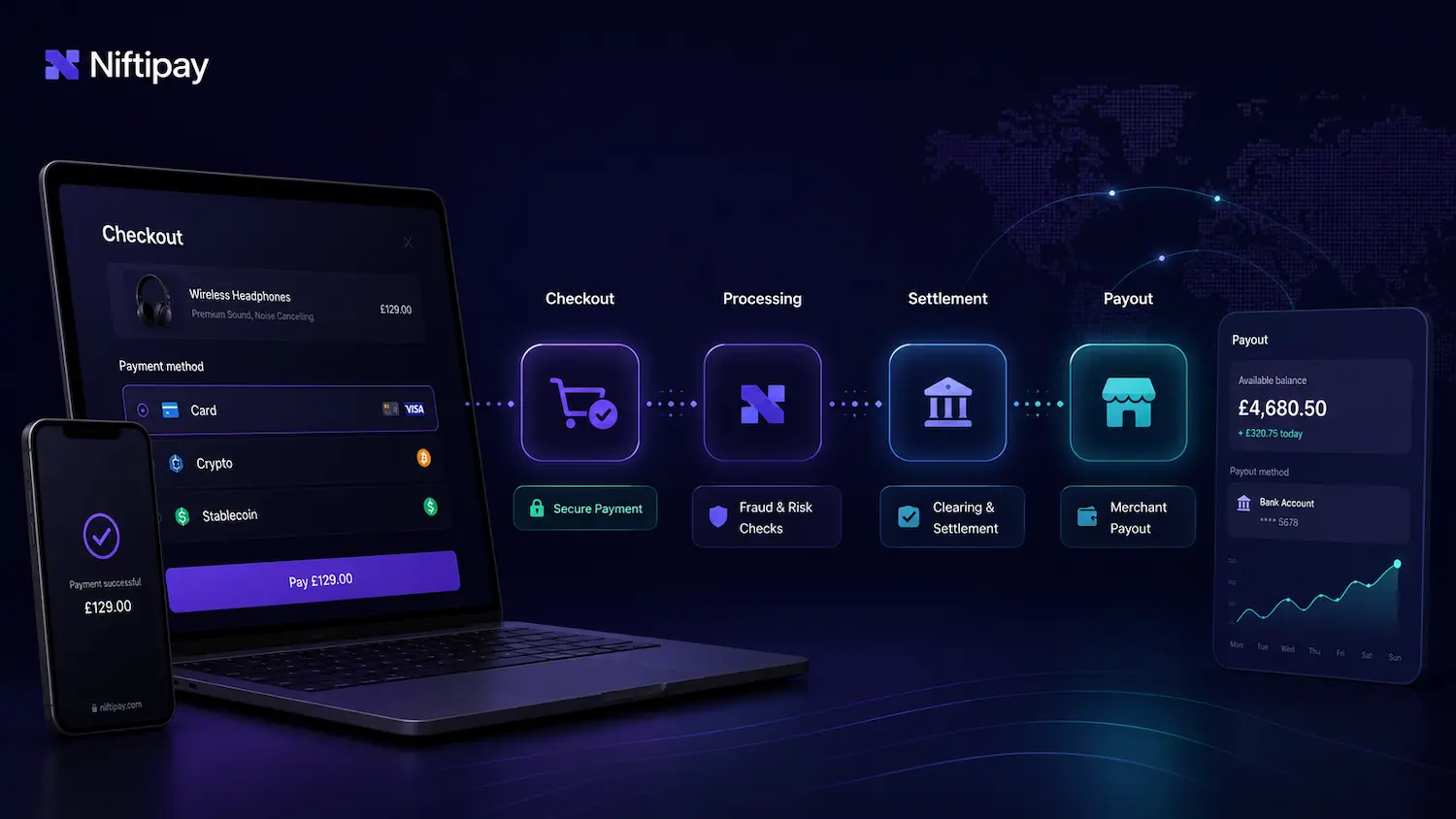
A completed checkout does not always mean the payment journey is finished.
For many merchants, the customer-facing part of the transaction is the easiest stage to see. The customer selects a product, chooses a payment method, clicks pay and receives confirmation. From the outside, it looks complete.
But behind that moment, the payment still needs to move through several operational stages before the merchant can actually treat the money as settled and ready for payout.
That is why a checkout to settlement flow matters.
A structured payment flow helps merchants understand what happens after the customer pays. It connects the first payment action with authorisation, capture, processing, fee calculation, settlement, payout reporting and reconciliation.
For businesses using cards, crypto, stablecoins or multiple payment methods, this visibility becomes even more important. The goal is not only to accept a payment. The goal is to understand how that payment moves from transaction to payout.
Why checkout-to-settlement needs structure
Checkout and settlement sit on opposite sides of the same payment journey.
Checkout is what the customer sees. Settlement is what the merchant needs to manage after the transaction has moved through the payment system.
If that journey is not structured, merchants can end up with successful payments that are difficult to trace, payouts that are hard to reconcile and fees that are not clearly connected to the original transaction.
A payment may look approved, but the business still needs to know:
- Has the payment been captured?
- Is the transaction still pending?
- Has it passed the required checks?
- What fees were deducted?
- Has the payment settled?
- Is it included in a payout?
- Can finance match it to the correct order?
Without a clear payment settlement workflow, teams often rely on manual checks, disconnected dashboards or spreadsheets to understand where money is.
That may work for low-volume businesses. It becomes risky for complex commerce environments.
The difference between checkout approval and settlement
Checkout approval and settlement are connected, but they are not the same thing.
Checkout approval means the payment has passed an initial stage. The transaction may have been authorised or accepted by the payment method, depending on the flow.
Settlement happens later. It refers to the movement and confirmation of funds through the payment infrastructure before they become available for payout.
That distinction matters because a merchant can see an approved payment before the final funds are ready.
For example, a card payment may be authorised and captured, but still follow a settlement cycle. A crypto payment may require confirmations before the merchant treats it as final. A stablecoin payment may support a different type of settlement flow, but still needs clear transaction records and reporting.
The payment method changes the process, but the merchant’s need is the same: visibility.
A strong checkout-to-settlement flow helps the business understand where each payment stands after the customer has completed the checkout step.
The problem with unstructured payment funds flow
Many merchants start by focusing only on payment acceptance.
That is understandable. If customers cannot pay, the business cannot sell.
But once the business grows, payment acceptance is not enough. The operational question becomes: what happens after the customer pays?
An unstructured payment funds flow can create several problems:
- Payments appear successful but are not easy to reconcile.
- Finance teams cannot clearly see which fees were deducted.
- Payouts arrive without enough transaction-level detail.
- Support teams cannot explain whether a payment is pending, failed or settled.
- Refunds and chargebacks become difficult to match to the original order.
- Card, crypto and stablecoin payments sit in separate reporting flows.
- Merchants cannot easily track the full transaction to payout journey.
This creates extra work for finance, operations and support teams.
The issue is not only technical. It becomes a business problem because cash flow, reporting and customer experience all depend on payment visibility.
What a checkout-to-settlement flow should include
A structured checkout-to-settlement flow should help merchants follow the payment from the first customer action to the final merchant payout.
The exact setup depends on the business model, payment methods, risk profile and provider structure, but most merchants need a few important layers.
1. A clear checkout event
The flow starts when the customer chooses a payment method and submits the payment.
This checkout event needs to connect with the rest of the merchant’s payment infrastructure. It should not exist as an isolated moment.
The merchant should be able to link the checkout event to:
- Customer information
- Order reference
- Payment method
- Transaction amount
- Currency
- Payment status
- Internal order status
If this information is incomplete, the business may struggle later when trying to match transactions with payouts.
A clean checkout event gives the rest of the payment flow a stronger foundation.
2. Authorisation and payment confirmation
After checkout, the payment moves into authorisation or confirmation.
For card payments, authorisation checks whether the payment can proceed. For crypto or stablecoin payments, confirmation may work differently depending on the payment rail and infrastructure.
The important point is that merchants should not treat this stage as the end of the journey.
An authorised or confirmed payment still needs to be tracked through the rest of the payment lifecycle.
This is where many businesses lose visibility. They know the customer submitted a payment, but they do not always know whether that payment has been captured, processed, settled or included in payout reporting.
3. Transaction status updates
A useful payment flow should show more than “success” or “failed”.
Complex merchants need more specific payment status information.
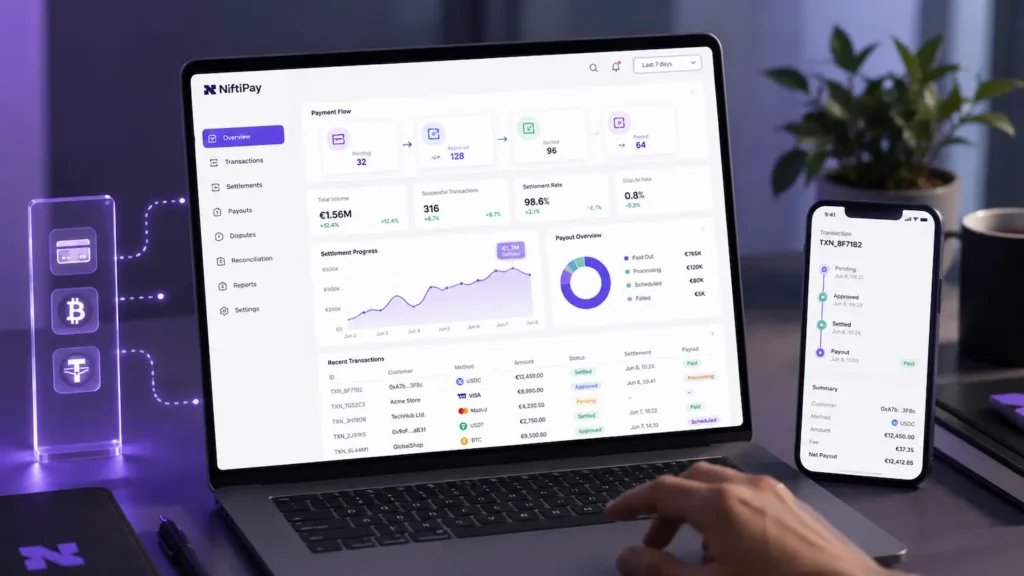
That may include statuses such as:
- Pending
- Approved
- Failed
- Captured
- Settled
- Refunded
- Disputed
- Paid out
These statuses help different teams make better decisions.
Customer support can understand whether a buyer needs help. Operations can decide whether an order should move forward. Finance can see whether the transaction is ready for reconciliation.
Without clear status handling, the merchant is forced to guess where the payment is inside the flow.
4. Risk and compliance checks
Some payments may require additional checks before they move forward.
This is especially relevant for high-risk merchants, restricted categories, subscription models, cross-border businesses and platforms with varied transaction patterns.
Checks may relate to transaction behaviour, payment method, customer data, business category, refund patterns or chargeback exposure.
This does not mean every payment will be delayed. It means merchants need infrastructure that can show when a transaction is moving normally and when it needs attention.
A structured flow makes these checks easier to understand instead of leaving the merchant with unclear payment status.
5. Fee calculation
The amount paid by the customer is not always the amount received by the merchant.
Before payout, the transaction may be affected by provider fees, network costs, processing fees, currency conversion, reserves, refunds or chargeback-related deductions.
This is why payment processing fees should be visible inside the settlement workflow.
Finance teams need to understand how the gross transaction amount becomes the net merchant amount.
Without this visibility, payouts can feel unpredictable. The business may receive money, but still struggle to explain exactly how the final figure was calculated.
6. Settlement processing
Settlement is one of the most important stages in the payment lifecycle.
It is the point where funds move through the payment infrastructure before they become available for payout.
Different payment methods may follow different settlement logic. Card payments, crypto payments and stablecoins should not be treated as identical. Each one may involve different timing, checks, confirmations and reporting requirements.
A good settlement process should help merchants see:
- What has settled
- What is still pending
- What has failed
- What is included in the next payout
- What adjustments apply
- What needs reconciliation
This is where structured settlement workflows become valuable for complex businesses.
7. Merchant payout
Payout is the stage where funds are transferred or made available to the merchant.
This is the moment finance teams usually care about most, but payout should not be viewed in isolation. A payout is easier to understand when it is connected to the transactions, fees and settlement records behind it.
Merchants need to know which transactions are included in each payout and why the payout amount may differ from the original payment volume.
Clear payout visibility supports cash flow planning, finance reporting and operational confidence. Visibility is a separate question from the commercial terms that decide when a payout can happen at all: the settlement schedule, the payout threshold, the payout currency and any reserve held against the account. Our guide to payment settlement and merchant payout terms sets those out, including the terms Niftipay applies to approved card processing.
8. Reporting and reconciliation
The final step is reconciliation.
This is where the merchant matches orders, transactions, fees, refunds, chargebacks and payouts against internal records.
For small businesses, reconciliation may be simple. For complex commerce, it can become one of the most time-consuming parts of payment operations.
A strong payment settlement workflow should reduce manual work by giving teams cleaner reporting and more consistent transaction data.
The goal is to help the business close the loop between checkout and payout.
How Niftipay helps structure the checkout-to-settlement flow
Niftipay is built for businesses that need more than a basic payment button.
For complex merchants, payment infrastructure needs to support the full journey from customer payment to merchant payout. That means thinking beyond checkout and looking at how transactions are processed, tracked, settled and reported.
Niftipay helps merchants structure payment flows across cards, crypto and stablecoins with a stronger focus on operational visibility.
This can support:
- Multi-method payment acceptance
- Transaction status tracking
- Settlement visibility
- Payout reporting
- Fee visibility
- Finance reconciliation
- Payment infrastructure for complex commerce environments
Niftipay does not remove the need for proper financial controls, compliance processes or business-specific payment planning. What it provides is a clearer infrastructure layer for businesses that need to manage payments across more complex flows.
Instead of treating checkout, settlement and payout as separate problems, Niftipay helps merchants think about the full payment journey.
When a structured checkout-to-settlement flow makes sense
A structured checkout-to-settlement flow is useful when the business needs more control over what happens after payment approval.
This is especially relevant for:
- High-risk merchants
- Subscription businesses
- Marketplaces
- Platforms
- Cross-border commerce
- Crypto-friendly businesses
- Stablecoin settlement use cases
- Businesses with multiple payment methods
- Merchants handling refunds or chargebacks regularly
- Finance teams managing complex reconciliation
The common point is complexity.
If the business only needs occasional online payments, a basic setup may feel enough. But if teams need to track payments, understand fees, manage settlement and reconcile payouts, then the infrastructure needs to be more structured.
Payment volume makes the problem more visible, but the structure should be planned before the volume becomes difficult to control.
Checkout-to-settlement flow vs simple payment acceptance
Simple payment acceptance answers one question: can the customer pay?
A checkout-to-settlement flow answers a bigger question: can the business understand the payment from customer transaction to merchant payout?
That difference is important.
A merchant may be able to accept payments but still struggle with settlement reporting, payout tracking and reconciliation.
A more structured payment flow helps connect the customer-facing checkout with the merchant-facing money movement.
This is especially important when cards, crypto and stablecoins are part of the same payment strategy. Each method may behave differently, but the business still needs one clear operational view.
What merchants should avoid
The biggest mistake is treating checkout as the whole payment system.
Checkout matters, but it is only the first stage.
Merchants should avoid:
- Choosing a provider only because checkout is easy to activate.
- Ignoring settlement reporting until finance problems appear.
- Treating approved payments as automatically paid out.
- Managing payout records manually across spreadsheets.
- Accepting multiple payment methods without a clear reporting structure.
- Overlooking fee visibility.
- Separating payment status from order status.
- Waiting until volume grows before fixing reconciliation issues.
A payment setup should make the business easier to run, not harder to understand.
If the merchant cannot explain how money moves after checkout, the payment infrastructure is incomplete.
Better payment operations start after the customer pays
A successful checkout is important, but it is not the full story.
The merchant still needs to know what happens next.
Where is the transaction? Has it been captured? Is it pending settlement? Were fees deducted? Is it included in the next payout? Can finance reconcile it against the original order?
These questions define the real payment experience for the business.
A clear checkout to settlement flow gives merchants the visibility they need to manage payments with more confidence. It connects customer payment, transaction status, settlement, payout and reconciliation into one more understandable journey.
For complex commerce, the payment is not finished when the customer sees confirmation.
It is finished when the merchant can follow the money all the way through.
FAQs
What is a checkout to settlement flow?
A checkout to settlement flow is the full payment journey from customer checkout to merchant payout. It includes authorisation, capture, payment processing, settlement, fee calculation, payout reporting and reconciliation.
Is checkout approval the same as settlement?
No. Checkout approval means the payment has passed an initial stage. Settlement happens later, when funds move through the payment infrastructure and become available according to the payment method and provider setup.
Why does payout visibility matter?
Payout visibility helps merchants understand which transactions are included in each payout, what fees were deducted, which payments are pending and which amounts need reconciliation.
Can cards, crypto and stablecoins be part of the same checkout-to-settlement flow?
Yes, they can be managed within one structured payment infrastructure, but each payment method may follow different processing and settlement logic. The goal is to give merchants clearer visibility across all payment types.
What should merchants check before choosing payment infrastructure?
Merchants should check whether the provider supports their payment methods, transaction status tracking, settlement visibility, fee reporting, payout tracking and reconciliation needs.