

A payment status API gives developers and operations teams a single, reliable way to follow a transaction from the moment it is created to the moment it is settled. This guide explains the states a payment moves through — pending, processing, approved, failed, declined, cancelled, refunded, chargeback and settled — and how clear status tracking keeps complex and high-risk payment flows consistent, reconcilable and easy to support.
A payment does not end when the customer taps “pay”. That tap is the beginning of a short, messy journey. The transaction might sit as pending while a bank checks it, flip to approved, drop to failed on a network timeout, or land days later as settled funds in your account.
For a single card on a simple checkout, that journey is easy to ignore. For platforms juggling multiple payment methods, several processors and high-risk verticals, those states are the difference between a clean ledger and a support queue full of “where is my money?” tickets.
A payment status API is what turns that journey into something you can query, interpret and sync with your own systems — in one consistent flow.
What Is a Payment Status API?
A payment status API is an interface that lets your application ask a payment provider a simple question: what is happening with this transaction right now?
Instead of guessing from a checkout redirect or a single webhook, you get a structured, queryable answer. A well-designed response typically exposes:
- A transaction ID and your own payment reference
- The current status (pending, approved, failed, settled, and so on)
- Timestamps for each change of state
- A failure reason when something goes wrong
- Settlement updates as funds move from authorisation to payout
Conceptually, a status response might look like this (illustrative only — field names vary by provider):
{
  "transaction_id": "txn_8f3a92c1",
  "payment_reference": "ORD-10245",
  "status": "approved",
  "amount": 149.00,
  "currency": "GBP",
  "updated_at": "2026-06-11T14:28:00Z",
  "failure_reason": null,
  "settlement": {
    "status": "pending",
    "expected_at": "2026-06-13"
  }
}
The point is not the exact schema. It is that every state has a name, a timestamp and a reason your systems can act on.
Why Payment Status Tracking Matters in Complex Payment Flows
In a basic flow, you might rely on the checkout result and move on. In a complex one, that assumption breaks quickly.
Consider a platform that routes payments across more than one processor for redundancy or approval rates. The same order can be authorised on one route, retried on another and settled through a third. Without consistent status tracking, your internal records and the provider’s reality drift apart.
This is the operational reality behind payment orchestration: when transactions can take different paths, you need one normalised view of status across all of them. A payment status API gives product, finance and support teams that shared source of truth, rather than three teams reading three different dashboards.
Common Payment States Developers Need to Handle
Most payment flows can be described with a small, predictable set of states. Handling each one explicitly — rather than treating everything as “paid or not paid” — is what makes an integration robust.
- Pending — the payment has been created but no final outcome exists yet.
- Processing — the provider or bank is actively working on authorisation.
- Approved — the transaction is authorised, but funds may not have moved.
- Failed — a technical problem stopped the payment (timeout, connectivity, gateway error).
- Declined — the issuer or risk engine refused the payment.
- Cancelled — the payment was stopped before completion, often by the customer or merchant.
- Refunded — an approved payment was returned to the customer.
- Chargeback — the cardholder disputed the transaction through their bank.
- Settled — funds have cleared and are on their way to, or already in, your account.
The mistake teams make is collapsing these into “success” and “error”. A declined card and a failed network request need very different responses, and a chargeback is not the same problem as a refund.
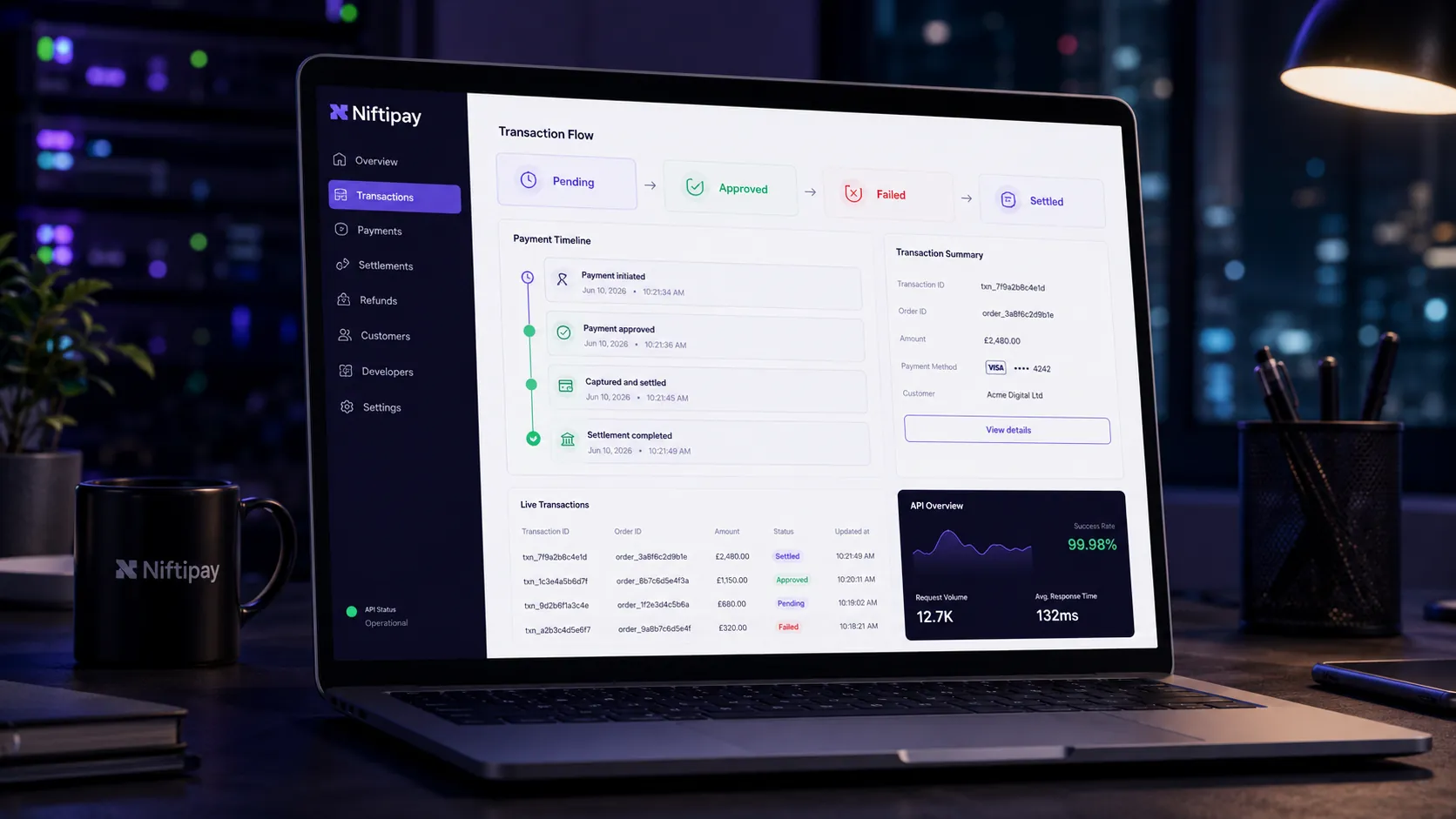
Pending Payments: Why They Need Clear Rules
Pending is the most under-handled state in payments. It looks harmless, but it is where most reconciliation errors begin.
A pending payment is unresolved. If your system marks it as paid too early, you risk shipping goods against money that never arrives. If you treat it as failed too quickly, you may charge a customer twice when the original payment later resolves to approved.
Clear rules help:
- Define a timeout window for how long a payment may stay pending.
- Decide what a pending payment is allowed to trigger — usually nothing irreversible.
- Use the status API to poll or receive updates rather than assuming an outcome.
Good transaction status handling treats pending as a temporary state with an expiry, not a permanent verdict.
Approved vs Settled: Why the Difference Matters
It is tempting to treat “approved” as “done”. It is not.
Approved means the payment was authorised — the issuer agreed the funds exist and reserved them. Settled means the money has actually cleared and moved into your settlement balance.
Between the two sits real risk. An approved payment can still be reversed, fail to capture, or be disputed before it settles. Reporting revenue on approval alone tends to overstate what you actually hold.
For finance and operations teams, the rule is simple: recognise availability of funds on settlement, not on authorisation. A payment status API that exposes settlement separately from approval lets you build that distinction directly into your reconciliation logic.
Failed, Declined and Cancelled Payments
These three states are often lumped together, yet they ask for different handling.
- A failed payment is usually a system problem. The right response is often a safe retry, ideally on a different route.
- A declined payment is a decision by the issuer or a risk check. Retrying the same card unchanged rarely helps and can look like card testing.
- A cancelled payment is intentional. It should close the transaction cleanly, not trigger retries.
Surfacing a failure reason with each state is what makes this possible. “Insufficient funds”, “do not honour” and “gateway timeout” all read as “not paid”, but they call for completely different next steps in your code and in your customer messaging.
How a Transaction Status API Supports Reconciliation
Reconciliation is where status tracking proves its value. At its core, reconciliation matches three things: what your system thinks happened, what the provider reports, and what landed in the bank.
A transaction status API makes this practical by giving every payment a stable identifier, a current state and a settlement reference. Operations teams can then:
- Match each internal order to a provider transaction ID.
- Confirm which approved payments have actually settled.
- Flag mismatches — approved but never settled, or settled without a matching order.
- Investigate disputes and refunds with a full state history rather than a single snapshot.
When status data is consistent and timestamped, monthly reconciliation stops being detective work and becomes a routine check.
Payment Status Handling for High-Risk Merchants
High-risk businesses feel every gap in status tracking more sharply. They tend to see higher decline rates, more retries across processors, and more disputes — which means more transactions sitting in ambiguous states at any given moment.
For these merchants, robust status handling is not a nice-to-have. It underpins fraud monitoring, chargeback response and the evidence needed to keep processing relationships healthy. A high-risk payment gateway API that exposes clear, granular states lets risk teams react to patterns — a spike in declines, an unusual run of pending payments — before they become losses.
The goal is visibility: knowing not just that a payment failed, but why, where, and what state every other transaction is in alongside it.
Where Settlement Status Fits Into the Payment Flow
Settlement is the final state most teams care about, because it answers the question that matters to the business: have we actually been paid?
A settlement status API extends visibility beyond the checkout. Rather than ending the story at “approved”, it tracks the movement of funds through clearing and into payout, often with an expected settlement date and a settlement reference you can match against your bank statement.
This closes the loop. Checkout tells you a payment was attempted, authorisation tells you it was accepted, and settlement confirms the money is real. When all three live behind one status flow, the gap between “the order looks paid” and “the funds have cleared” finally disappears.
How Niftipay Helps Teams Track Payment Status in One Flow
Niftipay is built around the idea that status should not be scattered across redirects, webhooks and spreadsheets. It connects checkout, transaction updates and settlement visibility into a single, consistent flow — so developers, operations and finance are reading the same states at the same time.
For high-risk and complex businesses, that means pending payments with clear rules, approvals and settlements kept distinct, failure reasons surfaced for every declined or failed transaction, and a reconciliation view that maps internal orders to real, settled funds.
The practical takeaway is this: treat each payment state as a decision point, not a label. A pending payment is a question, an approval is a promise, a failure is an instruction, and a settlement is the only true confirmation. Build your integration to respect those differences, and a payment status API stops being plumbing — it becomes the part of your stack that quietly keeps the money honest.