
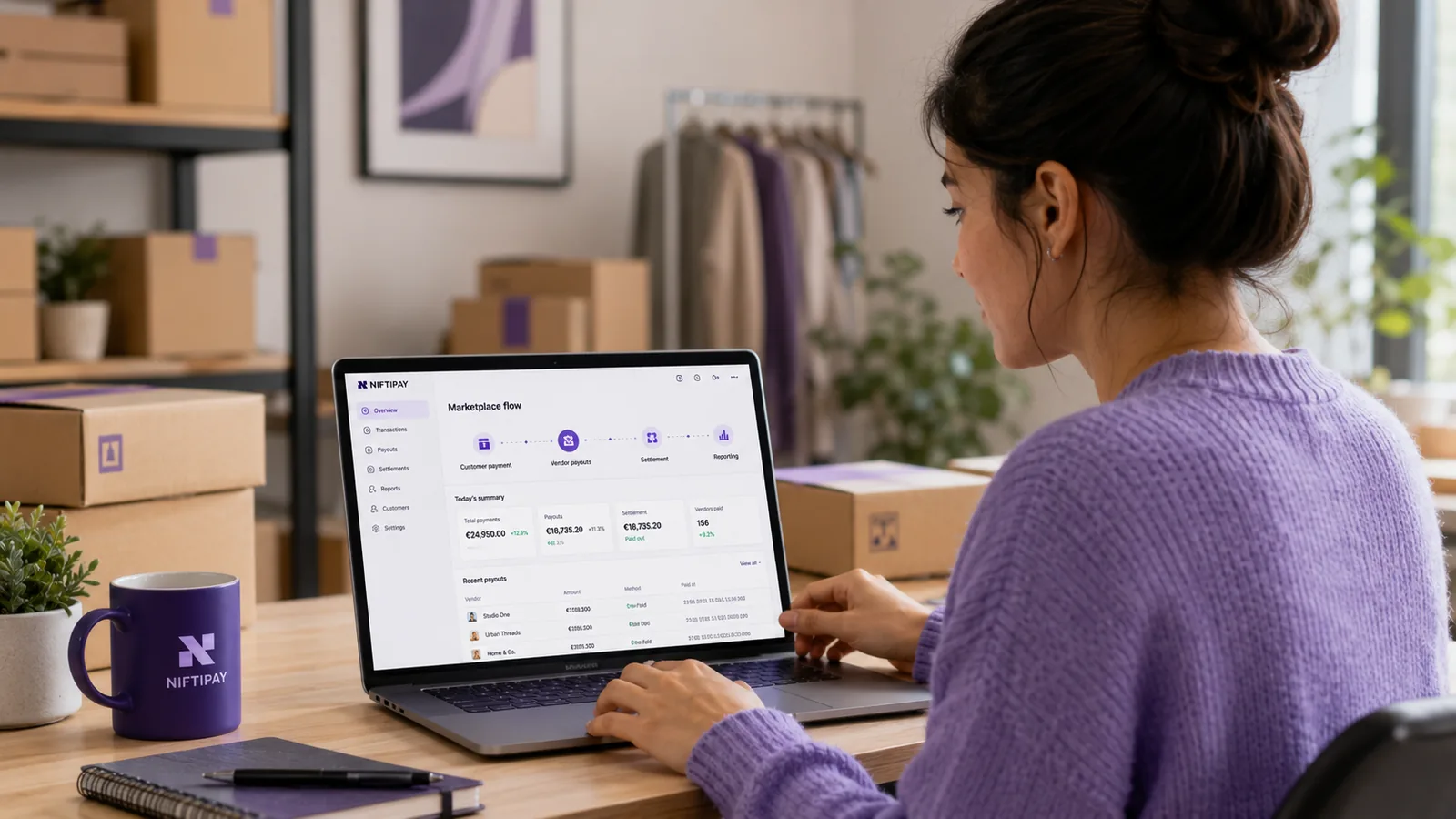
Running a marketplace means handling two payment problems at once. You have to collect money from buyers, and you have to pay out to the sellers, vendors or service providers on your platform. A marketplace payment gateway for vendor payouts is the layer that connects those two sides, so a single transaction can move from a customer’s checkout through to a vendor’s payout without being stitched together from disconnected tools.
Most platforms start simple and add complexity as they grow. What works for a handful of sellers rarely holds up once you have hundreds of vendors, several markets and a mix of payment methods. This guide looks at what marketplaces should check before scaling: how buyer payments and vendor payouts differ, how settlement timing and payout structure work, where crypto and alternative payouts fit, and the risk checks platforms should prepare for.
Why marketplace payments are more complex than single-merchant payments
A single-merchant store has one relationship to manage: the customer pays, and the money settles to one account. A marketplace sits in the middle of many relationships at once, which changes the shape of the whole payment flow.
The added complexity comes from a few structural facts:
- Money is collected for third parties. Funds a marketplace receives often belong, in part, to its vendors rather than to the platform itself.
- Payouts fan out to many recipients. One buyer order can map to several vendors, each needing a separate payout on a different schedule.
- Onboarding applies to sellers too. Vendors usually need their own verification before they can receive funds, not just the platform.
- Reporting has to reconcile both sides. Every payout must tie back to the original order, fees and any refunds or disputes.
These are the same issues that make marketplace payment processing for platforms in regulated sectors harder than standard ecommerce. The more vendors and markets you add, the more the gaps between separate tools start to show.
Customer payment and vendor payout are two separate flows
It is easy to treat “marketplace payments” as one thing. In practice, a marketplace runs two distinct flows that meet in the middle, and confusing them is where many operational problems begin.
The customer payment flow is inbound. It covers checkout, the payment methods you accept, authorisation, and the point at which a buyer’s payment is confirmed. This is where conversion, currency presentation and payment-status communication matter.
The vendor payout flow is outbound. It covers how much each seller is owed after fees, when they are paid, in which currency, and how those payouts are recorded. This is where payout structure, settlement timing and reconciliation live. Understanding how a payment moves from checkout to settlement is the foundation for designing the payout side well.
A marketplace payment gateway for vendor payouts is valuable precisely because it keeps both flows connected. When the inbound payment and the outbound payout share the same transaction record, reconciliation stops being a manual exercise in matching two systems together.
Settlement timing and payout structure for marketplaces
Settlement timing is the question of when money becomes available, and payout structure is the question of how it is split. Both sit at the heart of marketplace settlement, and both need deliberate design before a platform scales, because they affect vendor trust and platform cash flow directly.
Common payout structures include paying vendors per order, batching payouts on a fixed cycle, or holding funds until a delivery or service milestone is met. Each has trade-offs. Faster payouts keep sellers happy but leave less room to absorb refunds and disputes; delayed payouts protect the platform but can strain vendor relationships. The right balance depends on the merchant profile and the category you operate in.
The table below compares how these responsibilities tend to look with a fragmented setup versus a connected marketplace gateway. A connected model is not automatically better for every platform, but it changes where the operational effort sits, particularly when a payment gateway for marketplaces also coordinates the payout side.
| Operational area | Separate providers | Connected marketplace gateway |
|---|---|---|
| Checkout integration | Built and maintained per payment method | One integration across supported methods |
| Vendor payouts | Managed in a separate payout tool | Coordinated within the same payment layer |
| Settlement timing | Different schedules per provider | Aligned to one payout configuration |
| Reconciliation | Manual matching across systems | Payouts tied to the original order record |
| Reporting | Exports combined by hand | Buyer payments and payouts in one view |
| Seller onboarding | Verified in yet another system | Handled within the payment workflow |
| Technical maintenance | Multiple APIs and support teams | Fewer moving parts to maintain |
The point is not that separate providers are wrong. It is that fragmentation moves cost from integration time into ongoing reconciliation and support, and that cost grows with vendor count.
What a marketplace payment gateway for vendor payouts brings together
A connected gateway does not remove the differences between payment methods or payout types. What it does is give a marketplace one place to coordinate them, so buyer payments, vendor payouts, settlement and reporting share a common backbone rather than living in a separate merchant payout platform.
In practical terms, a marketplace payment gateway for vendor payouts can help a platform with:
- One integration for supported payment methods, rather than a separate build per rail.
- Coordinated payouts to multiple vendors from the same transaction data.
- Centralised transaction visibility across inbound payments and outbound payouts.
- Consistent reporting that finance, operations and support teams can all rely on.
- Fewer providers to manage, which reduces the number of contracts and support relationships.
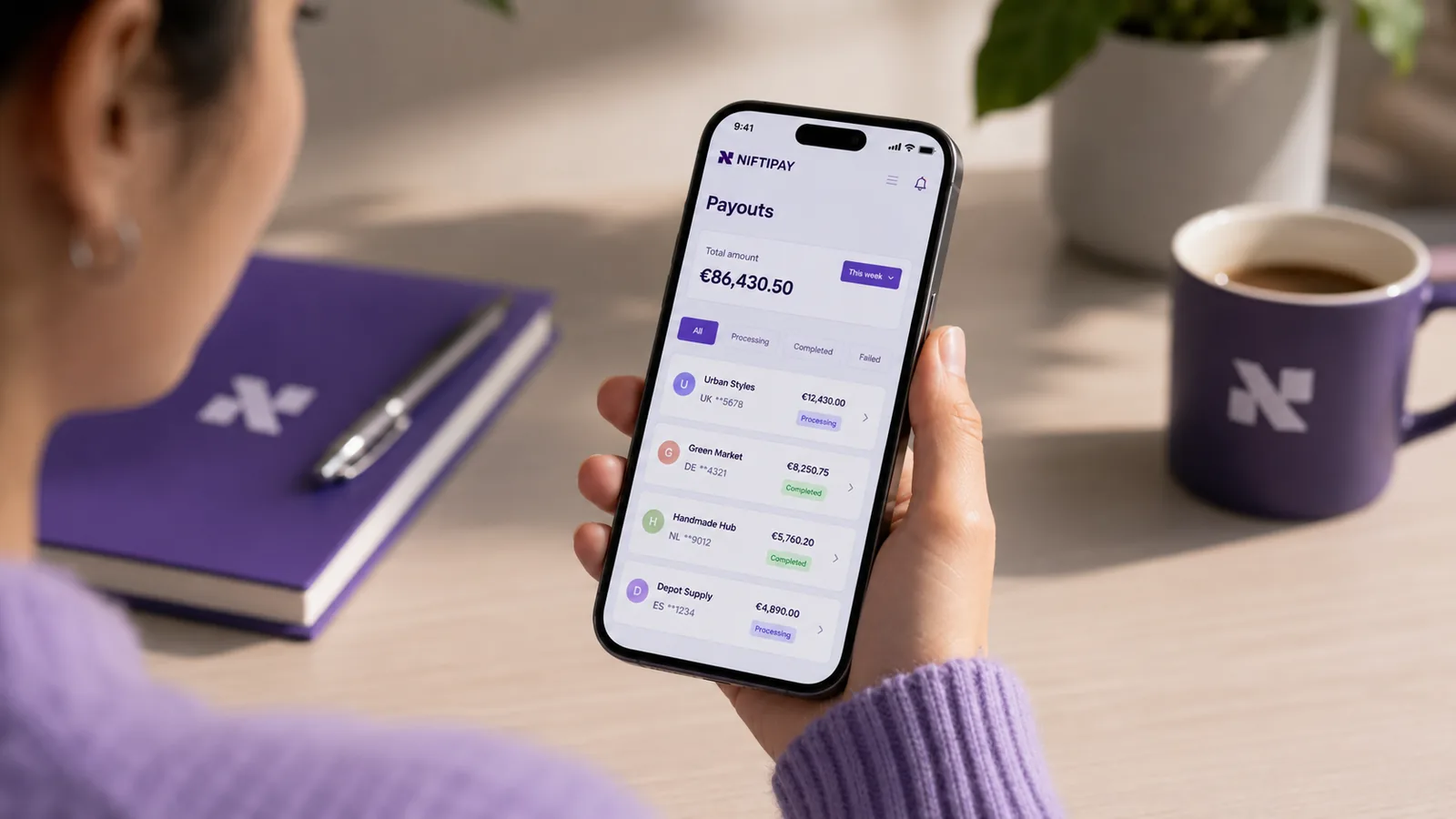
This is the same logic behind treating payments as infrastructure rather than a set of bolt-ons. A crypto payment processor built for marketplaces applies the idea specifically to vendor settlement in digital assets, but the underlying benefit is the same: fewer disconnected systems between the buyer and the seller.
Crypto and alternative payout options
Vendor payouts are not limited to bank transfers. As marketplaces expand across borders, sellers increasingly want options that suit where they are and how they operate, and this is where crypto and alternative methods become relevant.
Depending on the available payment configuration, payout options a marketplace may consider include:
- Local bank payouts where supported for a vendor’s market.
- Stablecoin payouts, which some cross-border sellers prefer for speed and predictability. Our guide to stablecoin settlement covers the trade-offs in more detail.
- Broader crypto payouts, subject to the platform’s risk appetite and the vendor’s preferences.
Crypto and stablecoin payouts introduce their own considerations, including volatility between transaction and payout, network fees, and the need for clear records of the currency used at each step. They are an option to evaluate against a vendor base, not a default for every marketplace.
Risk and compliance checks for marketplace models
Because a marketplace handles money on behalf of others, it carries risk that a single-merchant store does not. Vendors can be a source of fraud, disputes or prohibited activity, so risk controls have to reach both sides of the platform.
Key areas to prepare for include:
- Seller verification. Vendors typically need their own checks before receiving payouts. The KYB documentation a gateway asks for often applies to sellers as well as the platform.
- Payout holds and reserves. Holding funds for a defined period, or keeping a reserve, gives the platform room to handle refunds and chargebacks.
- Transaction monitoring. Watching for unusual patterns across vendors helps catch problems before they reach payout.
- Data security. Payment data handling should align with recognised standards such as PCI DSS.
These controls are more demanding for higher-risk categories, but the principle holds for any marketplace: eligibility, monitoring and payout rules should be defined before scale, not retrofitted afterwards.
What platforms should prepare before applying
Before approaching a provider, it helps to have a clear picture of how your marketplace actually moves money. Providers assess platforms on their model as much as their volume, and readiness shortens onboarding.
A practical checklist to prepare:
- Supported buyer payment methods and the vendor payout methods you need.
- Country and industry coverage for both your platform and your sellers.
- Seller onboarding and KYB requirements, and who is responsible for them.
- Your intended payout structure and settlement timing.
- Integration method, and whether you need a hosted or embedded checkout.
- Webhook and API availability for tracking payment and payout status.
- Refund, dispute and reserve handling across vendors.
- Reporting and reconciliation needs for finance and operations.
Working through a structured payment gateway onboarding checklist before you apply makes the difference between a smooth review and a stalled one. Capabilities vary by merchant profile and market, so having your model documented lets a provider give you an accurate answer.
The buyer-facing half of that flow is standard across platform models, and is described in the payment solutions overview: hosted checkout, payment links and crypto QR flows with transaction status visibility.
How Niftipay supports marketplace payments and vendor payout workflows
Niftipay is payment infrastructure, not a storefront or a marketplace platform. Your platform keeps its existing website, seller experience and commerce environment; Niftipay provides the connected payment layer underneath it.
For marketplaces, that means coordinated access to supported card, crypto, stablecoin and alternative payment options through one integration, rather than separate providers for each. Depending on the available payment configuration, platforms can use Niftipay to bring buyer payments, settlement visibility and reporting into a single environment that vendor payout workflows can be built around.
Niftipay is designed for more complex and higher-risk payment flows, where coordinated reporting and consistent transaction data matter to finance, operations, risk and support teams. What a given platform can enable depends on its model and is subject to onboarding and approval. If you already run a live marketplace, adding Niftipay works much like bringing a payment gateway to an existing website, rather than rebuilding what you have.
Marketplace payment gateway FAQs
What is a marketplace payment gateway for vendor payouts?
It is a payment layer that both collects payments from buyers and coordinates payouts to the vendors on a platform. Unlike a single-merchant gateway, it keeps the inbound payment and the outbound payout connected to the same transaction record, which simplifies settlement and reconciliation.
How is marketplace payment processing different from a single-merchant gateway?
A single-merchant gateway settles funds to one account. Marketplace payment processing has to split funds across multiple vendors, apply fees, manage separate payout schedules and verify sellers, so it involves more onboarding, reporting and risk control.
How are vendor payouts and settlement timing handled?
Payout structure and settlement timing depend on the platform’s model and the provider’s configuration. Common approaches include per-order payouts, fixed payout cycles, or holding funds until a milestone. Specific schedules and currencies vary by merchant profile and are set during onboarding.
Can a marketplace pay vendors in crypto or stablecoins?
Where supported, marketplaces can offer crypto or stablecoin payouts alongside traditional methods. This can suit cross-border vendors, but it introduces considerations such as volatility, network fees and clear currency records, so it should be evaluated against your seller base.
What risk checks do marketplaces need for vendor payouts?
Marketplaces typically need seller verification (including KYB where applicable), transaction monitoring, and payout holds or reserves to cover refunds and disputes. Because funds are handled on behalf of vendors, controls apply to both the platform and its sellers.
What should a platform prepare before applying to a payment provider?
Document your buyer payment methods, required vendor payout methods, country and industry coverage, seller onboarding rules, intended payout structure, integration method and reporting needs. A clear picture of how your marketplace moves money shortens onboarding and review.
Can Niftipay integrate with an existing marketplace?
Yes. Niftipay provides payment infrastructure that connects to your existing platform rather than replacing it, subject to onboarding and approval. What can be enabled depends on your model and the available payment configuration.