

Running a multi-seller platform is a logistics problem disguised as a payments problem. Every checkout fans out into commissions, vendor balances, refund liabilities and tax exposure. Getting crypto vendor settlement right decides whether that complexity stays invisible to your sellers or breaks them at scale. This guide walks you through the architecture, settlement options and operational checks that separate a payments stack you can build a marketplace on from one you will rip out in twelve months.
What is a crypto payment processor for marketplaces?
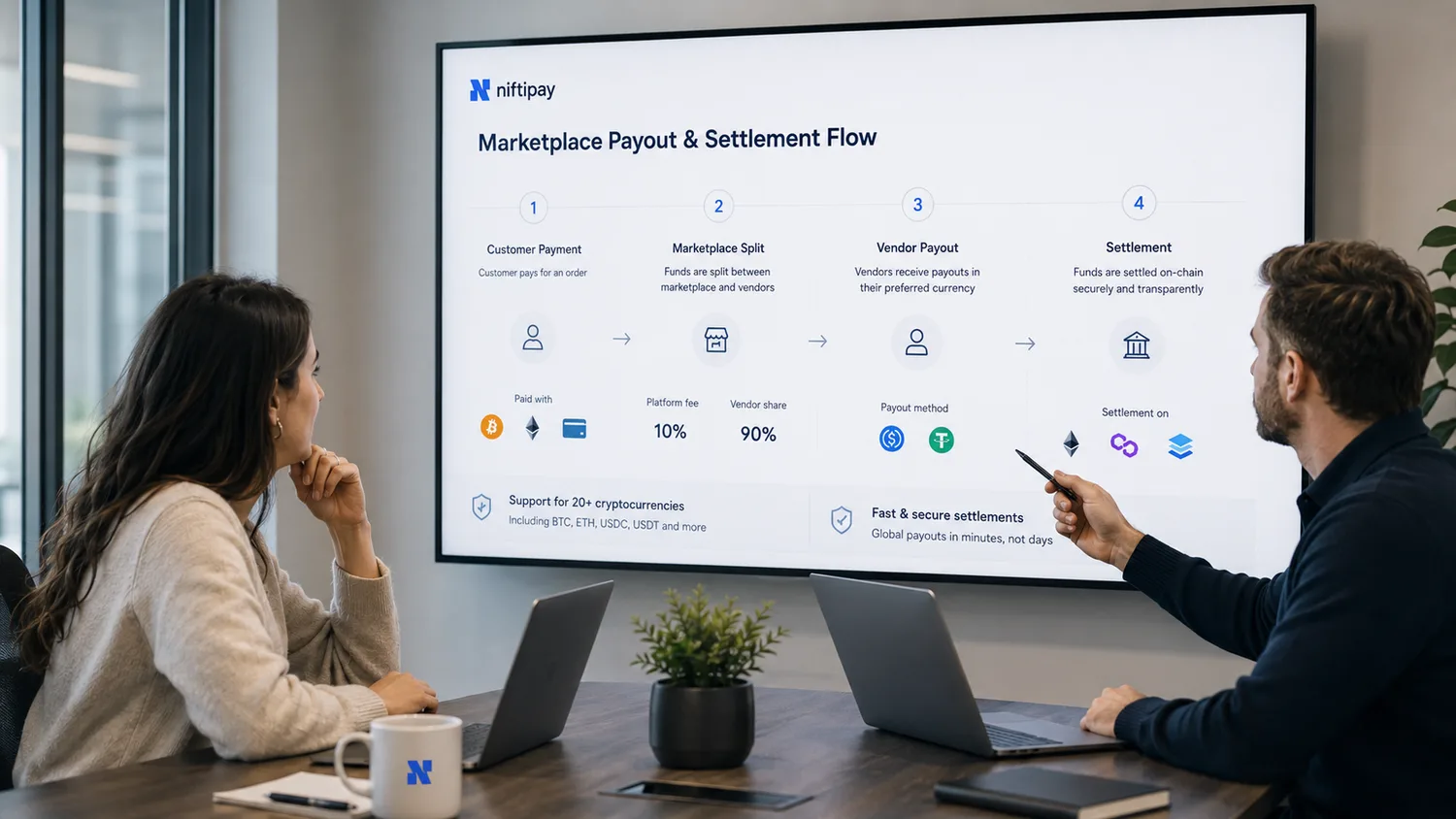
A crypto payment processor for marketplaces is a payment infrastructure layer that accepts on-chain payments from buyers, allocates funds across multiple vendors and settles each party in the currency and rail they expect. Unlike a single-merchant gateway, it treats every transaction as a multi-party event: one buyer, one platform fee, and one or more vendor payouts, each with their own KYC, tax and risk profile.
This guide focuses on the settlement side of that flow: how funds are split between vendors, when they are released, and how multi-currency and reporting obligations are handled. For a broader comparison of providers and features, see our guide to choosing a crypto payment processor for marketplaces.
The processor handles four jobs the platform should never build in-house: wallet generation per order or per vendor, real-time FX between stablecoins and local currencies, vendor onboarding with KYB and travel-rule data, and settlement routing to bank accounts, custodial wallets or self-custody addresses. For a deeper view on platform-specific stacks, see our breakdown of marketplace payment processing for high-risk platforms.
How vendor settlement works in crypto marketplace payments
Settlement is where most marketplaces underestimate the problem. A working flow has to answer three questions atomically: who gets paid, how much, and when the platform can recognise revenue. There are two dominant patterns in production today.
Hold-and-split flow
The buyer pays into a platform-controlled wallet. Funds sit in escrow until the order is marked fulfilled or a dispute window closes. Then the processor splits the balance: platform commission stays, vendor share moves out. This flow protects the marketplace from chargeback-style refunds and is the default for goods that ship, services with delivery proofs, and any vertical where holdback is normal.
Instant split (atomic settlement)
The processor allocates buyer funds across recipients in the same on-chain transaction. The vendor receives their share immediately, the platform receives its fee, and there is no pooled custody risk. This works for digital goods, ticketing, gaming credits and any product where delivery is instant or non-reversible. It is also the cleanest answer to regulators asking whether the platform is operating as a custodian.
The Vendor Settlement Problem: Why Payout Visibility Matters
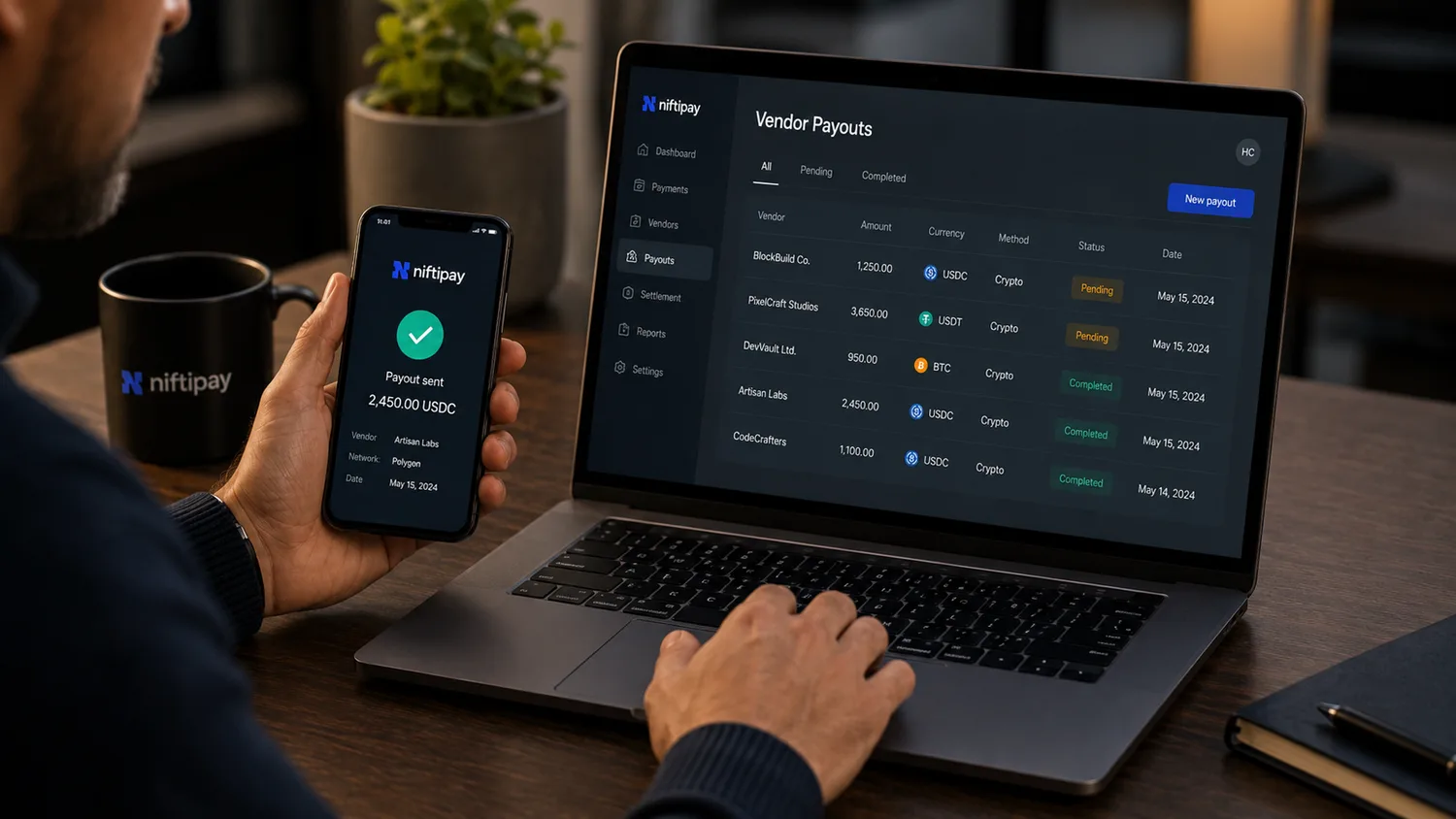
Settlement should never be a black box. When a buyer pays, the platform needs to know exactly where that money is at each step: pending, approved, failed, settled, refunded or ready for payout. Without that visibility, every vendor support ticket becomes a manual investigation, and every finance close becomes an exercise in spreadsheet archaeology.
Good vendor settlement means three things in practice:
- Every transaction has a status the platform can query in real time.
- Every vendor balance is calculated from the same ledger the platform reports from.
- Every payout is traceable from buyer charge to seller wallet, in one report.
A marketplace that cannot answer “where is my money?” to a vendor in under a minute is leaking trust on every cycle.
How Do Marketplace Payouts Crypto Work in a Multi-Vendor Flow?
The operational flow is simpler than it looks once each step is named. For a single order:
- Buyer pays in crypto or stablecoin at checkout.
- Payment is confirmed on-chain and recorded in the processor.
- The platform records the transaction against the order and the vendor.
- Seller allocation is calculated: vendor share, platform fee, taxes if applicable.
- Settlement is prepared on the platform’s payout schedule.
- Vendor payout is executed (or held for review when a flag is raised).
That last step is where most platforms get caught. Marketplace payouts crypto only work cleanly when payout rules, hold logic and reporting are part of the same system as the buyer-side acceptance. Bolting payouts onto a checkout-only processor is how reconciliation breaks.
Handling multi-currency buyers and seller risk
Buyers will pay in whatever they hold: USDT, USDC, ETH, BTC, sometimes native L2 tokens. Vendors almost always want a stable unit of account, either a stablecoin pegged to their reporting currency or a fiat off-ramp. The processor must absorb that mismatch through real-time FX quotes, conversion at the moment of capture, and slippage limits the platform can configure per vendor or per category.
Seller risk maps cleanly onto three controls: payout holds (delay settlement on new vendors), rolling reserves (retain a percentage for chargeback-equivalent disputes) and velocity caps (limit settlement volume per period until KYB is upgraded). A processor that exposes these as policy rules — not a support ticket — is what lets you scale onboarding without rebuilding fraud logic. For a side-by-side with traditional rails, our comparison on marketplace merchant direct debit vs crypto payments covers the trade-offs.
Compliance, reporting and transaction visibility
Multi-vendor crypto flows attract scrutiny that single-merchant flows do not. The platform must be able to produce a per-vendor settlement ledger, withholding totals for tax reporting, and chain-of-custody evidence for each payout. The processor should hand you these out of the box: webhook events for every state transition, signed receipts per settlement, and exportable ledgers in CSV or via API.
Travel-rule data for transfers above local thresholds, screening against sanctions lists at vendor onboarding, and on-chain analytics on incoming buyer funds are non-negotiable for any marketplace that wants banking partners to keep talking to it. Our note on cross-border high-risk payments goes deeper on the jurisdictional layer.
Hold-and-split vs instant settlement: how to choose
The decision is product-shaped, not engineering-shaped. Map your vertical against the table below before specifying the processor integration.
| Dimension | Hold-and-split | Instant settlement |
|---|---|---|
| Best for | Physical goods, services with delivery | Digital goods, ticketing, gaming |
| Custody profile | Platform custodies during hold window | No platform custody at any point |
| Refund handling | Reverse from escrow | Initiate counter-payment |
| Vendor cash flow | Delayed (T+window) | Real-time |
| Regulatory weight | Higher (custody implications) | Lower (pass-through) |
Platforms that need buyer-side acceptance working before the payout logic is finished can start with crypto and stablecoin acceptance through hosted checkout, payment links, QR codes or API, and add vendor settlement on top of it.
Choosing the right crypto payments for platforms
Treat the processor selection as a five-line scorecard. Does it support both hold-and-split and instant settlement under one contract? Does it expose per-vendor policy controls through API, not dashboard-only? Are settlement currencies configurable per vendor? Does it produce regulator-grade ledgers? And does it cover the chains and stablecoins your buyers actually use, not a marketing list of forty assets nobody touches?
Niftipay is built around exactly these requirements: multi-vendor splits, configurable settlement currencies, vendor-level risk policies and ledger exports designed for marketplace finance teams. The same primitives power our broader payment processor for crypto businesses stack, so platform operators get the marketplace logic without forking on a payments-only vendor.
The marketplace payments stack, redrawn
Most multi-seller platforms still wire payments as if they were a single-merchant store with an Excel sheet glued on top. That is the failure mode every scaling marketplace hits at the same revenue threshold: refunds become spreadsheets, vendor disputes become support tickets, and tax season becomes a forensic project. A processor built for the multi-vendor case turns those three failures into three webhook handlers. That is the entire point — and it is the work you no longer have to do yourself.
FAQ
What does a crypto payment processor for marketplaces actually do that a normal gateway does not?
It treats every payment as a multi-party transaction. The processor allocates funds across the platform fee and one or more vendor payouts, manages per-vendor KYB and settlement currency, and produces a per-recipient ledger. A normal gateway only knows one merchant.
How do marketplace payouts in crypto handle refunds?
Under hold-and-split, the platform reverses the relevant share from escrow before vendor release. Under instant settlement, the processor issues a counter-payment back to the buyer, optionally clawed back from the vendor’s next payout via a rolling reserve.
Do I need to register as a custodian to use vendor settlement?
It depends on the settlement model. Instant settlement keeps the platform out of custody entirely, which removes the heaviest regulatory weight. Hold-and-split can trigger custodian obligations in some jurisdictions when the hold window is long enough that funds are deemed safeguarded by the platform.
Can vendors choose their own settlement currency?
Yes, with a processor built for marketplaces. Each vendor profile carries a preferred stablecoin, fiat off-ramp or self-custody address, and the processor handles FX at capture so the buyer can pay in any supported asset.
What reporting should I expect for tax and audit?
Per-vendor settlement ledgers, signed receipts for every payout, withholding totals where applicable, and exportable transaction histories via API. According to the general cryptocurrency reporting framework, this level of granularity is becoming the baseline for any platform handling multi-party crypto flows at scale.