

Every high-risk sector carries the same compliance baseline, and then its own. High-risk payment compliance by vertical is what separates an application that clears underwriting from one that stalls: an iGaming operator is asked for a licence and a responsible-gambling policy, a forex broker for its regulator status and leverage caps, a crypto exchange for VASP registration and Travel Rule tooling. The shared document set is already covered in our high-risk payment compliance checklist. This guide starts where that one ends and maps the evidence each sector has to add on top.
Why compliance requirements diverge by vertical
Underwriting does not treat “high-risk” as one category. An acquirer prices and documents a merchant against the specific consumer harm its sector can produce, and the card schemes reinforce that with brand-protection programmes written per industry. The classification starts with the merchant category code assigned to the business, and everything downstream — reserve size, monitoring thresholds, document list — follows from it.
Three forces drive the divergence. Licensing: some verticals cannot legally operate without a regulator’s authorisation, so the licence becomes the first document an underwriter opens. Dispute profile: sectors with high friendly-fraud rates are asked for consent and delivery evidence that others never see. Jurisdiction: what is legal in one market is prohibited in the next, which turns “where do you sell?” into a compliance question rather than a commercial one.
The baseline every vertical starts from
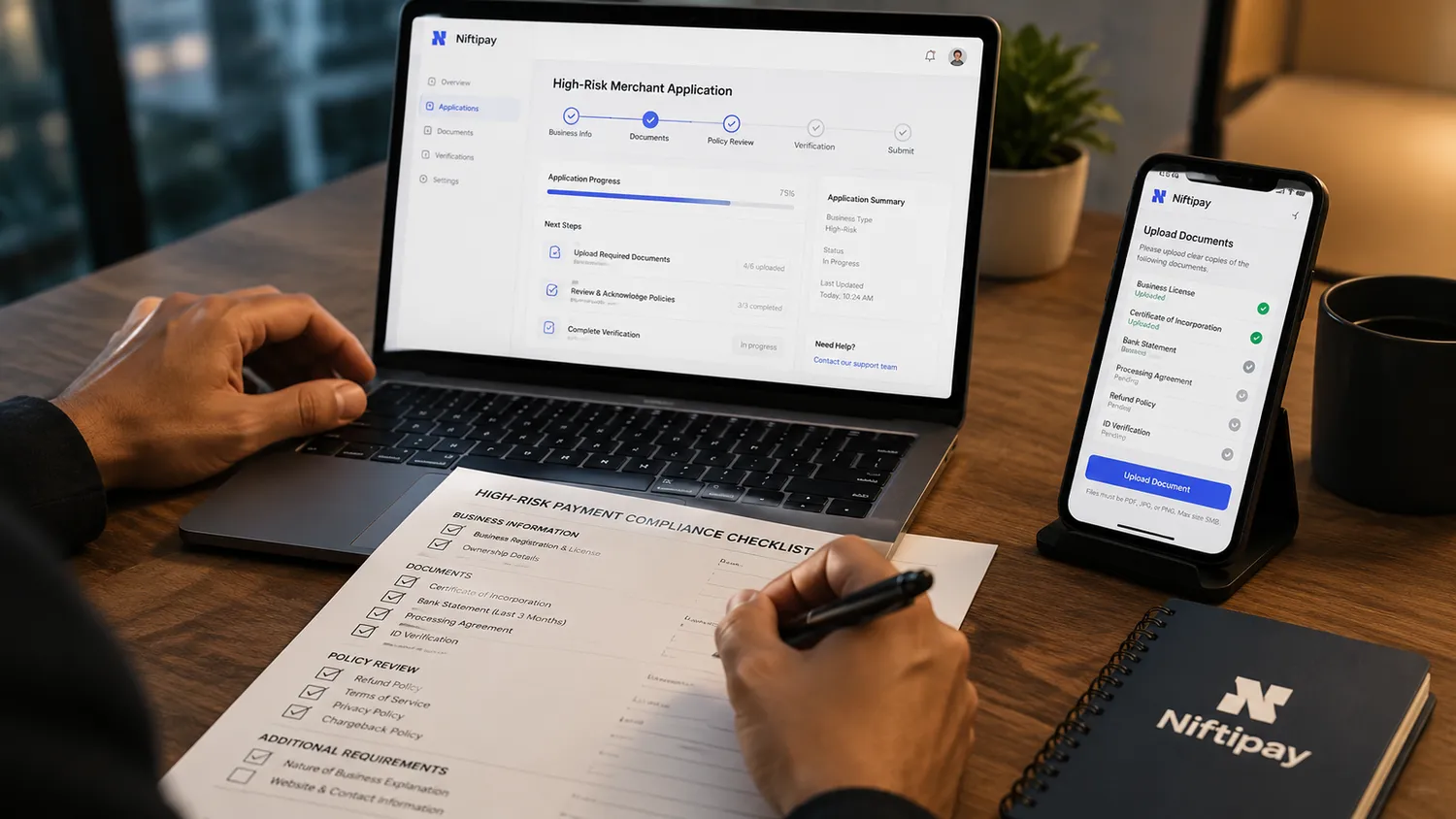
Before the sector-specific layer, every high-risk merchant is expected to produce the same core file: corporate and beneficial-ownership documents, published commercial policies, a transparent website, and evidence of how orders are fulfilled and disputes are handled. Those four blocks are the subject of the checklist guide linked above, and the ownership side in particular is unpacked in our breakdown of KYB requirements for payment gateways.
Assume that baseline is non-negotiable and already done. Everything below is what an underwriter asks for in addition, plus the item merchants in each sector most often fail to anticipate.

iGaming: licence scope, player funds and responsible gambling
The licence itself is rarely the problem. What underwriters scrutinise is whether the territories the operator actually sells into sit inside the licence’s scope, and whether the technical controls prove it. Expect to evidence:
- Licence number, issuing regulator and the exact list of permitted jurisdictions.
- Geolocation and IP-blocking configuration that enforces those jurisdictions, with a test report.
- Responsible-gambling policy: deposit limits, self-exclusion, reality checks, and who reviews them.
- AML programme with a named compliance officer, plus the player-funds segregation arrangement.
- Agreements with game providers, since unlicensed content puts the operator’s own licence at risk.
The most common rejection trigger is a mismatch between the licensed territories and the countries reachable at checkout. Operators bringing card and crypto rails live at the same time should read our notes on choosing an iGaming payment gateway before the technical review begins.
Forex and CFD brokers: regulator status, leverage and risk disclosure
Brokers are assessed on whether a retail client could plausibly claim they did not understand the product. That makes disclosure a compliance artefact rather than a legal footnote. Underwriters ask for the regulator registration number and the exact entity it belongs to, the risk warning displayed at the same prominence as the offer, leverage caps applied per jurisdiction, and the client-money segregation arrangement.
Introducing-broker and affiliate pages are reviewed as part of the merchant’s own marketing. Any page promising guaranteed returns, recovery of losses or risk-free trading is treated as deceptive marketing by the card schemes, and that is a decline regardless of how compliant the main site is. Our guide to payment gateways for forex brokers covers how the same controls interact with deposit conversion.
Crypto exchanges and OTC desks: registration and Travel Rule tooling
For exchanges, brokers and OTC desks, the sector layer is almost entirely about counterparty risk. Acquirers want to see registration as a virtual asset service provider or the local equivalent, and the concrete tooling behind it:
- VASP, MSB or equivalent registration, with the scope of activities it authorises.
- A named Travel Rule solution and the protocol it uses to exchange originator and beneficiary data.
- Blockchain analytics and sanctions-screening provider, plus the thresholds that trigger a freeze.
- Custody arrangement — self-custody, qualified custodian or hybrid — and how client assets are segregated.
- A written policy on privacy coins, mixers and high-risk counterparties.
These expectations trace back to the FATF Recommendations on customer due diligence and virtual assets, which underpin most acquirer frameworks worldwide. Desks running fiat and digital rails side by side will find the operational picture in our overview of a crypto and fiat payment processor.
Adult and dating: age verification, consent and content provenance
A self-declared age checkbox does not satisfy any acquirer in this vertical. The file needs a documented verification method, the vendor behind it, and what happens when a check fails. Alongside it, underwriters expect a content moderation policy with a stated takedown SLA, model-release and identity documentation for every performer where user-generated content is monetised, and consent records that can be produced per item on request.
Dating platforms carry a second, quieter problem: descriptor discretion. Merchants soften the billing descriptor to protect the customer, and that softening is exactly what drives friendly fraud. The workable answer is a neutral but recognisable descriptor plus a pre-charge reminder, an approach we go into in the guide to payment gateways for dating sites.
Nutraceuticals, supplements and CBD: substantiation and country-by-country legality
This is the vertical where marketing copy, not paperwork, causes most declines. Every health-related claim on the site, on landing pages and on affiliate or influencer pages has to be traceable to something: a certification, a study, an approved label, or a qualifying disclaimer. Disease claims — treating, curing or preventing a condition — are a rejection trigger on their own.
The second layer is legality per destination country. CBD limits, novel-food status and ingredient bans differ market by market, so an acquirer wants a country list with a legal position against each, plus a certificate of analysis per batch for anything ingestible. Merchants shipping across the UK and EU will recognise the pattern from our piece on payment gateways for supplement brands.
Subscriptions and SaaS: consent, renewal notice and cancellation flow
Recurring models are judged on how a cardholder experiences the second charge, not the first. Underwriters want a stored consent record for every subscriber — timestamp, IP, the terms version accepted and the state of the opt-in control — plus a pre-renewal notification and a cancellation route that lives in the same channel where the customer signed up.
Trial logic gets read line by line. The price after the trial, the date of the first full charge and the descriptor all have to appear before the pay button, not in an email afterwards. Dunning rules matter too: aggressive retry schedules inflate decline ratios and attract monitoring. The commercial side of that trade-off is covered in our guide to payment gateways for high-risk subscription businesses.
Marketplaces and multi-vertical operators: the layers stack
Platforms that host third-party sellers inherit the compliance profile of the riskiest category they allow. An underwriter scores the marketplace against that category, not against the average, so the file needs a seller-onboarding policy with KYC thresholds, a prohibited-category list that is actually enforced, and payout controls that can hold funds while a seller is under review.
The same logic applies to a single operator running two verticals under one entity — an affiliate network selling both supplements and financial signals, for example. Splitting them across separate merchant IDs is usually cheaper than defending the combination. The payout mechanics behind that structure are set out in our guide to marketplace payment gateways and vendor payouts.
Vertical compliance requirements at a glance
The table collapses the sector layers into one reference. Read it as an addition to the baseline file, and name the applicable row in the application instead of waiting to be asked for it.
| Vertical | Extra compliance evidence | Most common rejection trigger |
|---|---|---|
| iGaming | Licence and permitted jurisdictions, RG policy, geolocation enforcement, AML programme, player-funds segregation | Checkout reachable from a territory the licence does not cover |
| Forex & CFD | Regulator registration, risk disclosure at offer prominence, leverage caps per jurisdiction, client-money segregation | Guaranteed-returns language on an affiliate or IB page |
| Crypto exchange / OTC | VASP or MSB registration, Travel Rule solution, sanctions and analytics provider, custody arrangement | No named Travel Rule tooling for counterparty data |
| Adult & dating | Verified age gate, content moderation policy with takedown SLA, model releases, consent records | Self-declared age checkbox instead of a verification vendor |
| Nutraceuticals & CBD | Claim substantiation dossier, certificate of analysis per batch, country-by-country legal position | Disease claims or unsupported benefits in marketing copy |
| Subscriptions & SaaS | Consent record per subscriber, pre-renewal notice, in-channel cancellation, trial terms at checkout | Trial price and first full charge disclosed only after purchase |
| Marketplaces | Seller onboarding KYC, enforced prohibited-category list, payout hold controls | Scored against the riskiest category the platform permits |
How Niftipay supports compliance across verticals
Niftipay works with merchants in iGaming, forex, crypto, adult and dating, nutraceuticals, subscriptions and marketplaces, so qualification starts from the sector layer rather than a generic form. The evidence list is matched to the vertical up front, the gaps are named before an acquirer sees the file, and the payment setup — card acceptance alongside crypto and stablecoin settlement — is structured around the risk profile the sector actually carries.
That matters most for merchants sitting across two verticals, or expanding into a market where the legal position changes. Mapping the new layer before launch is considerably cheaper than explaining it to a risk team after a monitoring alert. For the stages that follow qualification, our guide to high-risk payment gateway approval sets out the typical timeline.
Keeping the vertical layer current
Sector rules move faster than the baseline. Licence conditions get amended, leverage caps are revised, novel-food lists are updated and Travel Rule thresholds drop. Acquirers re-score active merchants roughly every twelve months, and a vertical layer that was accurate at onboarding is the thing most likely to have quietly gone stale by that review. Treat it as a versioned document with a named owner, and refresh it whenever the business adds a market, a product or a licence.
High-risk payment compliance FAQs
What does high-risk payment compliance by vertical mean?
It means the sector-specific evidence an acquirer expects on top of the shared compliance baseline. Every high-risk merchant supplies corporate documents, policies and website transparency; an iGaming operator additionally supplies a licence and responsible-gambling policy, a crypto exchange a VASP registration and Travel Rule tooling, a nutraceutical merchant claim substantiation.
Which vertical faces the strictest payment compliance requirements?
iGaming and regulated financial services carry the heaviest documentary burden, because neither can operate without a regulator’s authorisation. Nutraceuticals and CBD face fewer documents but a higher rejection rate, since a single unsupported product claim can decline an otherwise complete file.
Do I need a licence before applying for a high-risk merchant account?
For iGaming, forex, CFD and most crypto activities, yes — the authorisation is the first document underwriting opens, and the file does not progress without it. Adult, dating, nutraceutical, supplement and subscription merchants do not need a licence, but they must evidence the equivalent controls: age verification, claim substantiation or consent records.
What happens if my business spans two high-risk verticals?
The acquirer applies the stricter of the two layers to the whole entity and prices the reserve against the riskier category. Where the two are genuinely separate businesses, splitting them across distinct legal entities and merchant IDs usually produces better terms than defending the combined profile.
How often do vertical compliance requirements change?
Card-scheme rules are revised on a roughly semi-annual cycle, and sector regulators move independently of that. Review the vertical layer quarterly, and always before entering a new market, launching a product line or adding a licence — acquirer re-scoring assumes the merchant has kept it current.