
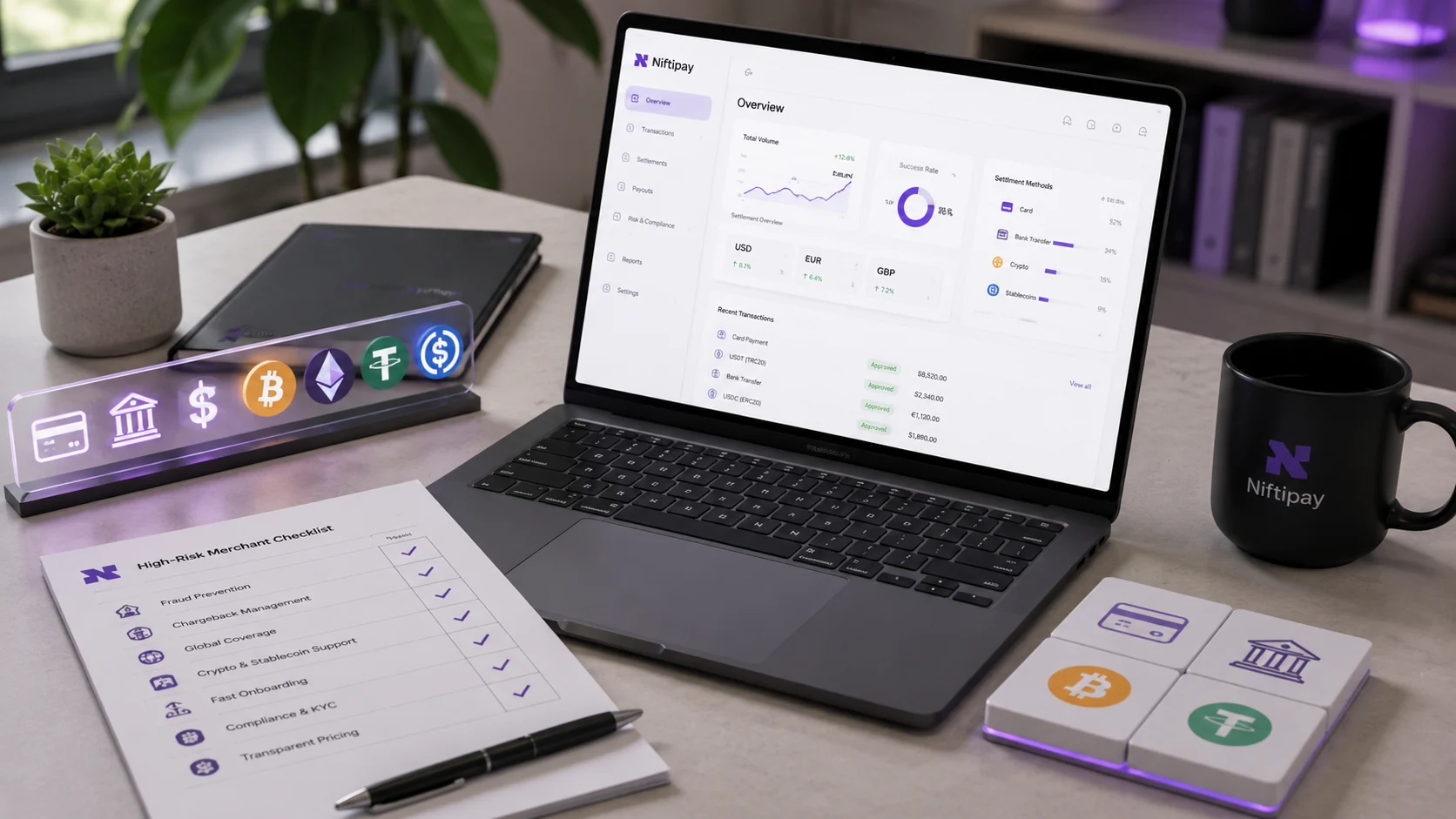
Plenty of high-risk merchants arrive at the same point. Cards still bring in most of the revenue, because customers recognise and trust them. But cards alone have started to feel fragile: an acquirer withdraws from the category, a settlement is held back, or a region becomes hard to serve. Adding crypto or stablecoins looks like the obvious hedge.
It is rarely that simple. Choosing a crypto and fiat payment processor is not a matter of switching on more currencies at checkout. Two payment types that behave very differently end up inside one commercial relationship, and they have to be assessed together: approval, compliance, settlement, integration, refunds, chargebacks, conversion and operational continuity.
Quick answer: A crypto and fiat payment processor handles both traditional payments — cards, bank-based methods and fiat currencies — and cryptocurrency or stablecoin payments through a single provider relationship. For high-risk merchants, the decisive factors are underwriting appetite, settlement structure and refund handling, not the number of coins listed on a website.
What is a crypto and fiat payment processor?
A crypto and fiat payment processor accepts, processes and settles payments in traditional currencies and in digital assets, under one merchant account and one set of commercial terms. The value is not the currency list. It is that a single underwriting decision, one integration and one settlement flow cover both sides.
These terms are used loosely across the industry, so it helps to separate them before comparing providers:
- Fiat payments — payments in government-issued currencies such as GBP, EUR or USD.
- Card payments — transactions on Visa, Mastercard and similar networks, governed by scheme rules that include chargeback rights.
- Bank-based methods — transfers, SEPA and open banking rails that move fiat without a card network.
- Cryptocurrency payments — payments in assets such as Bitcoin or Ethereum, settled on a blockchain and priced by the market.
- Stablecoins — digital assets intended to track a reference currency, usually the US dollar, removing most price movement while keeping blockchain settlement.
- Payment gateway — the layer that captures the payment at checkout and passes it on.
- Payment processor — the layer that carries it through authorisation, settlement and payout.
Many providers do both, which is why the labels blur in marketing material. Our explainer on the difference between a payment gateway and a payment processor covers where one ends and the other begins.
Why high-risk merchants consider both fiat and crypto
The motivation is practical rather than ideological. Merchants in restricted categories are exposed to decisions made by parties they do not control, and a second payment type reduces that exposure. The common reasons:
- Payment method diversification — a declined card is not automatically a lost sale.
- International reach — some markets have low card penetration but active crypto use.
- Less reliance on a single acquiring route — if one acquirer pauses a category, trading does not stop entirely.
- Customer preference — a share of buyers in iGaming, forex and digital services already hold and spend crypto.
- Cross-border transactions — blockchain settlement is largely indifferent to the corridor.
- Access to stablecoins — dollar-referenced settlement without holding a volatile asset.
- Business continuity — a second rail keeps revenue moving during a review or migration.
- Underwriting pressure — where conventional processors apply stricter terms, an alternative route can be the difference between trading and waiting.
One correction is worth making early, because it drives poor decisions. Crypto does not remove compliance. A merchant accepting cryptocurrency is still subject to KYB checks, anti-money-laundering obligations, sanctions screening, fraud exposure and the terms of the provider’s own licences. Regulated activity does not stop being regulated because the settlement asset changed. If crypto acceptance is new to you, our guide to how businesses accept cryptocurrency payments covers the operational basics.
What to look for in a fiat and crypto payment processor
This is where the real evaluation happens. These checks matter more than headline pricing, because they decide whether the setup survives contact with your actual order flow.
Support for cards, fiat, crypto and stablecoins
“Crypto supported” is a claim, not a specification. Ask which assets and networks are available, which fiat currencies can be accepted and settled, and which of those apply to your markets and your approved category. Support varies by jurisdiction and merchant profile, so a capability advertised on a homepage may not be enabled on your account. The same applies to alternative payment methods for high-risk merchants, the most region-dependent part of the stack.
Experience with high-risk merchant underwriting
A provider that understands your category asks uncomfortable questions early. That is a good sign. Expect a review of your business model, country of incorporation and trading countries, products, fulfilment method, refund policies, expected volume, average order value and chargeback history.
A provider that approves quickly without examining any of this is not necessarily easier to work with. It usually means the risk assessment happens later, once volume has built up — which is when accounts get paused.
Clear KYB and compliance requirements
Know Your Business documentation confirms who owns and controls the company. Requirements differ between providers and jurisdictions, so treat any list as provider-specific rather than universal. For Niftipay, the confirmed KYB requirements are:
- company registration information;
- details of directors or beneficial owners holding 25% or more;
- business address;
- passport of the director.
Other providers may request considerably more, including processing history, bank statements or audited accounts. Our high-risk merchant application checklist sets out what is commonly requested across the market. For UK regulatory context, the Financial Conduct Authority’s cryptoasset guidance is the primary source. This article is general information, not legal advice.
Settlement structure and currency conversion
Settlement is where fiat and crypto setups diverge most, and where merchants are most often surprised. Confirm in writing:
- Settlement currency — what you receive, which may differ from what the customer paid.
- Crypto-to-fiat conversion — whether it happens, when, and at which reference rate.
- Stablecoin settlement — whether you can be settled in a dollar-referenced asset instead.
- Settlement schedule — the delay between an approved transaction and available funds.
- Reserves — whether a rolling or fixed reserve applies to your category.
- Withdrawal process — thresholds, approvals and payout timing.
- Network fees — blockchain fees vary by network and congestion, and someone pays them.
- Conversion costs — the spread from crypto to fiat is a real cost even when it is not called a fee.
With Niftipay, settlement is normally T+9. As with any provider, final terms depend on the merchant profile and the outcome of the review.
Refunds, disputes and chargebacks
These three are often treated as one topic. They are not, and the difference is structural:
- Card refunds — initiated by the merchant and returned along the original card rail.
- Card chargebacks — initiated by the cardholder through their issuer, decided under scheme rules, and capable of being forced against the merchant’s wishes.
- Blockchain transactions — irreversible once confirmed, with no network-level mechanism to claw a payment back.
- Merchant-managed crypto refunds — a refund is a new outbound transaction to an address the customer supplies, which carries its own operational and fraud risk.
- Penalties — chargebacks typically carry a fee, and excessive ratios can affect account standing.
Irreversibility is often marketed as the elimination of chargeback risk. More accurately, the risk moves: disputes still occur, but they arrive as customer service issues, refund requests or platform complaints rather than scheme chargebacks, and the merchant absorbs them directly. With Niftipay, refunds are generally processed within approximately 48 hours, and chargebacks may involve a variable penalty depending on the case.
Integration options
The integration route determines how much engineering time the setup consumes. Assess hosted or embedded checkout and its effect on conversion; API access for custom checkout and order logic; platform plugins for WooCommerce, PrestaShop or others; marketplace and bot-commerce flows; and webhooks that push status updates so orders reconcile without manual work.
For Niftipay, the confirmed integration routes are API, a WooCommerce plugin and a PrestaShop plugin. On any other platform, a direct API integration is the route to discuss rather than assuming a native plugin exists.
Geographic and industry coverage
Availability is never uniform. It depends on jurisdiction, product, risk category and the outcome of the merchant review, and it shifts as regulation changes — the European Commission’s crypto-asset regulatory framework is one example of rules that reshaped provider coverage across the EU.
For Niftipay, merchants from a range of countries can be considered, but restrictions apply. Restricted countries include Russia, Iran, China and Venezuela. Weapons and drugs are not accepted. Certain adult content may require evaluation or may not be accepted depending on the case. These are examples of how coverage is assessed rather than a complete policy statement; the position for any merchant is confirmed during review.
Transparent commercial terms
Compare the whole cost structure, not the headline percentage: processing fees, conversion fees, network fees, chargeback penalties, refund costs, settlement timing, reserve requirements, account or transaction limits, and any integration or setup costs.
Niftipay does not publish a universal rate, because pricing is assessed individually against the merchant profile. It also does not apply general predefined transaction or account limits, though any final condition is confirmed during the evaluation.
Crypto-only vs fiat-only vs combined processing
No single model is correct for every business. The table compares them on the dimensions that tend to decide the outcome.
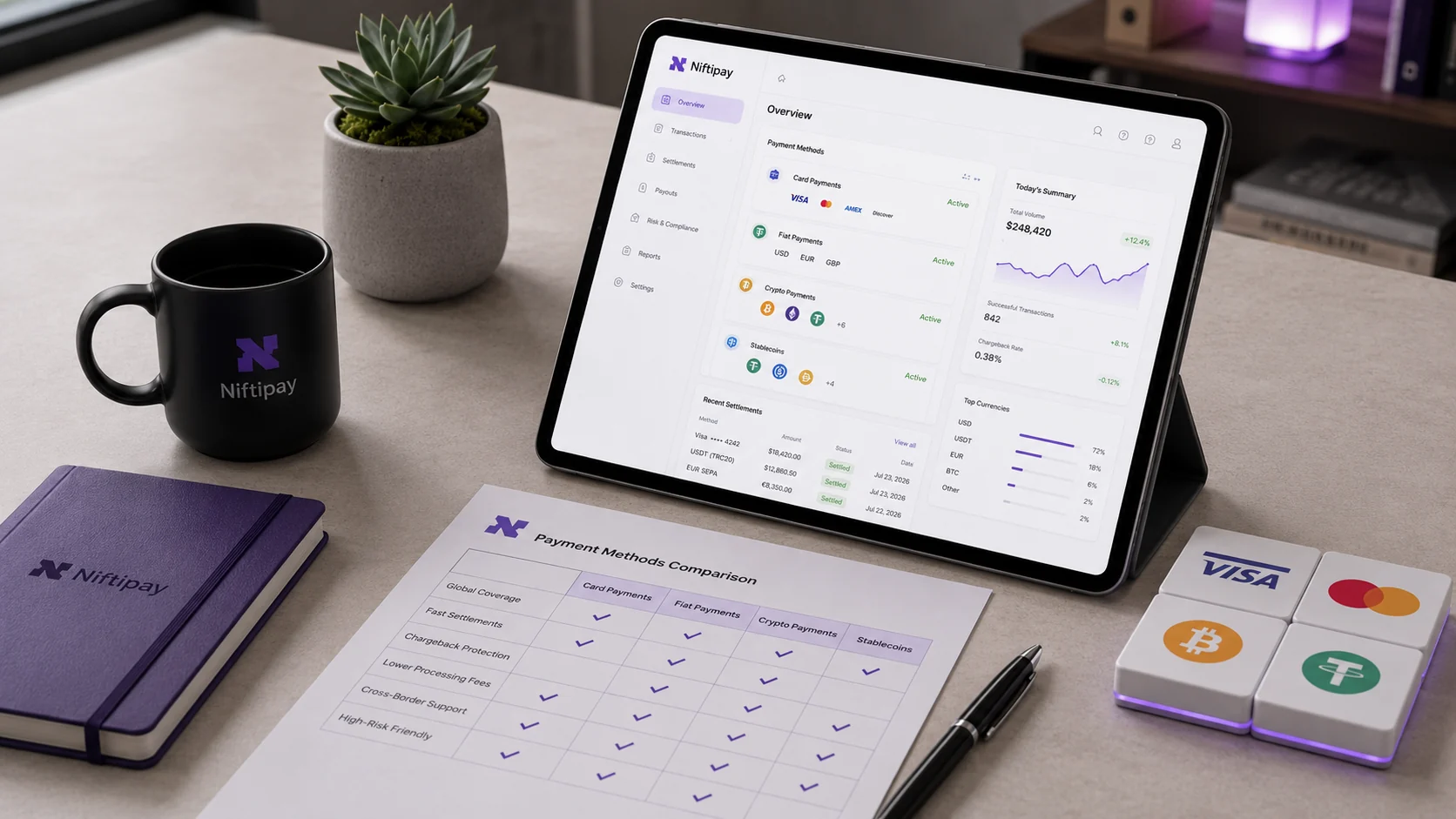
| Processing model | Customer familiarity | Chargebacks | Settlement | Volatility | International reach | Best suited for |
|---|---|---|---|---|---|---|
| Fiat / card-only | Highest | Full scheme exposure, with fees and ratio monitoring | Fiat payouts to a bank account; reserves common in high-risk categories | None on the payment; FX applies cross-border | Limited by acquiring coverage and category appetite | Merchants whose customers pay by card and whose category is accepted |
| Crypto-only | Lower — needs customers who already hold digital assets | No scheme chargebacks; disputes arrive as refund and service issues | Crypto, stablecoin or converted fiat; network fees apply | Significant unless settled in stablecoins | Broad, largely indifferent to corridor | Businesses with crypto-native customers or blocked card routes |
| Combined fiat and crypto | Broadest — familiar checkout plus a second route | Apply to the card portion only | One relationship covering both; terms differ per method | Manageable where stablecoin settlement is available | Widest, subject to jurisdiction and category | Merchants needing card conversion plus a rail for continuity |
A combined setup is not automatically superior. It makes most sense when card acceptance is commercially necessary but not sufficient — typically cross-border merchants, restricted categories and businesses that have already been interrupted once. If your customers pay exclusively by card and your category is comfortably accepted, adding crypto may add operational work without adding revenue. Our comparison of when a card and crypto payment gateway beats separate providers goes further into that trade-off.
One provider or several payment routes?
Both, in practice, and the distinction matters. A single provider covering cards, crypto and stablecoins reduces integration work, consolidates reporting and leaves one underwriting relationship to maintain. That is an operational win.
It is not, on its own, redundancy. If the entire stack sits behind one commercial relationship, a single account review can still stop everything. Larger high-risk merchants generally consolidate integrations while keeping at least one alternative route available — a second provider, a backup acquiring path, or a crypto rail that keeps working if card processing is paused. Consolidation is about efficiency; redundancy is about continuity. They are separate decisions.
Questions to ask before choosing a provider
Take these to every provider on your shortlist. Comparable answers make proposals genuinely comparable.
- Which fiat currencies, cryptocurrencies and stablecoins are supported for my account, in my markets?
- Can customers pay by card while I settle in crypto, stablecoins or fiat?
- Which countries and industries are restricted, and where does my business sit?
- What KYB documents are required, and what triggers additional requests?
- How long does approval normally take once you have everything?
- How are refunds handled for card and for crypto payments, and what does each cost?
- What is the settlement schedule, and does it differ by payment method?
- Are reserves or rolling reserves required for my category?
- Which integrations are available — plugin, API or both — and who maintains them?
- Which costs are charged beyond the transaction fee, including conversion, network and chargeback fees?
If you are evaluating the crypto side in more depth, our guide to choosing a crypto-friendly payment processor is useful complementary reading.
The reverse direction matters too. Merchants who accept stablecoins and want to use that balance directly can fund a Niftipay Card with USDT from the dashboard rather than converting to fiat first.
How Niftipay supports high-risk merchants
Niftipay operates as a card and crypto payment solution for businesses that need more than a standard checkout. The confirmed position:
- support for card, crypto and stablecoin payment strategies within one setup;
- works with high-risk and non-standard online business models, subject to review;
- approval normally takes approximately 2–5 days after the required information is received;
- settlement is normally T+9;
- refunds are generally processed within approximately 48 hours;
- chargebacks may involve a variable penalty;
- pricing is assessed individually rather than published as a universal rate;
- integrations include API, WooCommerce and PrestaShop;
- no general predefined transaction or account limits;
- availability depends on the merchant, jurisdiction, products and compliance review.
None of this guarantees approval, and none of it is a fixed contractual term. Timelines and conditions are typical rather than promised, and the terms that apply to a specific business are the ones confirmed after review.
Where the business needs to move value between the two rails rather than simply accept both, that conversion sits in the fiat-to-crypto on-ramp and off-ramp, which handles quoting, compliance and settlement behind the checkout.
Crypto and fiat payment processor FAQs
What is a crypto and fiat payment processor?
It is a provider that accepts, processes and settles both traditional payments — cards, bank-based methods and fiat currencies — and cryptocurrency or stablecoin payments under one merchant relationship. The practical benefit is a single underwriting decision, one integration and consolidated reporting, instead of running separate providers for each payment type.
Can a high-risk merchant accept both cards and cryptocurrency?
Often yes, though it depends on the business model, jurisdiction, product category and the provider’s compliance review. Card acceptance normally requires acquiring appetite for your category, while crypto acceptance depends on the provider’s own licensing and coverage. Neither is automatic, and approval is always subject to review.
Is a crypto payment processor the same as a payment gateway?
Not quite. A gateway captures the payment at checkout and passes it onward; a processor carries the transaction through authorisation, settlement and payout. Many providers do both, which is why the terms get used interchangeably. When comparing providers, ask which functions they actually perform rather than relying on the label.
Can crypto payments receive chargebacks?
Not in the card scheme sense. Confirmed blockchain transactions are irreversible, so there is no issuer-initiated chargeback mechanism. Disputes still happen, but they reach the merchant as refund requests, customer service complaints or platform disputes, and the merchant handles them directly. The risk shifts rather than disappearing.
Can a merchant settle crypto payments in fiat currency?
Often, yes. Many processors convert incoming crypto to fiat before payout, or offer stablecoin settlement as a middle option. Confirm when conversion happens, which reference rate applies, what spread is charged and who pays the network fee, because these affect the amount received more than the headline processing rate does.
What documents are required, and how long does approval take?
Requirements vary by provider. For Niftipay, KYB covers company registration information, directors or beneficial owners holding 25% or more, the business address and the director’s passport, and approval normally takes approximately 2–5 days once that information is received. Incomplete documentation is the most common cause of delay.
Check whether Niftipay fits your payment model
If your business needs to accept card, fiat, crypto or stablecoin payments, Niftipay can review your business model, target markets and integration requirements. Starting the qualification process is the fastest way to understand which payment setup may be available for your company, what the commercial terms would look like and which integration route fits your platform.
Choosing a crypto and fiat payment processor comes down to fit rather than feature counts. Bring the questions above, ask for terms in writing, and compare the answers against how your business actually operates. Get Started to begin the review.