
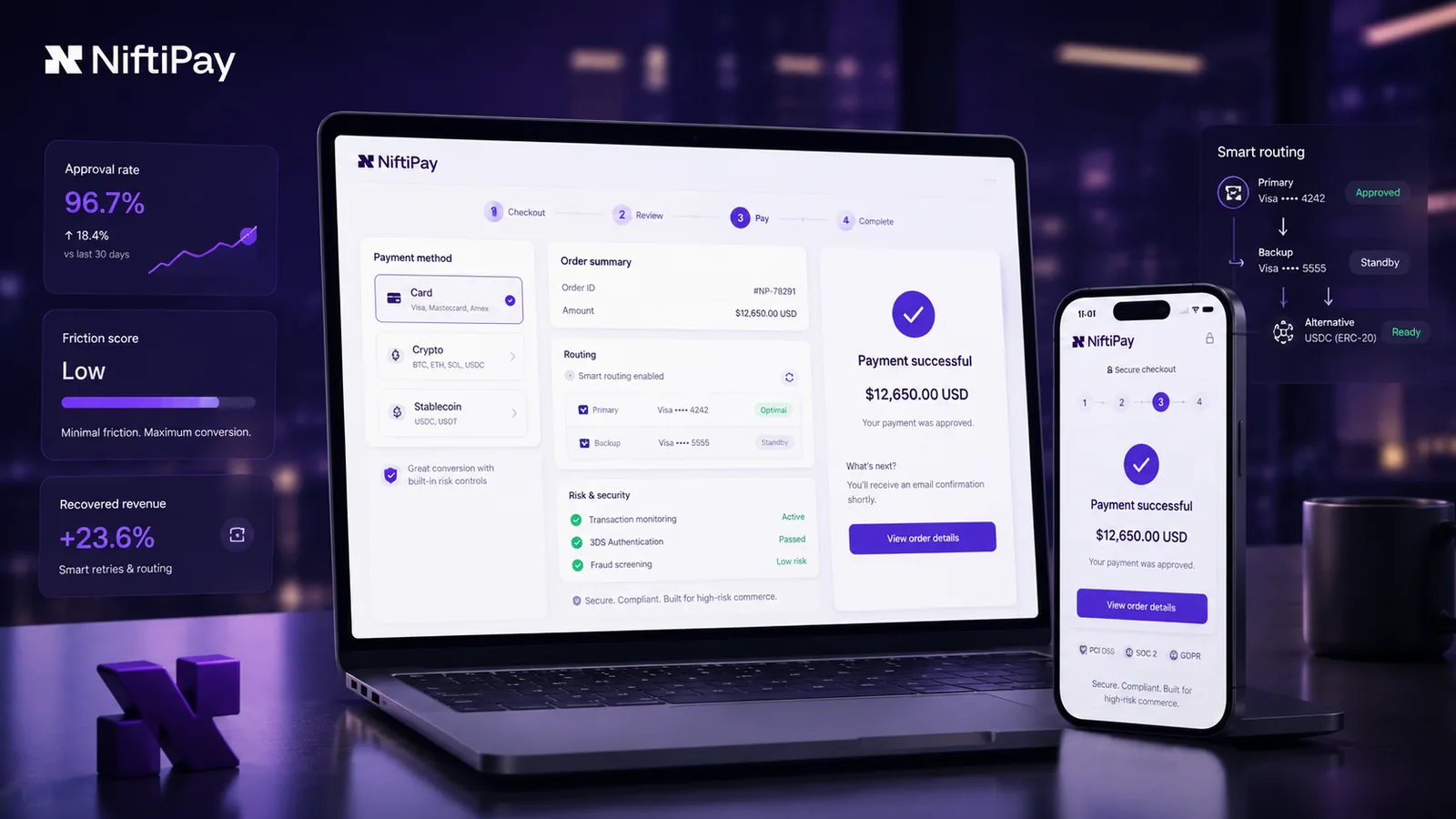
High-risk checkout conversion is harder to win than ordinary ecommerce conversion, because every improvement has to survive risk controls, compliance checks and processor restrictions. The aim is not to strip friction out blindly — it is to remove the friction that quietly costs you legitimate customers, while keeping the controls that keep you trading. This guide covers where that friction hides in complex checkout flows, and how stronger payment infrastructure reduces it without weakening fraud screening or compliance.
For merchants in regulated or high-dispute verticals, the checkout is the most expensive point to get wrong. You have already paid to acquire the customer, so a confusing payment step, a missing method or an unexplained failure does not just lose one sale — it trains that customer not to come back.
What makes high-risk checkout conversion different?
In standard retail, conversion is mostly a design and pricing problem. In high-risk and complex commerce, it is a payment infrastructure problem too. Several pressures stack up at once:
- Risk review and screening add checks that low-risk stores never run, from manual review queues to step-up authentication.
- Payment method limitations are common — some acquirers restrict certain card types, currencies or business categories.
- Card declines happen more often because issuers and acquirers scrutinise high-risk traffic more heavily.
- Compliance checks such as Strong Customer Authentication and KYC sit directly in the payment path.
- Customer trust is harder to earn when the brand or category already carries a reputation cost.
- Processor restrictions can cap volumes, hold reserves or limit how you present payment options.
None of these can simply be switched off — they are the price of staying compliant and bankable. The work is to make the checkout experience around them as smooth as possible, and to recover gracefully when a payment does not go through. That is a different problem from purely trying to reduce payment declines, although the two reinforce each other.
Where does payment friction appear in high-risk checkout flows?
Payment friction in complex commerce rarely comes from one big flaw. It accumulates from small frustrations that each push a few more customers to abandon:
- Confusing payment steps — too many fields or unclear ordering of authentication and confirmation.
- Limited payment options that do not match how the customer actually wants to pay.
- Unclear failed payment messages that say “declined” with no guidance on what to do next.
- Redirects to third-party pages that look different from your brand and break trust.
- Slow confirmation, where the customer is left unsure whether the payment worked.
- Missing trust signals at the moment the customer is asked to hand over card or wallet details.
Each of these is fixable without touching your risk rules. Mapping your own checkout to settlement flow end to end is the fastest way to see where customers drop and why.
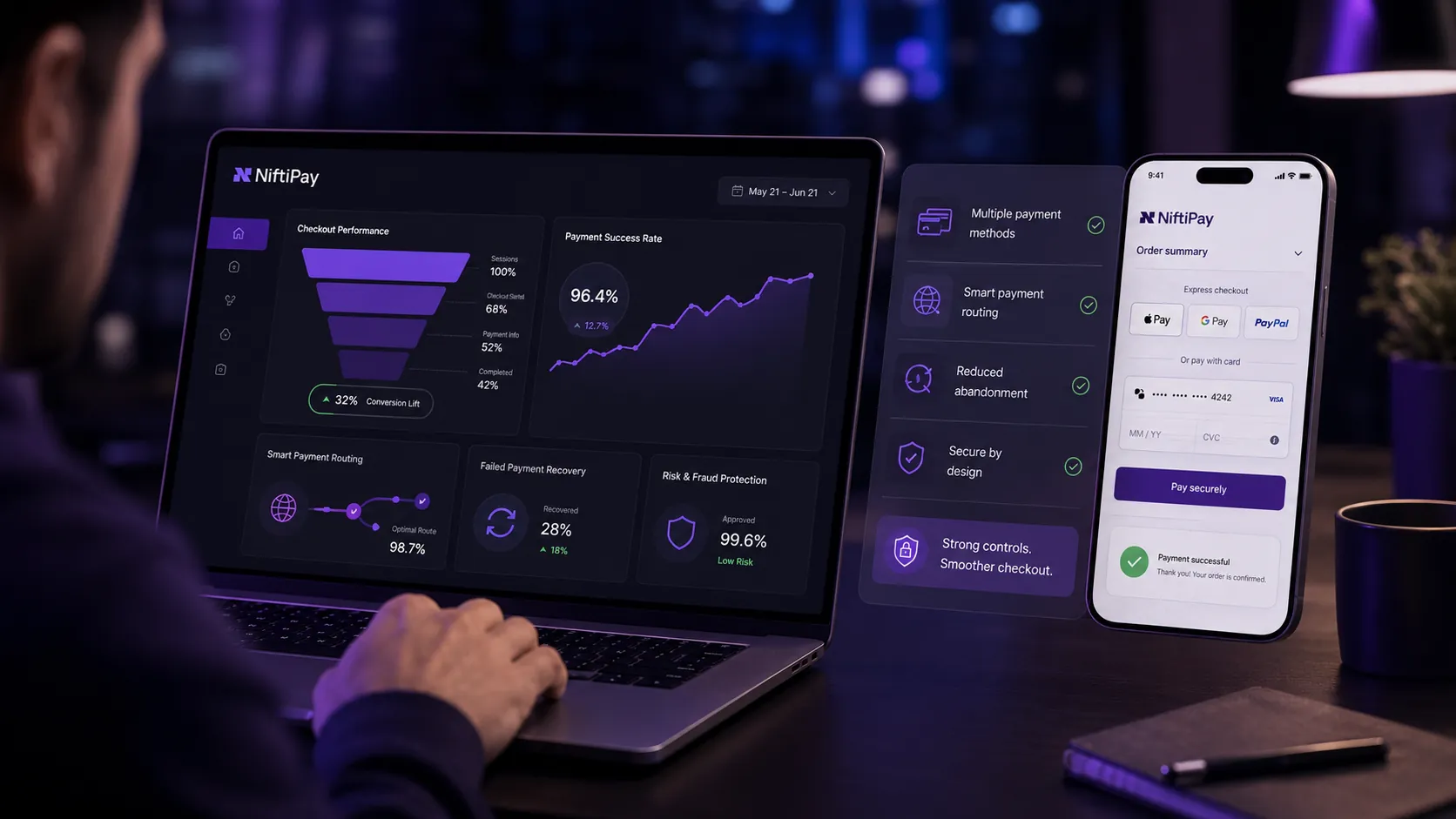
How to reduce payment abandonment without removing controls
The instinct under pressure is to loosen checks to push more payments through. For high-risk merchants that is the wrong trade — it invites chargebacks, reserves and account termination. The better path is to reduce payment abandonment by simplifying everything that is not a control:
- Keep verification and authentication, but run them at the right moment and explain why they are happening.
- Cut non-essential fields and pre-fill what you safely can.
- Make security visible rather than hiding the work.
- Keep customers on a branded, consistent surface instead of jarring redirects.
A customer who understands why a check is happening is far more likely to complete it than one who hits an unexplained wall. Regulated checks such as Strong Customer Authentication are non-negotiable, but how you present them is within your control.
Which payment methods should you offer?
Method choice is one of the strongest levers in high-risk checkout conversion. When a customer’s preferred option is missing, many will not switch — they leave. A practical mix for complex commerce often spans three categories:
- Cards, still the default for most buyers, supported by sensible retry and routing logic.
- Crypto, useful where card coverage is patchy or cross-border friction is high.
- Stablecoins, which add settlement predictability for international and high-value flows.
The point is not to offer everything, but to offer the methods your specific audience expects. Reviewing alternative payment methods for high-risk merchants helps you match options to real customer behaviour rather than guessing.
Authentication is the other half of this. How 3D Secure and SCA affect approval rates, and where the friction can legitimately be removed, is covered in our guide to 3D Secure and SCA for high-risk payments.
How payment routing and backup options support conversion
Payment routing decides which processor or acquirer handles each transaction, and gives you a fallback when one path is unavailable. It will never guarantee approval, and any provider promising that should be treated with caution. What good routing does is reduce avoidable losses — sending traffic down the path most likely to succeed and retrying intelligently when it does not.
For merchants who outgrow a single provider, a multi-processor setup adds redundancy so one outage or restriction does not stop the checkout. Our guide to high-risk payment routing covers how to structure this without over-engineering it.
How to improve payment decline UX
Declines are inevitable in high-risk processing, so the payment decline UX matters as much as the decline rate — a failed payment should never be a dead end. Aim for:
- Clear error messages in plain language — what happened and what to try next, without exposing risk logic.
- Alternative payment methods offered immediately, so a card failure becomes a crypto or stablecoin success.
- Retry logic that re-attempts sensibly rather than hammering the same path.
- Customer guidance, such as prompting to check details or contact their bank.
Checkout conversion checklist for high-risk merchants
Use this as a quick audit of your own flow:
- Clear payment method options that match your audience.
- Minimal unnecessary steps and fields.
- Visible trust and payment reassurance at the point of payment.
- Strong but proportionate controls — never weakened for the sake of speed.
- A defined payment routing strategy with fallbacks.
- Alternative payment options ready when a primary path fails.
- Clear failed payment recovery and retry guidance.
- Settlement and payment status visibility, so you both know where each payment stands.
Most of the friction described above lives in the card flow, where a hosted card checkout keeps the payment page consistent instead of asking the merchant to rebuild it for every method.
How Niftipay helps reduce checkout friction
Niftipay is structured payment infrastructure for complex and high-risk commerce. Rather than bolting together separate tools, it brings card, crypto and stablecoin flows, routing logic, status visibility and operational control into one payment layer — so you can reduce friction without loosening a single control. Our overview of payment infrastructure for complex commerce is a good starting point.
Reduce friction, keep control
High-risk checkout conversion improves when friction is removed intelligently, not when controls are removed. Map your flow, offer the right payment methods, route with sensible fallbacks, and turn every decline into a clear next step. Do that with proper infrastructure behind it and you protect conversion and compliance at the same time.
FAQ
What is high-risk checkout conversion?
It is the rate at which customers in high-risk or complex verticals complete a payment, given the extra constraints those merchants face — risk review, compliance checks, method limits and processor restrictions.
Can I improve conversion without weakening fraud checks?
Yes. Most checkout losses come from confusing steps, missing payment methods and poor failure handling — not from the controls themselves. Fixing the experience around the controls lifts conversion without raising fraud risk.
Does payment routing guarantee more approvals?
No. Routing and a multi-processor setup reduce avoidable losses and add fallbacks, but no legitimate provider can guarantee approval — treat any such promise as a warning sign.
Which payment methods reduce abandonment for high-risk merchants?
It depends on your audience, but a mix of cards plus crypto and stablecoins gives customers real choice and a fallback when a card path fails.
How does Niftipay help with checkout friction?
Niftipay provides structured payment infrastructure — card, crypto and stablecoin flows, routing and payment status visibility — so high-risk merchants can simplify checkout while keeping controls intact.