

Alternative payment methods for high-risk merchants are not a fallback — they are the operating model. iGaming, forex, adult, dating, nutraceutical and crypto-exchange businesses lose checkouts the moment a single rail goes down, so a stack that pairs cards, crypto, stablecoins and bank transfers has become the baseline for staying online and paid. This guide compares the four rails, side by side, on conversion, settlement speed, fees and failure modes.
Mainstream processors keep tightening their underwriting, and high-risk MCCs are first to feel it. Reserves grow, payouts slow, and a single MID freeze can dry up cash flow for months. Mixing the right rails is what keeps revenue moving when one of them stalls — and the right mix depends on geography, vertical and how much treasury complexity the finance team can absorb.
What are alternative payment methods for high-risk merchants?
The term covers any payment rail outside the default Visa/Mastercard checkout that a restricted merchant uses to collect revenue, settle funds or pay suppliers. In practice that means four families: card networks routed through a high-risk acquirer, crypto payments on public blockchains, stablecoin settlement in USDC, USDT or EURC, and bank transfers via SEPA, SWIFT, ACH or local instant schemes. Each rail trades a different combination of conversion, cost, speed and regulatory exposure.
Why high-risk merchants need alternatives
Single-rail stacks fail predictably. Card-only checkouts collapse when an acquirer triggers a reserve hold or pulls a Merchant ID after a chargeback spike. Crypto-only checkouts lose every shopper who will not paste a wallet address. Bank-transfer-only flows convert at a fraction of card rates. High-risk alternative payments exist to spread that operational risk across rails that fail for different reasons.
Approval volatility and rolling reserves
Specialist acquirers price high-risk MCCs with rolling reserves of 5%–15% held for 180 days. That trapped capital becomes a working-capital problem fast for any merchant growing past a few hundred thousand euros a month. A second rail — stablecoin settlement or instant bank transfer — keeps liquidity flowing while the reserve drains on its own schedule. We have already mapped what underwriters actually look at before they sign off a high-risk merchant, and the reserve schedule is rarely the first thing they negotiate on.
Geographic and currency friction
Cards convert well in the US, EU and UK, but approval rates fall sharply in parts of LATAM, Africa and Southeast Asia, where local schemes and shopper habits favour bank push, e-wallets or crypto. Payment methods for restricted businesses operating across these corridors typically blend a multi-currency card acquirer with a stablecoin off-ramp so payouts and refunds clear without correspondent-bank delays.
Card payments: the conversion baseline
Card acquiring still wins on checkout conversion for most B2C high-risk verticals. Shoppers know the 16-digit flow, refunds are automatic, and 3D Secure shifts fraud liability away from the merchant. The trade-off is cost and fragility: interchange plus scheme fees, MCC-based pricing, rolling reserves and the ever-present risk of a MID review. Cards remain the rail that earns the first sale; what they rarely do well is move the money out cleanly.
Crypto alternative payment methods
Crypto rails on Bitcoin, Ethereum, Tron and Solana let customers pay without a bank intermediary, which matters in markets where carded checkout fails or where the shopper actively prefers crypto. Approval is binary — the chain confirms or it does not — so chargebacks effectively vanish. The friction sits elsewhere: volatility on non-stable assets, on-chain confirmation times, and the operational lift of running wallet custody. When the question moves from should we accept crypto to which provider can actually run the volume, we have written about what separates a serious crypto-friendly processor from a marketing landing page.
Stablecoin payments: the treasury workhorse
Stablecoin payments in USDC, USDT and EURC strip the volatility out of crypto while keeping the speed. Settlement clears in minutes, fees are predictable, and a stablecoin balance can be held, hedged or off-ramped to fiat on demand. For cross-border B2B payouts to affiliates, suppliers and partner gateways, stablecoins outperform SWIFT on both cost and timing. The deeper read sits in our look at the operators currently moving real volume through USDC and USDT settlement. Stablecoin issuance and reserves are now well-documented public infrastructure — see the stablecoin overview on Wikipedia for the regulatory backdrop.
Bank transfers: slow but resilient
SEPA in Europe, SEPA Instant, UK Faster Payments, US ACH/Wire and local instant schemes (Pix in Brazil, UPI in India) round out the alternative payment methods for high-risk merchants. Conversion at checkout is lower than cards because shoppers must authenticate inside their bank, but the cost is minimal and chargeback exposure is near zero. Bank transfers are also the most resilient B2B payout rail when card networks or crypto off-ramps wobble.
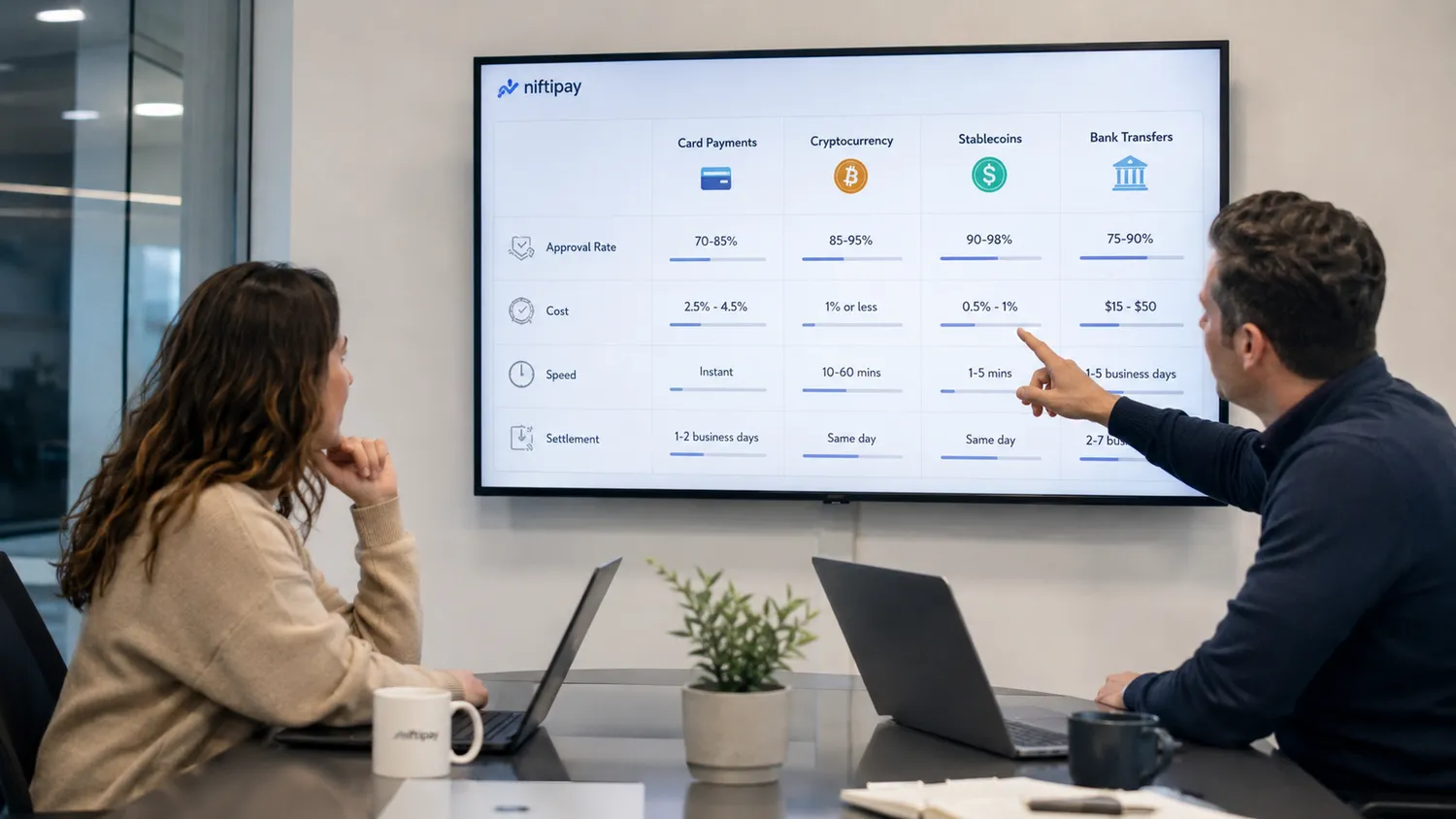
Cards, crypto, stablecoins and bank transfers compared
| Rail | Best for | Settlement | Typical cost | Failure mode |
|---|---|---|---|---|
| Card acquiring | B2C checkout, conversion | T+2 to T+5, rolling reserve | 2.5%–6% + scheme fees | MID freeze, chargeback ratio |
| Crypto (BTC, ETH, TRX, SOL) | Crypto-native customers, no-chargeback B2C | Minutes to 1 hour | 0.5%–1% + network fee | Volatility, wallet key risk |
| Stablecoins (USDC, USDT, EURC) | Treasury, cross-border B2B payouts | Same day | 0.5%–1% | Off-ramp limits, issuer risk |
| Bank transfer (SEPA, ACH, Pix, UPI) | B2C in non-card markets, B2B payouts | Seconds to 2 business days | Flat fee or < 0.5% | Lower checkout conversion |
Choosing between methods is one question; choosing between providers is another. If the immediate problem is that a mainstream processor will not support the category, see Stripe alternatives for high-risk merchants, and for the buy-now-pay-later end of the market, alternatives to Klarna.
How to choose the right mix
The right combination is rarely all four rails at full strength. Most high-risk merchants run cards as the primary B2C rail, stablecoins as the treasury and B2B payout rail, and a regional bank transfer or crypto option layered in for markets where card approval drops. The right starting point is auditing where conversion bleeds today — geography, currency, MCC — and matching each gap to a rail that solves it. For the layer underneath the routing logic, we have unpacked how the merchant account itself is actually built for an online high-risk operation, reserves and all.
Routing logic, not parallel checkouts
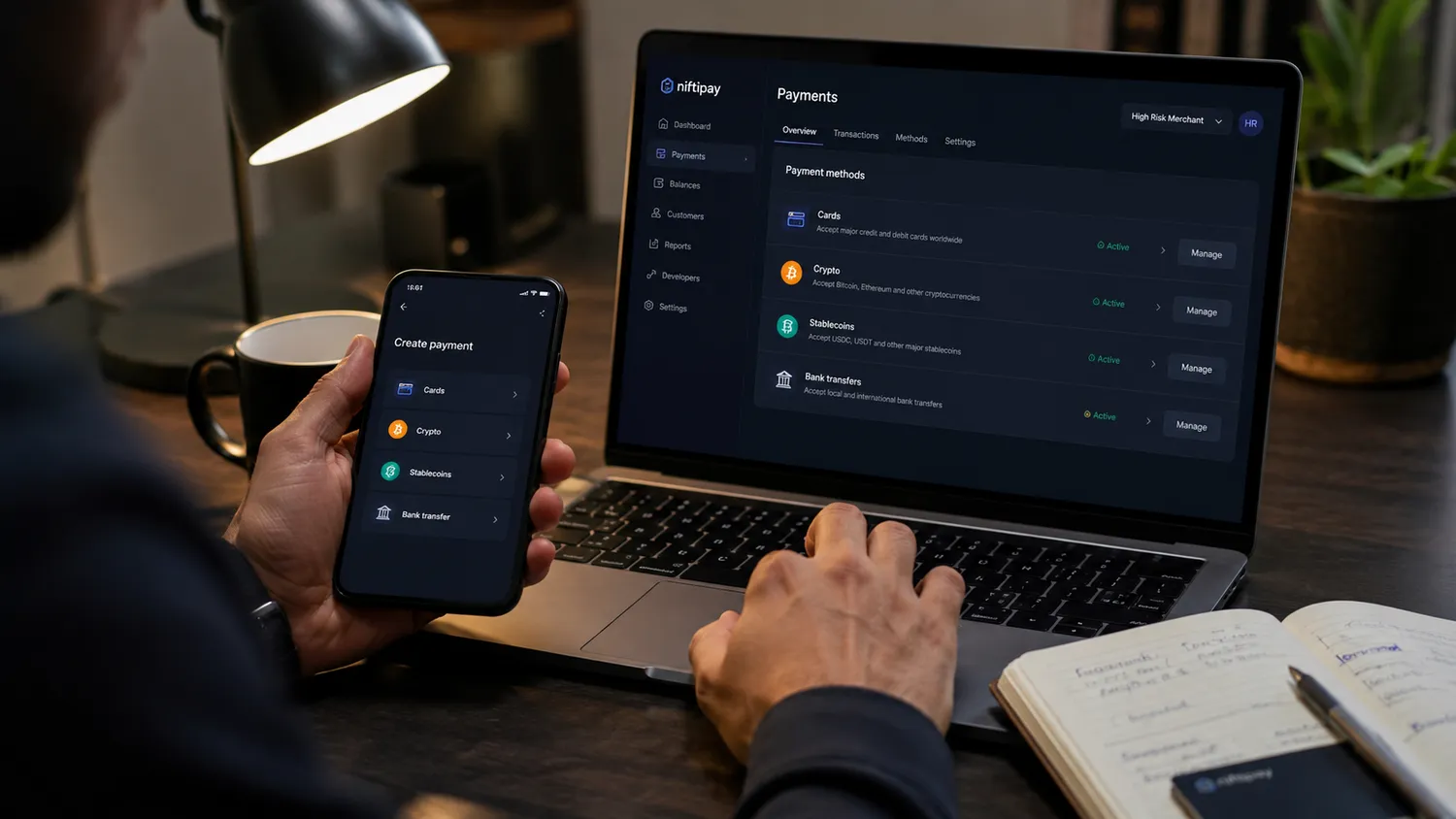
Bolting four standalone checkouts onto a site is the wrong answer. One routing layer that decides per transaction — cards first, crypto second, bank transfer third by geography — is what keeps the experience clean and the back-office reconcilable. Niftipay covers the card and crypto part of that mix: Visa and Mastercard, Apple Pay and Google Pay where supported, and supported cryptocurrencies and stablecoins, with payment status visible in one merchant dashboard. It does not route transactions between providers or process bank transfers, so any routing logic stays in the merchant’s own stack. Before the next acquirer review cycle hits, open a Niftipay merchant account to see which card and crypto payment methods are available for your business.
Stop choosing rails, start designing the stack
The merchants that survive long-term in high-risk stop framing the question as which payment method. They frame it as what mix, then they build the routing logic so no single rail becomes the single point of failure. Walk through the production view of the hybrid stack if you want to see the setup in motion — same dashboard, four rails, one reconciliation layer.
FAQ on alternative payment methods for high-risk merchants
1. What counts as an alternative payment method for a high-risk merchant?
Any rail outside the default Visa/Mastercard checkout that a restricted merchant uses to collect or settle funds. In practice that means crypto, stablecoins (USDC, USDT, EURC) and bank transfers via SEPA, ACH, Pix or UPI, alongside specialist high-risk card acquiring.
2. Which alternative payment methods convert best at checkout?
Cards still lead B2C conversion in the US, EU and UK. In markets where carded checkout is weaker — parts of LATAM, Africa and Southeast Asia — local instant bank transfers and crypto outperform, which is why most high-risk stacks route by geography.
3. Are stablecoin payments legal for high-risk businesses?
Yes, when settlement runs through licensed counterparties — a VASP, e-money institution or regulated stablecoin issuer — and the merchant maps AML, KYC and travel-rule obligations end to end. Stablecoin payments do not create a new regulatory category; they inherit the rules of the rail underneath.
4. How quickly can a merchant add a second payment rail?
With a hybrid-ready provider, a second rail — crypto, stablecoin or instant bank transfer — plugs into the existing checkout in days, not months. The primary acquirer stays in place; the gateway adds routing logic and a unified reporting view.
5. Will alternative payment methods rescue a frozen MID?
Not the funds already inside the reserve. What a second rail does is keep new revenue flowing while the merchant rebuilds card acquiring elsewhere, shrinking the cash-flow gap during a freeze from months to days.