
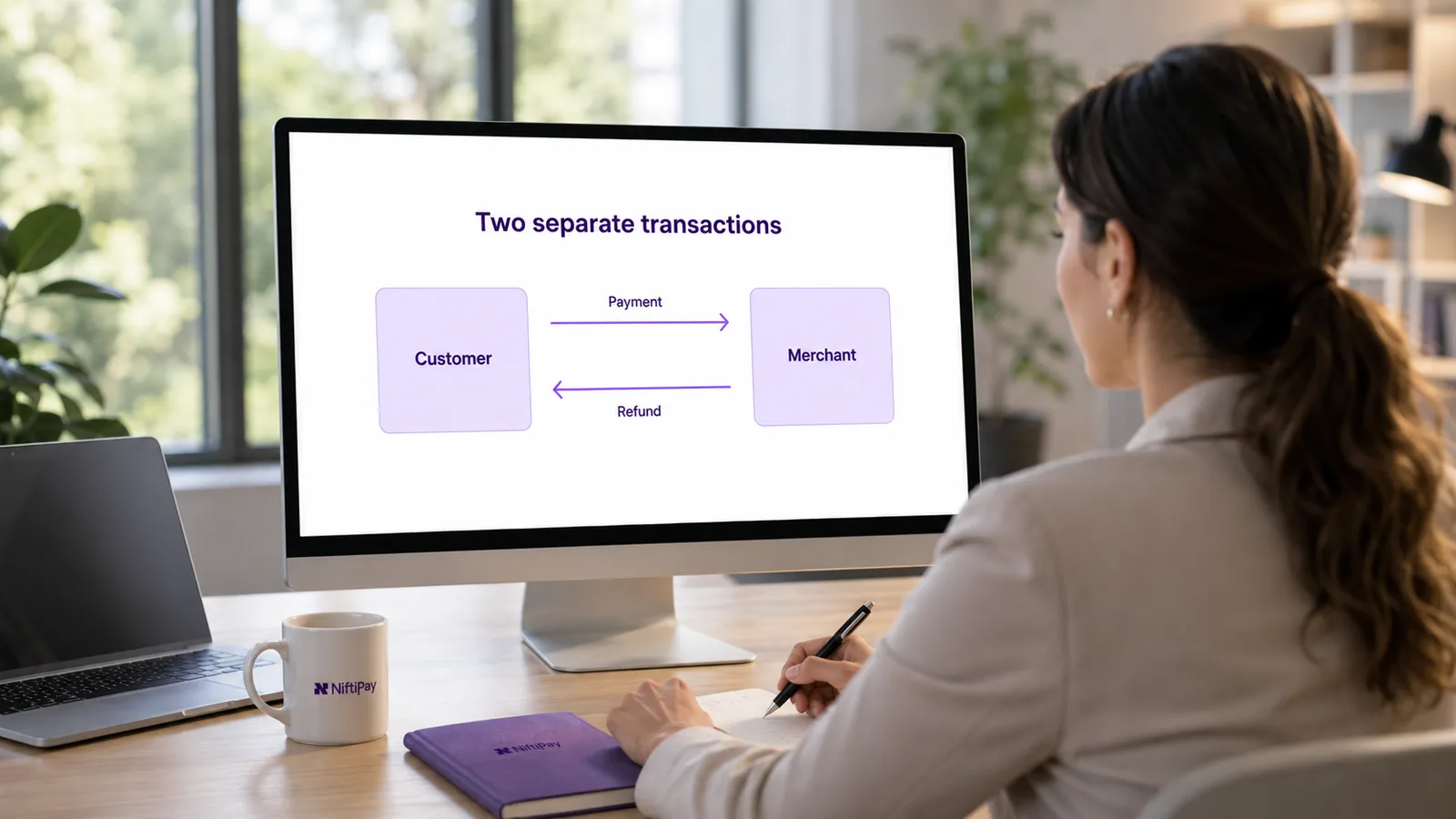
Crypto payment refunds are possible, but they do not work the way a card refund works. A merchant cannot reverse a blockchain transaction. What a merchant can do is send a new transaction back to the customer, under its own refund policy, to an address the customer provides.
That single difference drives everything else. The customer has to supply a wallet address, the asset and network have to match, the network charges a fee, and on some chains a small balance cannot be moved at all. This guide covers what a merchant needs before issuing a refund, what the customer actually receives, why network mechanics change that figure, and what to record afterwards.
Are crypto payments refundable?
Yes, within conditions. A crypto payment can be refunded when the merchant’s own policy allows it, the customer has supplied a valid destination address, and there are funds available to send. What cannot happen is the undoing of the original payment: once a blockchain transaction is confirmed, no merchant, wallet or payment provider can reverse it.
Confusing those two statements is the most common mistake merchants make when writing a first crypto refund policy. Irreversibility is a property of the network, not a limit on the merchant’s ability to return money. The practical version is short: funds are not returned automatically to the wallet that paid, the customer normally has to provide a valid wallet address, and network conditions and fees affect the amount that arrives. Those three points are the whole of the operational difference, and they are why crypto acceptance needs its own refund procedure rather than a copy of the card one.
A crypto refund is a new transaction, not a reversal
When a customer pays a crypto invoice, value moves from their wallet to the address shown for that order. A refund moves value the other way, to an address the customer nominates: two transfers, two entries in the ledger.
That is why a crypto refund needs information a card refund never asks for. A card refund is issued against the original payment and the issuing bank credits the card used, so the destination is already known. A blockchain refund has no such memory, and sending funds back to the address that paid is frequently the wrong move.
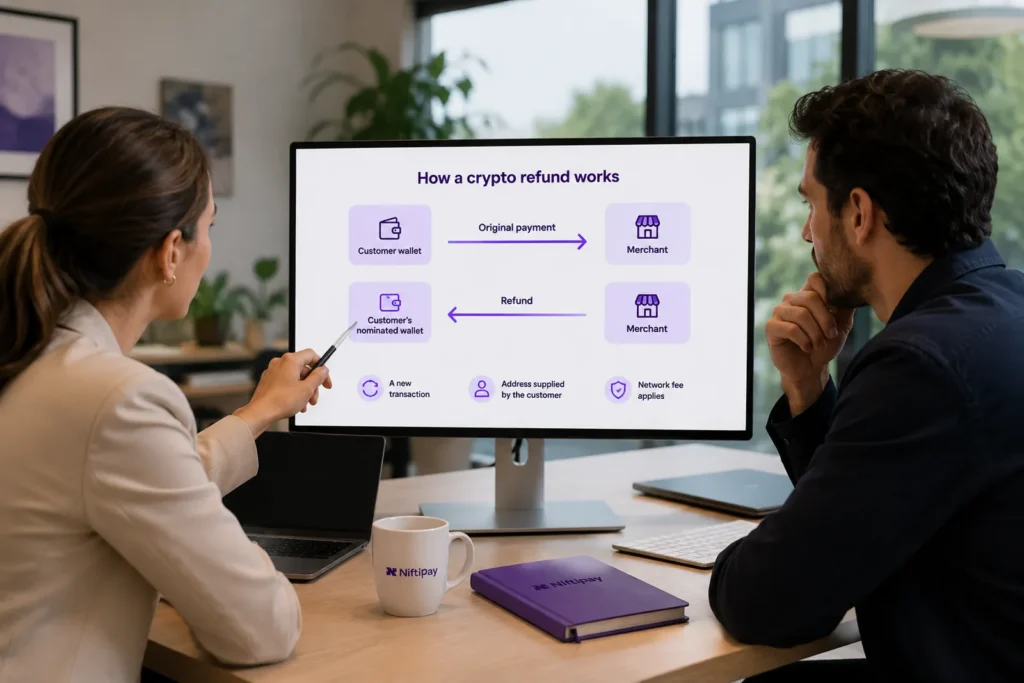
How a crypto payment refund works, step by step
The sequence below is the one most merchants converge on. It is deliberately procedural, because almost every crypto refund complaint comes from a step being skipped rather than from anything going wrong on the network.
- Confirm the refund is due and authorised. Check the order against your own refund policy, confirm it has not already been refunded, and record who approved it.
- Request a refund address from the customer. Ask in writing through your support channel and record it against the ticket. Do not infer it from the blockchain.
- Confirm the asset and the network. The refund goes out on the same network the payment arrived on, in the same asset.
- Verify the address before anything is sent. Read it back to the customer or require confirmation from the account the order was placed under.
- Work out what will actually arrive. The network fee, and any minimum balance the network requires, reduce the amount that reaches the customer.
- Send the refund and capture the reference. Keep the transaction reference or hash with the order record as soon as it is available.
- Confirm to the customer and book it. Tell them the amount, the network and that confirmation time depends on the network, then record the refund against the original order.
No part of that flow is automatic or instant. A person authorises it, the customer supplies the destination, and the network decides how quickly the transfer confirms. Building the process around that assumption avoids the two failures that actually hurt: money sent to an address nobody can recover it from, and a customer told to expect a figure that was never going to arrive.
Why the customer may not receive the exact amount originally sent
A crypto refund is a transaction, and transactions cost money on the network. What leaves the merchant is a net amount once the rules of the relevant network are applied. Two effects move that figure, and a third changes how it looks in the accounts.
The network fee. On native coins the fee normally comes out of the same balance being returned, so the customer receives slightly less than the amount originally paid. Tokens work differently: a token transfer pays its fee in the network’s own coin rather than in the token, so the token amount and the fee are accounted for separately. That distinction matters for anyone handling stablecoin payments such as USDT, where the two sit in different columns of the ledger.
Minimum balances. Some networks require an account to retain a minimum balance to stay usable. Where that applies, the minimum is held back rather than sent, and the customer receives the remainder.
The asset, not the fiat amount, is what comes back. Where prices are displayed in fiat and converted at the checkout, the customer pays in the asset and the refund returns that asset. The fiat equivalent of what arrives can therefore differ from its value at the time of purchase, in either direction. Explain that before the refund is sent, not afterwards.
What a refund address is and why it must come from the customer
The refund address is the destination the customer nominates and the merchant sends to. Without one there is nothing to send to, which is why it is the first thing a support team should collect rather than the last.
There is a strong reason not to guess it. The address that sent the payment is often not a wallet the customer controls: payments regularly arrive from exchange withdrawal addresses and custodial accounts, and value sent back to one of those may not reach the customer at all.
- Match the network. Funds sent through an incorrect or unsupported network may be unrecoverable, and that applies to money leaving the business as much as to money arriving.
- Match the asset. A customer asking for a different coin is asking for a conversion, which is a separate commercial decision.
- Verify before you send. A broadcast transaction cannot be recalled. Read the address back, or require confirmation from the account the order was placed under.
- Keep the evidence. Store the address supplied, when, and who processed the refund. This is the record that resolves the dispute six weeks later.
Dust, gas and network reserves: why small refunds can fail
Network mechanics differ from chain to chain, and the differences show up most sharply on small amounts. Merchants are usually surprised the first time a genuinely small refund cannot be sent at all. Four terms explain most cases.
- Network fee. What the chain charges to include a transaction in a block. On Ethereum this is called gas, and it is paid in ETH regardless of which token is moving.
- Dust. An amount so small that moving it would cost more in fees than it is worth.
- Rent reserve. On Solana, the minimum balance an account holds to remain open.
- Account reserve. On the XRP Ledger, the minimum an account must hold to exist at all.
A small refund is therefore not a smaller version of a large one. On a low-value order the fee and any minimum balance can absorb most of what remains, and a transfer that would not confirm is better refused than attempted. Decide the remedy in advance: store credit, a replacement item or an adjustment on a future order, each subject to your own terms and to applicable consumer law.
Crypto refunds compared with card refunds
Merchants running both rails need to keep the two processes separate in their documentation. The differences are structural rather than a matter of degree, and they land on the people who write the policy and answer the tickets. Neither rail is universally better.
| Area | Card refund | Crypto refund |
|---|---|---|
| Is the original transaction reversed? | No. A credit is issued against the original payment through the same payment flow | No. A separate outbound blockchain transaction is sent |
| Destination | The card used for the original payment | A wallet address the customer supplies |
| Who identifies the destination | The payment flow already holds it | The customer provides it and the merchant has to verify it |
| Amount the customer receives | The amount issued, subject to the card process | Can be reduced by the network fee and by any minimum balance the network requires |
| Dispute route | Customers can raise a chargeback through their card issuer | No equivalent customer-initiated route, because a confirmed blockchain payment cannot be reversed |
| Timing | Depends on the issuing bank and the card network | Depends on network confirmation rather than a fixed schedule |
| Reconciliation | Matched against the original payment record | Recorded as two separate transactions against the same order |
The dispute row is the one that reshapes workflows. A card merchant budgets for chargebacks and for defending them. A crypto merchant has no incoming dispute channel to defend, and instead carries the burden at the other end: getting the address right, explaining the delivered amount and keeping the two transactions matched. Our guide to payment settlement and merchant payouts covers where refunds sit in the wider settlement picture.
What belongs in a crypto refund policy
These are operational points to work through with whoever drafts your terms, rather than legal advice. Most crypto refund complaints trace back to one of them being unwritten.
- Eligibility. Which orders can be refunded, within what window, and on what evidence.
- Destination wallet. That the refund goes to an address the customer supplies and confirms, not back to the wallet that paid.
- Asset and network. That the refund is returned in the asset and on the network of the original order.
- Network fees and reserves. That the amount delivered can be lower than the amount paid.
- Expected amount. That the refund is returned in the asset, so its fiat equivalent may differ from the value at the time of purchase.
- Small balances. What happens when the amount is too small to send on-chain, and what alternative you offer.
- Incorrect addresses. Where responsibility sits if the customer supplies an address they do not control, or one on the wrong network.
- Process and timing. Who approves a refund internally, and that on-chain timing depends on the network.
- Confirmation and support. What the customer receives as proof, and how to raise a problem.
Reconciliation deserves its own line. Book the original payment and the refund as two separate transactions against the same order rather than netting them into one, and record the original payment transaction hash and the refund transaction reference or hash where available. That is what lets finance explain a balance that no longer matches the order value, and the same discipline keeps crypto processing costs traceable at the end of a quarter.
Where Niftipay fits
Niftipay supports card and crypto payments for eligible merchants. Merchants accepting crypto should define their refund, customer-communication and reconciliation processes before going live, because those processes are the merchant’s own and sit outside any payment method. Availability and configuration depend on the merchant’s approved setup.
Merchants running both rails, as covered in our guide to a crypto and fiat payment processor, should keep two refund procedures rather than one. The destination, the amount the customer ends up with and the message support has to deliver all differ, and a single procedure written for cards will be wrong on every one of those points.
Crypto payment refunds FAQs
Can a crypto transaction be refunded?
The payment itself cannot be undone, but the merchant can send the money back. A crypto refund is a new transaction to an address the customer provides, issued under the merchant’s own refund policy rather than by reversing anything on the blockchain.
Does a crypto refund reverse the original transaction?
No. The original transaction stays confirmed on the blockchain permanently. The refund is a second transaction moving value the other way, and both should appear separately in your records.
Who pays the network fee on a crypto refund?
The network charges a fee for the outbound transfer. On native coins it normally comes out of the balance being returned, so the customer receives slightly less than the amount originally paid. Token transfers pay the fee in the network’s own coin instead, so the token and the fee are accounted for separately. A merchant that intends to absorb the fee should say so in its refund policy.
Can I refund a USDT payment?
Stablecoin payments are refunded the same way as any other crypto payment: as a new transaction to an address the customer supplies, on the same network the payment arrived on. The refund address has to be valid for that network, and because a token transfer pays its fee in the network’s own coin, the accounting differs slightly from a native-coin refund.
What happens if the refund amount is too small?
It may not send. Networks have a minimum viable transfer size, and some require an account to keep a minimum balance, so on a low-value order the fee and that minimum can absorb most of what is left. The merchant then needs a remedy off the chain, such as store credit or an adjustment on a future order, subject to its own terms and to applicable consumer law.
Do I need the customer’s wallet address to refund a crypto payment?
Yes. A refund needs a destination address, and there is no automatic return to the wallet that paid. Ask for an address the customer controls on the correct network, confirm it in writing, and keep that confirmation with the order record.