
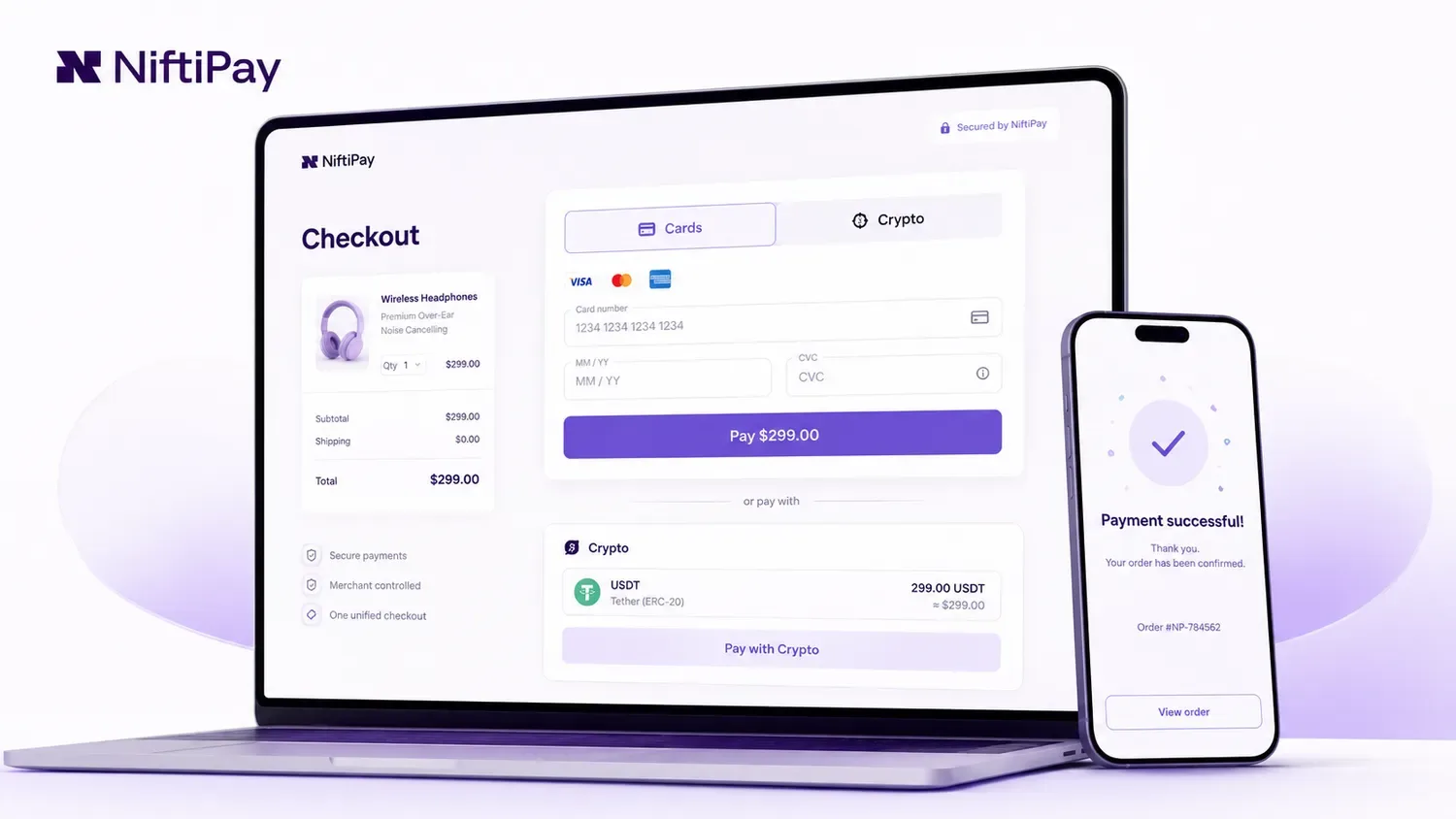
Many merchants do not only need to accept crypto. They need a payment layer that can connect card payments, crypto payments, stablecoin settlement, transaction visibility and operational control without forcing the business to juggle disconnected providers. That is the real promise behind a modern card and crypto payment gateway: not just one extra checkout button, but a single infrastructure that helps you process, monitor and settle payments across methods.
If you are evaluating providers, the right question is no longer “card or crypto”. It is whether your payment setup can grow with the business — across countries, currencies, customer preferences and risk profiles — without turning finance and operations into a full-time integration project.
What is a card and crypto payment gateway?
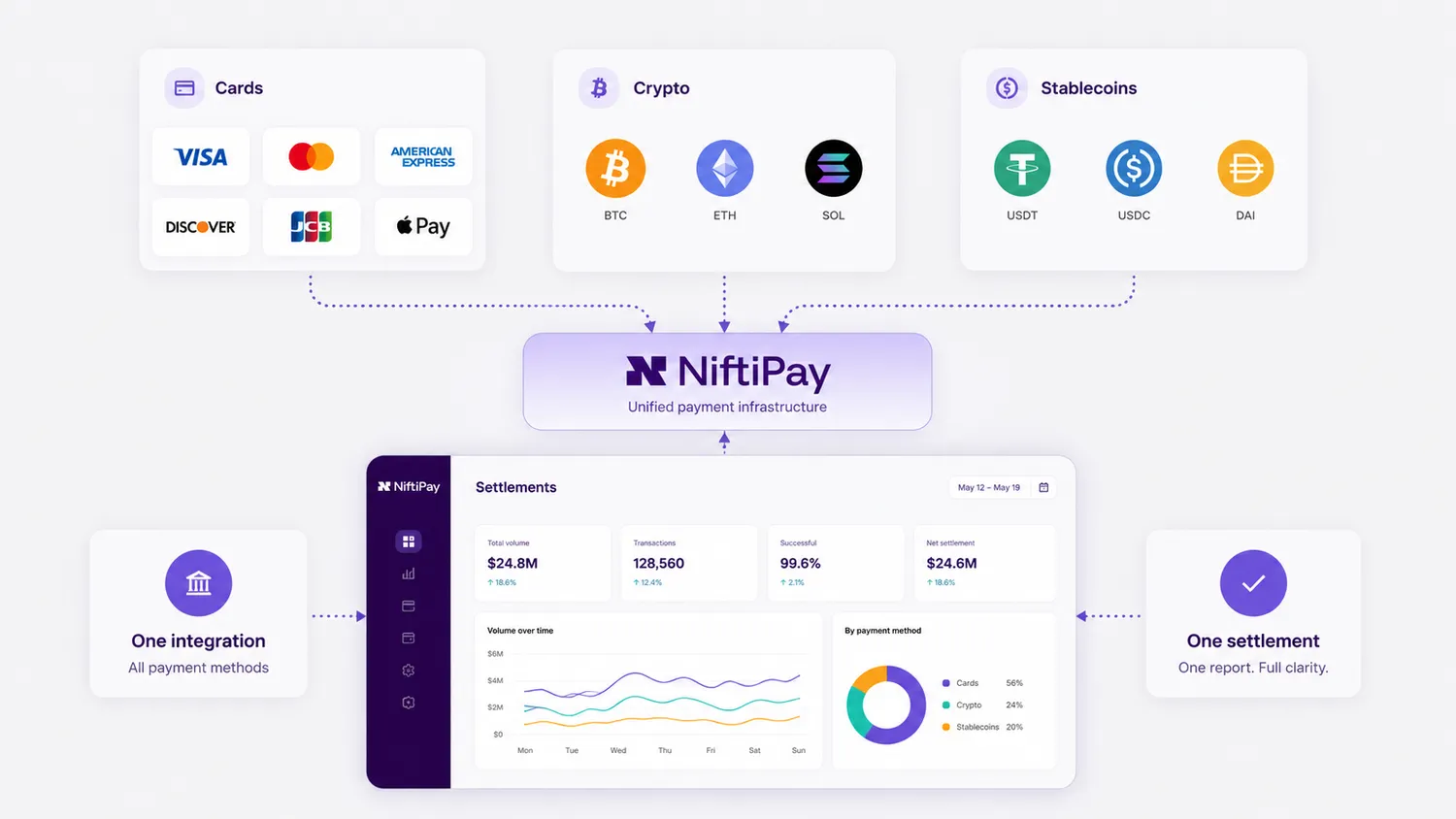
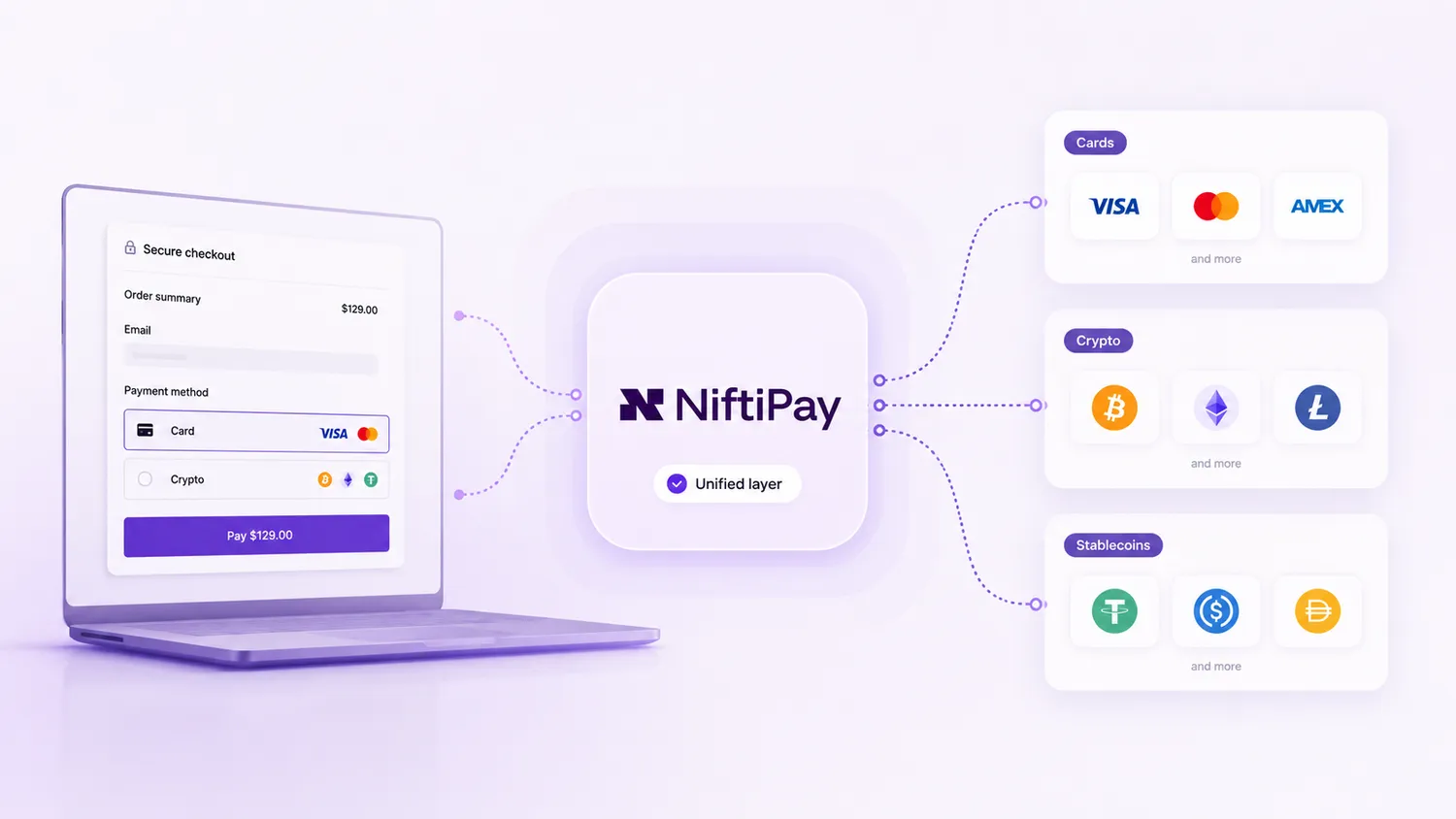
A card and crypto payment gateway is a payment infrastructure that lets merchants accept and manage card payments, crypto payments and, where applicable, stablecoin payment flows from a more connected back end. Instead of plugging in one provider for Visa and Mastercard and another for digital assets, the merchant works with a single layer that handles payment acceptance, transaction tracking, settlement visibility and reporting.
Operationally, that means fewer dashboards to monitor, fewer reconciliation steps at month-end and a clearer picture of how every payment moves from authorisation to settled funds. It is less about adding a method and more about reducing the operational cost of supporting several at once.
Why businesses often end up with separate payment providers
Most merchants do not plan to fragment their payment stack — it happens incrementally. The business launches with a card processor, then adds a crypto checkout when buyers start asking for it, then bolts on a stablecoin payout tool to deal with cross-border suppliers, and perhaps a separate gateway to handle a high-risk vertical the original provider would not approve.
Each step solves an immediate problem. The cumulative result, however, is a patchwork: different contracts, different fee structures, different reporting formats, different support teams. It works at low volume. It starts to bite when sales grow, when more countries come online, or when finance needs a single source of truth for revenue.
The problem with disconnected card, crypto and stablecoin flows
Disconnected flows tend to surface the same recurring frictions, regardless of vertical:
- Fragmented reporting across separate dashboards and exports.
- Transaction status that lives in different systems — approved here, pending there, refunded somewhere else.
- Settlement timelines that do not align, which complicates cash-flow planning.
- More manual work for finance teams reconciling card batches against crypto and stablecoin ledgers.
- Limited visibility into failed, pending, approved or settled payments at a portfolio level.
- Difficulty comparing fees, payout timing and actual customer payment preferences.
- Heavier engineering load whenever a new checkout, region or method is added.
None of these are catastrophic on day one. They quietly raise the cost of running the business, and they tend to grow faster than revenue.
When one payment layer makes more sense
Consolidating into a single card and crypto payment gateway is not a default recommendation — small, single-method merchants rarely need it. It tends to make more sense when the business:
- Sells to international buyers and needs a multi-currency payment gateway rather than ad-hoc FX workarounds.
- Needs to accept card and crypto payments side by side at checkout.
- Wants to include stablecoin settlement to reduce volatility or shorten payout cycles.
- Operates in complex or high-risk verticals where mainstream processors deny or restrict accounts.
- Needs reliable visibility on transaction status across methods, not just per provider.
- Wants to reduce reliance on manual reconciliation and CSV exports.
- Needs a cleaner integration story for checkout, platform or embedded payments.
If two or more of those points apply, a unified payment layer usually pays for itself in operational time, not just in processing fees.
How a unified payment gateway supports better transaction visibility
Visibility is where a unified payment gateway tends to earn its place. The merchant needs to know, at any moment, which payments are pending, approved, failed, refunded, settled or ready for payout — across cards, crypto and stablecoins. When that information sits in three different consoles, even good teams lose hours per week and accept blind spots they would not tolerate elsewhere.
A multi-payment infrastructure exposes those states through a consistent model. The status of a card authorisation and a stablecoin transfer is presented in the same vocabulary, so finance, support and operations can reason about them together. It also makes patterns easier to spot: which methods convert best by region, which fail most often, where chargebacks cluster, and where settlement is slow.
Cards, crypto and stablecoins: why merchants may need all three
Customer preferences are not uniform. Some buyers will only pay by card. Others, particularly in higher-ticket or cross-border purchases, prefer crypto. A growing share of B2B and platform flows is moving towards stablecoins because they combine the speed of crypto rails with a more predictable unit of account.
No method is universally better. Cards still dominate consumer checkout in most markets. Crypto can unlock buyers who are excluded from card rails. Stablecoins are useful where settlement timing and FX exposure matter more than the payment method itself. The point of combining them is to meet customers where they already are, while letting the merchant choose how to receive funds.
This guide is about how the two rails work together operationally. Merchants who are past that question and want to see the product side — what can be accepted through a single checkout, and what activation involves — will find it on the Niftipay solutions page, which covers card, crypto and stablecoin acceptance through hosted checkout, payment links and QR flows.
What to look for in a card and crypto payment gateway
Use the checklist below as a baseline when comparing providers. A real card and crypto payment gateway should cover most of it — not as marketing claims, but as features you can test during onboarding.
| Capability | What to verify |
|---|---|
| Card payment support | Major schemes, 3-D Secure, regional acquiring options. |
| Crypto payment support | Supported assets, networks and confirmation logic. |
| Stablecoin payment gateway | Which stablecoins, which chains, how settlement is handled. |
| Multi-currency support | Pricing, presentment and payout currencies. |
| Transaction status visibility | Unified statuses across methods, webhooks and dashboard. |
| Settlement reporting | Frequency, granularity, reconciliation files. |
| API-first integration | Documented endpoints, sandbox, idempotency, versioning. |
| Embedded checkout | Hosted, drop-in and fully custom UI options. |
| High-risk experience | Track record with the merchant’s vertical and geography. |
| Security controls | PCI scope, key management, fraud and chargeback tooling. |
| Support before integration | Real humans during scoping, not only after go-live. |
| Onboarding requirements | Clear KYB checklist, expected timelines, documentation list. |
Conversational and bot-driven sales are a case of their own, where the storefront is not a web page at all — see our guide to a bot payment gateway.
Use cases for a multi-payment infrastructure
The clearest fit for a multi-payment infrastructure is businesses where payment friction directly limits growth or operational clarity:
- High-risk ecommerce categories where mainstream processors are restrictive.
- Marketplaces that need to route payments across multiple sellers and methods.
- Subscription businesses with mixed billing currencies and recurring crypto buyers.
- Digital service providers selling to a global, payment-preference-diverse audience.
- International sellers exposed to FX volatility and slow cross-border settlement.
- Platforms with cross-border buyers who prefer stablecoins for larger purchases.
- Merchants that need card payments for retail flow and crypto or stablecoin settlement upstream.
- Businesses actively moving away from a stack of disconnected payment providers.
For these profiles, payment infrastructure is part of the product, not just a back-office cost. A more structured layer — sometimes complemented by payment orchestration — turns it into a real lever for conversion and margin. Vendors selling inside chat apps sit in the same bracket, where the checkout has to work within the conversation rather than on a web storefront — see payments inside a Telegram bot flow.
How Niftipay supports card, crypto and stablecoin payment flows
Niftipay is built as payment infrastructure for complex commerce: merchants and platforms that need to combine card, crypto and stablecoin payment flows under one operational umbrella. The focus is not on being yet another crypto-friendly payment processor, but on structuring how payments are accepted, monitored and settled across methods.
In practice, that includes API-first integration, embedded checkout compatibility, transaction visibility across methods, settlement support and the kind of operational control that complex and high-risk merchants tend to ask for. Niftipay is not a fit for every business — very small, card-only merchants are usually better served by a single mainstream processor. Where it tends to fit best is the moment a business is weighing whether to add a third or fourth provider just to support another method or geography.
Choose the payment layer before you add another provider
The instinct, when checkout starts straining, is to add. Add a crypto plugin. Add a stablecoin payout tool. Add a separate high-risk acquirer. Each addition feels small, until the day finance can no longer answer simple questions about cash flow without exporting from four systems.
The more useful move, before adding the next provider, is to decide what the payment layer should look like. Where do transactions live? Who owns settlement? How is status communicated across cards, crypto and stablecoins? Once that is clear, each new method becomes a configuration choice instead of a new silo. That is the gap a structured card and crypto payment gateway is designed to close.
If your business needs to accept card, crypto and stablecoin payments without managing disconnected providers, Niftipay can help you review a more structured payment setup.
FAQs
What is a card and crypto payment gateway?
It is a payment infrastructure that lets a merchant accept and manage card payments, crypto payments and, where supported, stablecoin payments from a single back end, with consolidated reporting and settlement.
Can one gateway support cards, crypto and stablecoins?
Some providers cover all three methods within a single platform. Coverage varies by asset, network and region, so it is worth confirming exact support during onboarding rather than assuming parity across methods.
Why do separate payment providers create operational issues?
Separate providers usually mean separate dashboards, settlement timelines and reporting formats. As volume grows, that fragmentation increases reconciliation work, reduces transaction visibility and slows decisions about pricing, routing and risk.
When should a business use a unified payment gateway?
A unified gateway tends to make sense when the business sells across borders, needs more than one payment method, operates in a complex or high-risk vertical, or wants a single view of transaction status and settlement across cards, crypto and stablecoins.
What should merchants check before choosing a card and crypto payment gateway?
Beyond fees, check supported assets and networks, settlement options, transaction status visibility, API quality, embedded checkout compatibility, experience with the relevant vertical and clear onboarding requirements.