
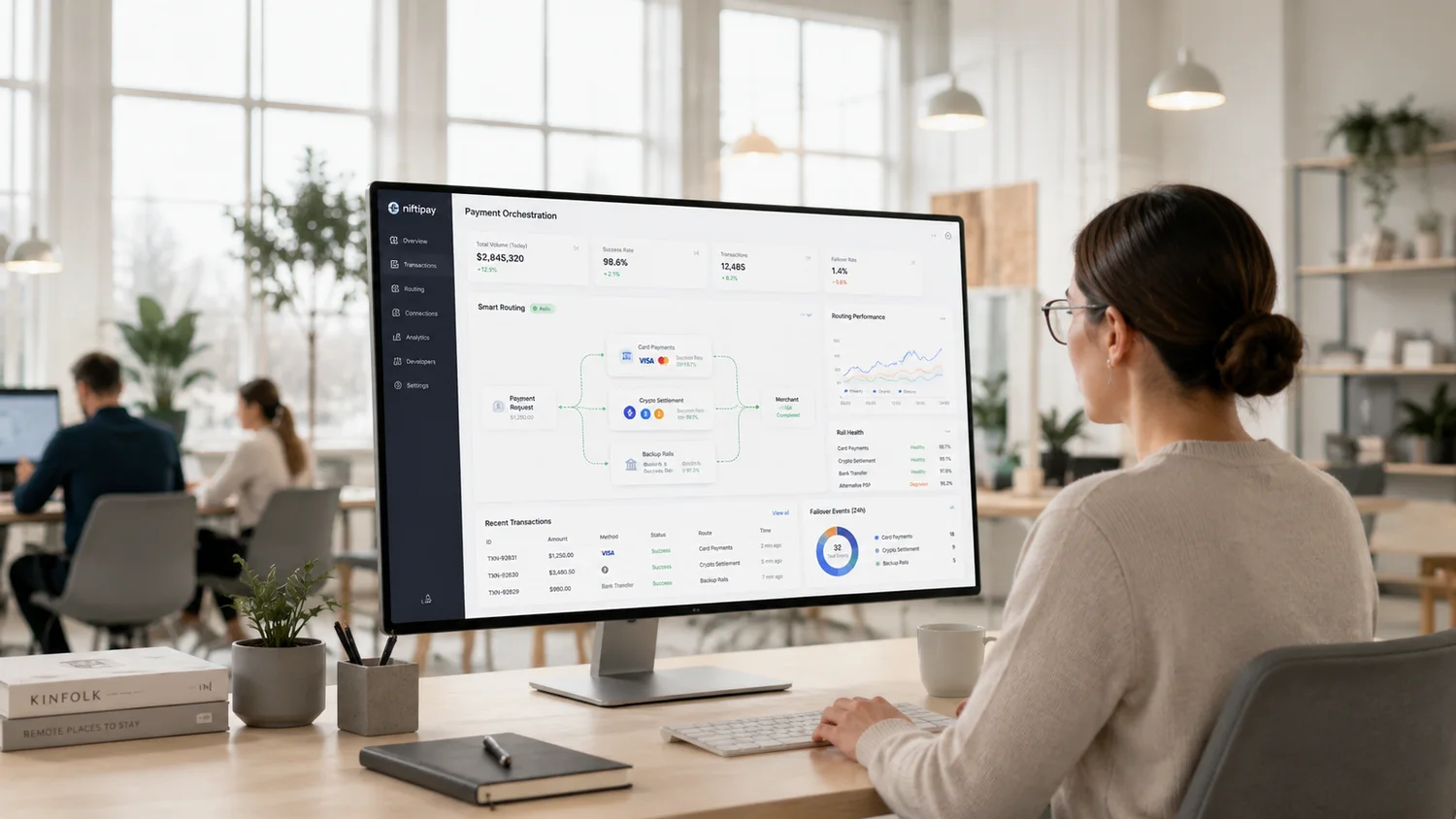
For a high-risk merchant, a single payment processor is a single point of failure. Payment orchestration for high-risk merchants reframes the problem: instead of relying on one acquirer or one gateway, the merchant routes each transaction through the rail with the best odds of approval at that moment, with backup payment rails standing by when the primary route stumbles. The result is fewer declines, less downtime and a finance stack that bends with regulation, geography and customer behaviour rather than breaking with them.
Why high-risk merchants outgrow a single payment rail
Industries classified as high risk — iGaming, forex and trading, adult and dating, nutraceuticals, crypto exchanges, subscription products with elevated chargeback exposure — carry approval profiles that traditional acquirers struggle to digest. Card schemes apply tighter chargeback thresholds, issuing banks decline borderline transactions more aggressively, and one suspended MID can knock out an entire revenue line.
Concentration risk is the quiet killer here. A merchant that processes every euro through one acquirer is one fraud spike, one MCC review, one cross-border block away from a frozen account. High-risk payment orchestration spreads volume across processors, rails and currencies, so any single failure becomes an inconvenience rather than an outage.
What payment orchestration for high-risk merchants actually does
A payment orchestration platform sits between the checkout and every downstream provider. It evaluates the transaction context — amount, currency, BIN, customer profile, risk score, geography, time of day — and chooses the best route in real time. If the primary route declines or times out, it falls over to a secondary acquirer or an alternative rail without bouncing the customer back to checkout.
The orchestration layer vs traditional gateway routing
A classic gateway sends every transaction to one acquirer through a fixed pipe. An orchestration layer maintains live connections to multiple acquirers, alternative payment methods, crypto rails and reconciliation engines, then applies routing logic on top. For high-risk merchants, that logic is what turns a noisy decline rate into a steady approval curve.
Combining cards, crypto and backup payment rails
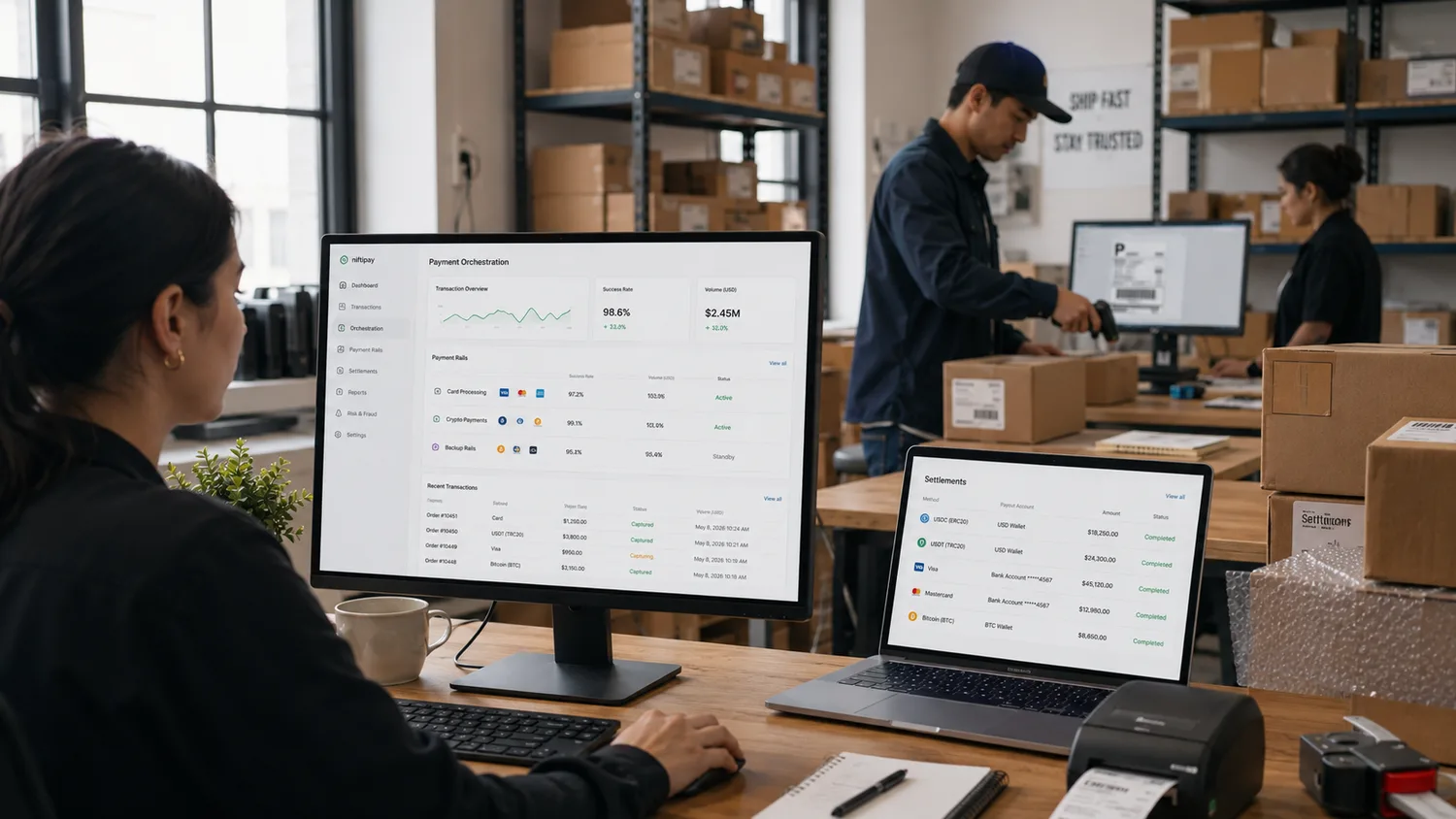
A modern multi-rail payment processing setup blends three categories of rails. Each one covers a different failure mode, and together they form a continuity plan rather than a wish list of providers.
Card rails — the primary acceptance channel
Visa and Mastercard still anchor most volume, even in high-risk verticals. The orchestration layer typically holds at least two card acquirers per region, ideally on different licensing structures and with different sponsor banks. When one acquirer’s risk team tightens limits, the secondary acquirer absorbs the spillover without the customer ever seeing a soft decline screen.
Crypto rails — stablecoin settlement as a secondary engine
For cross-border traffic, USDT and USDC settlement bypass the slow, expensive correspondent-banking chain that keeps cards from clearing in some jurisdictions. Crypto rails are not just a hedge: in regions where card penetration is thin or local interchange is punitive, they often become the most profitable channel.
Backup payment rails — staying open when something breaks
Backup payment rails are the contingency layer: open banking, local APMs, account-to-account transfers, regional schemes such as SEPA Instant or PIX. They activate when card networks throttle or a specific BIN range starts declining. The point is not to make them the primary route — it is to make sure the checkout never goes dark.
Smart payment routing for high-risk merchants
Routing is where orchestration earns its keep. Payment routing for high-risk merchants goes beyond simple fail-over: it predicts which route is most likely to convert before the transaction is sent. The smarter the routing, the higher the approval rate, and the lower the cost per successful transaction.
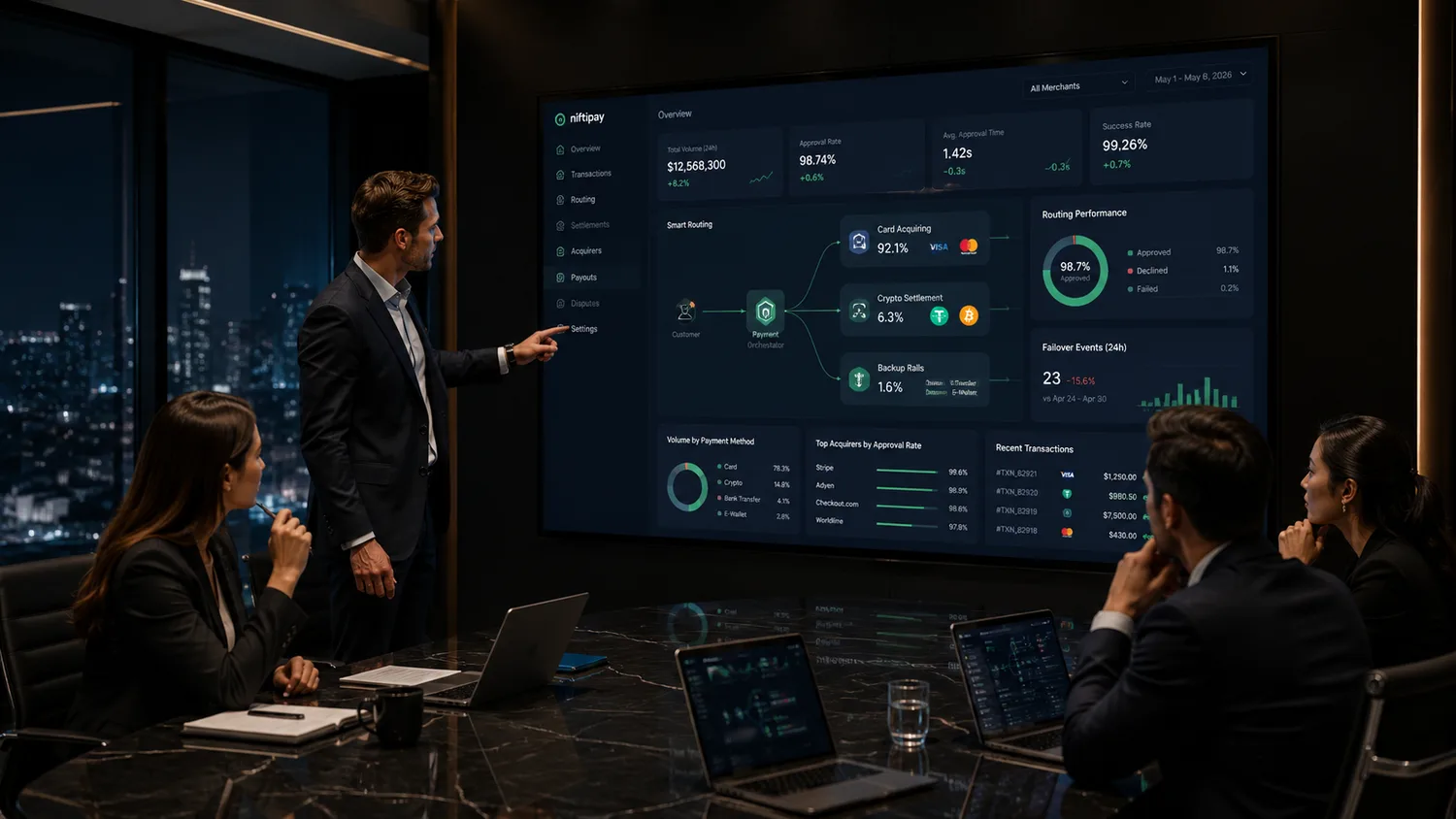
Routing rules that move the needle in high-risk verticals usually include:
- Issuer affinity: route to the acquirer with the best historical approval rate for that BIN.
- Currency and geography: keep transactions on local rails whenever the issuer is local, to avoid cross-border decline codes.
- Velocity and risk score: send low-risk volume to the cheapest acquirer; reserve the premium one for high-ticket or high-risk transactions.
- Health-aware fail-over: monitor each rail’s real-time decline rate and pull volume off any rail that crosses an internal threshold.
- Time-of-day rules: shift volume away from acquirers running batch maintenance windows.
A merchant moving from naive load-balancing to data-driven routing typically lifts approval rates by 3–8 points, with the upside concentrated in cross-border traffic. For an explainer of routing fundamentals before orchestration is layered on top, see our note on High-Risk Payment Routing.
Approval rates, redundancy and the business case
The numbers behind orchestration are straightforward. Every additional rail adds incremental approvals on the transactions a single acquirer would have declined. Every fail-over event saved is revenue that would have churned to a competitor. And every diversified MID lowers the probability that one risk review takes the whole operation offline.
The cost case is just as direct. Routing low-risk volume to the cheapest acquirer compresses average interchange and scheme fees. Routing high-risk volume to specialised acquirers reduces chargeback ratios that would otherwise force the merchant into reserve. The orchestrator effectively becomes a margin-management tool, not just an uptime tool.
Designing your orchestration stack: a practical checklist
Building payment orchestration for high-risk merchants is less about picking a vendor and more about deciding which contingencies the business cannot afford to lose. A workable design covers seven decisions:
- Two card acquirers minimum per region, on different sponsor banks.
- At least one crypto rail for cross-border or restricted geographies. Stablecoin settlement is usually the lowest-friction entry point — see Cross-Border High-Risk Payments for the settlement mechanics.
- One or two backup payment rails in each major market: SEPA Instant in the EU, FedNow or ACH in the US, PIX in Brazil, local APMs elsewhere.
- Routing rules documented per BIN range, currency and risk tier.
- Tokenisation at the orchestrator level so the same card token can be retried against multiple acquirers without re-asking the customer.
- Unified reconciliation: one ledger view across every rail, with chargebacks attributed back to the original route.
- Health monitoring: live dashboards with automated alerts when any rail’s approval rate drops below baseline.
The same checklist explains why a basic Multi-Processor Setup for High-Risk Merchants is the prerequisite to orchestration: you cannot route what you have not connected.
When orchestration breaks — and how to recover
Orchestration introduces its own failure modes. A misconfigured cascade can hammer the same declined card across five acquirers in a row, inflating issuer fraud flags. A poorly tuned risk score can starve a healthy rail of volume and concentrate everything on a smaller one. The discipline is to retry intelligently: limit cascades to two or three attempts, hold a cooling-off period after a hard decline, and never re-route a customer transaction that came back as suspected fraud.
The other recurring issue is silent degradation. An acquirer that has stopped approving Maestro cards for a specific BIN range will look healthy on volume but bleed conversions on the affected segment. Orchestration only pays off when every rail is observed at the BIN, currency and country level — not just at the totals. Pair this with a tight decline-recovery loop, the kind described in How to Reduce Payment Declines, and the recovery curve flattens out within a few weeks.
Standards bodies such as the Committee on Payments and Market Infrastructures publish guidance on cross-border resilience and backup arrangements that maps cleanly onto how high-risk orchestration should be operated in practice.
Build the stack with a team that has already run it in production
High-risk orchestration is rarely a vendor purchase — it is an integration project that touches checkout, risk, treasury and reconciliation. Niftipay has built and operated this exact stack for iGaming, forex, crypto exchanges, adult and dating, and nutraceutical merchants, blending card acquiring with stablecoin settlement and APM fallbacks under one routing layer. If your business is approaching the limits of a single processor — or already past them — the next step is a side-by-side review of the current routing, decline patterns and rail coverage before any commercial discussion.
Open a Niftipay merchant account and start the orchestration audit with the team that runs the rails every day.
Beyond the next decline: what an orchestrated stack changes
The payoff of payment orchestration for high-risk merchants is not just a higher approval rate on a quarterly dashboard. It is a finance operation that survives the regulatory headlines, the acquirer policy changes and the BIN-level outages that decide whether a high-risk business compounds or contracts. The merchants who treat cards, crypto and backup payment rails as a single coordinated stack are the ones still trading on the days everyone else is on a call with their processor.
Frequently asked questions
What is payment orchestration for high-risk merchants?
It is a routing layer that connects a high-risk business to several payment processors, alternative methods and crypto rails, then chooses the best one for each transaction in real time. It replaces the single-acquirer model with a coordinated multi-rail setup.
How is high-risk payment orchestration different from a payment gateway?
A gateway sends a transaction to one acquirer. An orchestration layer sits above multiple gateways and acquirers, applies routing logic, and can switch rails mid-flow if one fails. High-risk merchants need the second layer because a single acquirer cannot absorb their volatility.
Why add crypto rails to a card-based stack?
Crypto rails — particularly USDT and USDC settlement — complete cross-border transactions that cards would reject or delay. They are not a replacement for cards; they are a parallel rail that protects revenue in jurisdictions where card processing is unreliable or expensive.
What counts as a backup payment rail?
Anything that can carry a transaction when the primary card rail is unavailable: open banking, account-to-account transfers, SEPA Instant, FedNow, PIX, local APMs, or stablecoin settlement. The defining feature is that it activates automatically when the primary rail degrades.
How many acquirers should a high-risk merchant connect?
At minimum two card acquirers per region on different sponsor banks, plus one crypto rail and one local backup. The exact number depends on volume, geography and the chargeback profile of the vertical.
Does payment orchestration reduce chargebacks?
Indirectly, yes. Routing high-risk transactions to specialised acquirers and applying tighter risk scoring at the orchestration layer lowers the share of chargeback-prone transactions that reach the main acquirer, which protects MID health over time.