

A high-risk payment gateway API is only as strong as what happens after the merchant integrates it. Card approvals, crypto routing, webhook reliability and settlement visibility decide whether a checkout becomes revenue or a ticket queue. Merchants evaluating a payment provider should look past marketing decks and inspect the technical surface that production traffic will actually hit.
This guide breaks down what to check before signing an integration: which payment methods are exposed through the API, how authentication is handled, how webhooks behave under load, and how settlement data flows back into the merchant’s ledger. The same checklist applies whether the business is a marketplace, a broker, an OTC desk, an iGaming platform or any merchant classified as high-risk in 2026.
Why API quality matters more in high-risk payment environments
High-risk verticals run on thin margins of trust. Acquirers can suspend MIDs, banks can freeze settlements, and chargeback ratios can flip from healthy to monitored in days. When that happens, the payment API stops being a passive transport layer and becomes the only place where the merchant can react: rerouting card traffic, switching to crypto, surfacing risk alerts, or pausing payouts. An API-first payment gateway built for high-risk operations exposes those controls explicitly. A consumer-grade API hides them.
For a deeper look at the licensing, MID structure and acquirer architecture behind these flows, see our high-risk payment gateway explained guide. This article focuses on the integration surface that sits on top of that infrastructure.
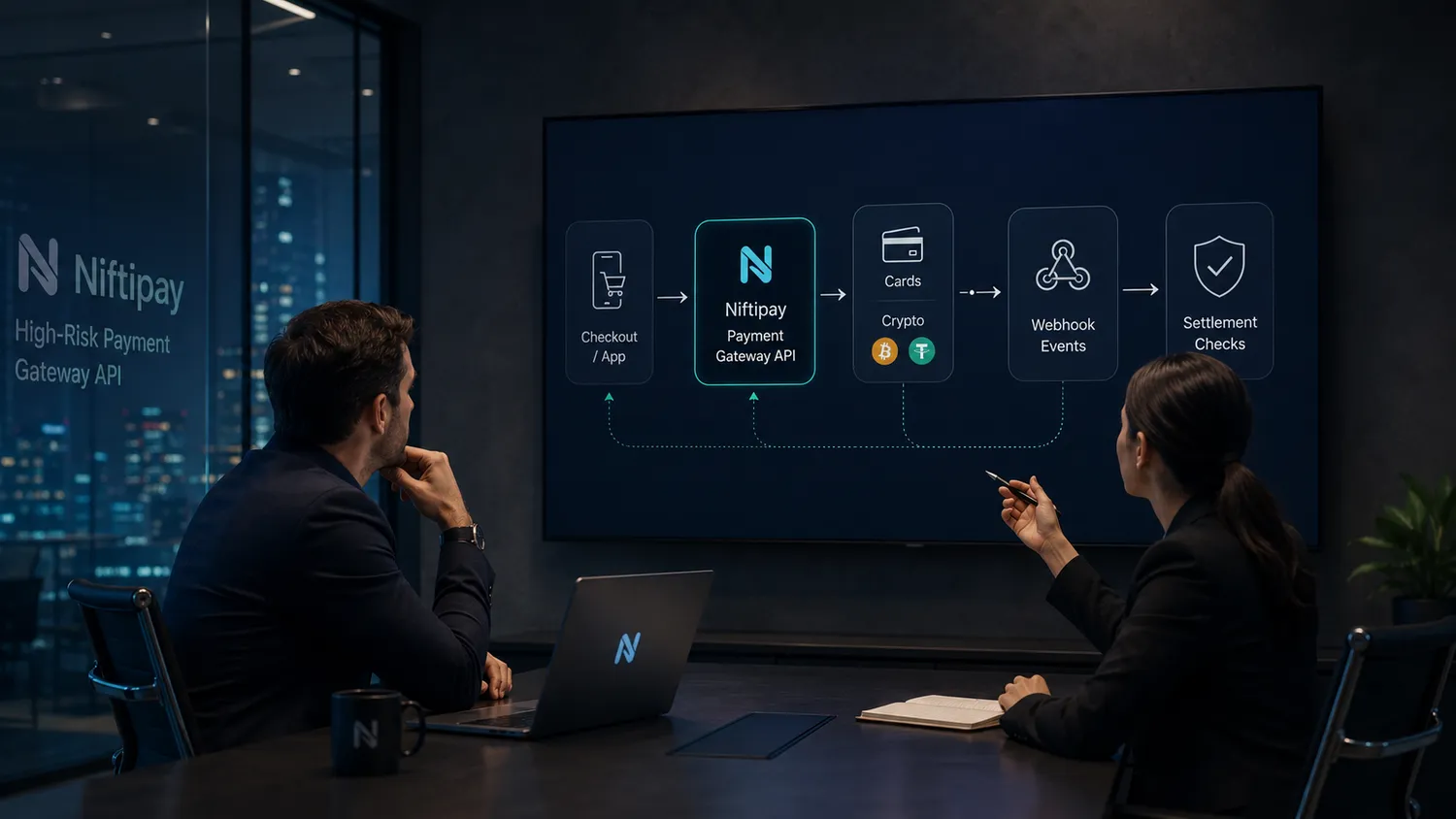
Card, crypto and stablecoin payment methods in one payment layer
The first technical question is not “does the API work” but “what payment methods are reachable through it.” A modern high-risk payment gateway API should expose card payments, crypto payments and stablecoin payments behind a consistent payment object, so the merchant does not maintain three integrations to ship one checkout.
In practice that means one create-payment endpoint, one payment-status model, one set of webhook events, and one settlement view, regardless of whether the underlying rail was a Visa authorization, a USDT transfer on Tron or a USDC payment on Ethereum. The merchant’s code should not branch on rail type for basic operations like create, confirm, refund or reconcile.
Niftipay covers card and crypto payment infrastructure through one REST API with a separate create endpoint per rail: POST /api/orders for crypto invoices and POST /api/fiat/orders for card payments. Both use the same API key authentication and report status changes through the same signed webhook model.
What to check before integrating a high-risk payment gateway API
The following checks separate a payment API that survives production from one that becomes the merchant’s problem. Each item maps to a real failure mode seen in high-risk integrations.
Payment method availability
Ask which payment methods are enabled per MID and per geography, not just which methods exist on paper. A card payment API that lists Visa, Mastercard and local debit schemes is only useful if those schemes are live on the MID assigned to the merchant’s vertical. The same applies to crypto: confirm which networks (Bitcoin, Ethereum, Tron, Solana, Polygon) and which assets (BTC, ETH, USDT, USDC, EURC) are actually routable, and on which chains stablecoin settlement is supported.
API keys and authentication
The API key model decides how safely the merchant can scale. Look for separate test and live keys, scoped permissions (read-only, payments, refunds, payouts), per-environment rotation without downtime, and IP allowlists. Bearer tokens over TLS with short-lived secrets are the baseline; anything weaker is a red flag for a high-risk vertical where credential leakage turns into chargebacks within hours.
Webhook reliability
Webhooks are how the merchant’s system learns that something happened. A serious payment gateway webhooks implementation includes signed payloads (HMAC over the raw body), automatic retries with exponential backoff, a dead-letter queue for repeated failures, and a replay endpoint so the merchant can re-trigger events during incident recovery. Without those, every transient 502 on the merchant side risks a missed payment status update.
Payment status updates
The payment status webhook model should reflect the real lifecycle: created, authorized, captured, partially captured, failed, refunded, partially refunded, charged back, settled. Crypto adds confirmations, underpayments and overpayments. A flat “success / fail” status hides operational reality and forces the merchant to poll, which scales badly and breaks reconciliation.
Refund and chargeback events
Refunds and chargebacks must be first-class objects on the API, not side effects buried in a status string. The merchant should receive structured events for refund.created, refund.completed, chargeback.opened, chargeback.evidence_required and chargeback.resolved, each with the reason code and the linked payment ID. In high-risk verticals this is what feeds the merchant’s risk dashboards and the acquirer’s monitoring thresholds.
Idempotency and safe retries
Every write endpoint (create payment, refund, payout) must accept an idempotency key. Without it, network retries duplicate charges, double refunds and break reconciliation. The contract should be explicit: same idempotency key plus same request body returns the original result; same key with a different body returns a documented error. This pattern follows standard HTTP idempotency semantics defined in RFC 9110.
Settlement and reconciliation visibility
The checkout to settlement API should let the merchant trace every payment from authorization to the funds landing in a bank account or wallet. That requires settlement batches as queryable objects, payouts linked to the underlying payments, and exportable reports in CSV or JSON. If the gateway only shows a single net amount per day, reconciliation becomes manual and disputes become unwinnable.
| Integration check | What “good” looks like in 2026 | Red flag |
|---|---|---|
| Payment methods | Cards + crypto + stablecoins under one payment object | Separate APIs per rail |
| Authentication | Scoped keys, IP allowlists, key rotation without downtime | One master key, manual rotation |
| Webhooks | Signed payloads, retries, dead-letter, replay endpoint | Unsigned, no retries, no replay |
| Status model | Full lifecycle including chargebacks and settlement | Binary success / fail |
| Idempotency | Required header on all write endpoints | Optional or undocumented |
| Settlement | Payouts linked to source payments, exportable | Net amount only, no traceability |
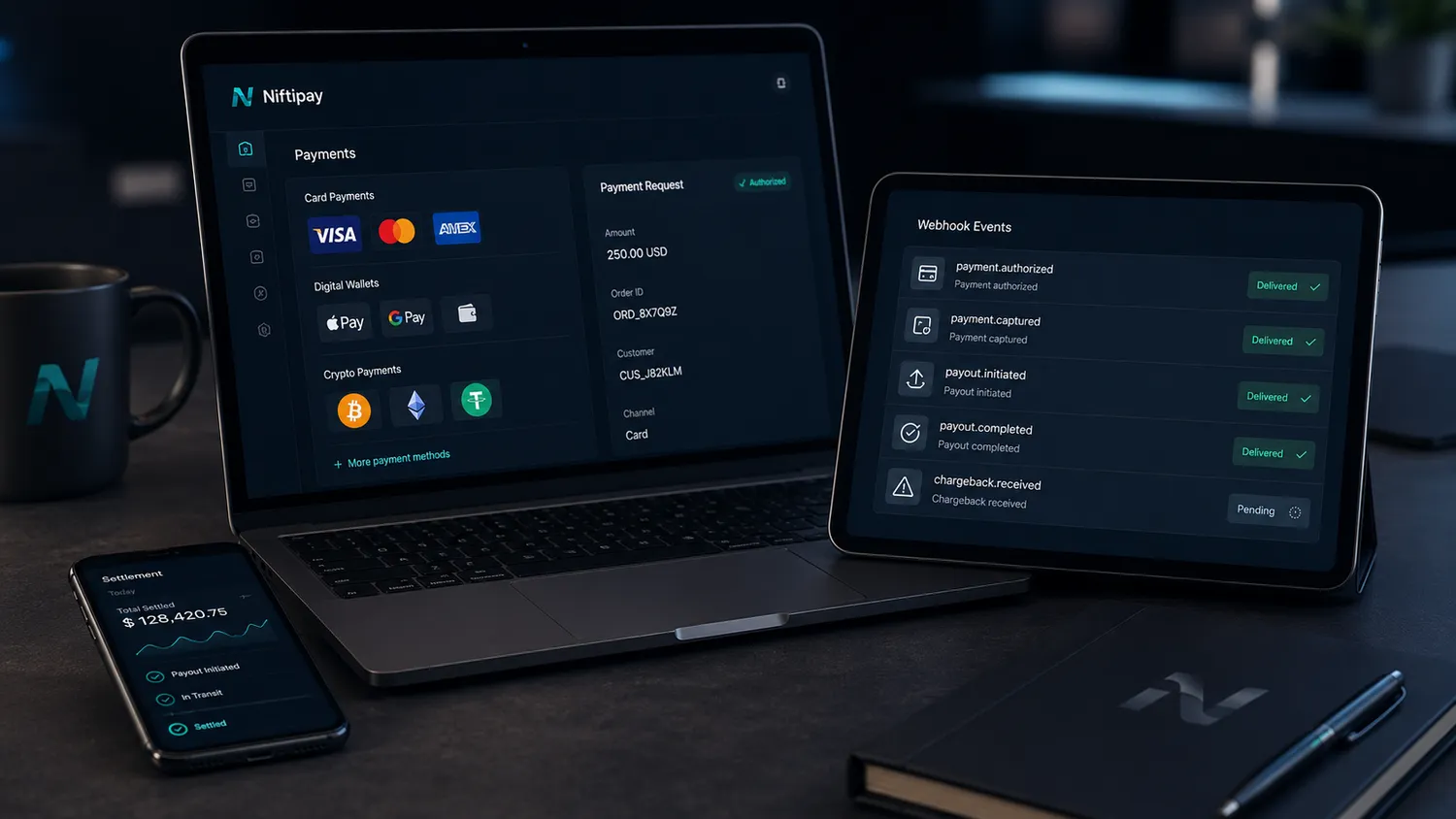
Why webhooks matter for high-risk merchants
In a low-risk vertical, a missed webhook is a delayed email. In a high-risk vertical, a missed webhook is an unreleased order, a duplicated refund, or a chargeback that nobody fought because the evidence window closed. Payment webhooks are the merchant’s nervous system, and their reliability is the single biggest predictor of operational quality on an integration.
Three properties matter most in production: delivery guarantees (at-least-once, never silently dropped), signature verification (so the merchant trusts the source), and replay (so an outage on the merchant side does not create permanent state drift). Anything less and the merchant ends up writing a polling layer on top of the API, which defeats the point of having a real-time gateway.
Not every merchant needs to build against the API directly. Where the store already runs on a common platform, the plugin route is usually faster — see payment gateways for WordPress, Magento and PrestaShop.
When a merchant should choose API-first payment infrastructure
Not every business needs an API-first stack. A single-store merchant selling low-ticket items can run a plugin and never touch a curl request. The picture changes when any of the following apply:
- The merchant is a platform or marketplace settling funds to multiple sellers.
- The vertical is high-risk and acquirers expect granular reporting per MID.
- The product accepts both fiat and crypto, and the checkout must abstract the rail.
- Reconciliation feeds an ERP, an accounting system, or an in-house risk engine.
- The merchant operates across geographies and switches processors based on routing rules.
In those scenarios, embedded payment infrastructure exposed through a clean API outperforms a hosted checkout, because every event (auth, capture, refund, chargeback, settlement, risk alert) can be wired into the merchant’s own systems. Related reading: payment gateway for crypto exchanges and OTC desks.
The integration options themselves are documented for developers: a REST API, WooCommerce and PrestaShop plugins, hosted checkout, payment links, crypto QR payments and webhooks.
Where Niftipay fits in the payment stack
Niftipay was built as a high-risk payment gateway API from the first endpoint. The same payment object covers card acquiring, crypto payments and stablecoin settlement; webhooks are signed and replayable; idempotency keys are required on every write; refunds and chargebacks are structured events; and settlement reports tie every payout back to the originating payment. The Niftipay API documentation walks through each surface with request and response examples, so engineering teams can validate the checklist above against real payloads before the integration kicks off.
For merchants in iGaming, crypto, adult, nutraceuticals, forex, marketplaces and other high-risk verticals, that combination removes the usual gap between “the gateway works in sandbox” and “the gateway works under live traffic on a monitored MID.”
Test the API against your own checklist
The fastest way to evaluate a high-risk payment gateway API is to run real requests against it. Create a Niftipay account and, once your merchant account is approved, use the API credentials to create a crypto invoice with POST /api/orders and a card payment with POST /api/fiat/orders, then confirm that your endpoint verifies the signed webhook events for each. Every item in the checklist above maps to a documented endpoint, so the evaluation takes hours, not weeks.
Frequently asked questions
What is a high-risk payment gateway API?
A high-risk payment gateway API is a programmatic interface to a payment processor built for verticals that acquirers classify as elevated risk, such as crypto, iGaming, forex, adult or marketplaces. It exposes card, crypto and stablecoin payments, webhooks, refunds, chargebacks and settlement data through endpoints designed for the chargeback ratios and compliance scrutiny these verticals face.
How is a crypto payment API different from a card payment API?
A card payment API authorizes against a card scheme and captures funds through an acquirer; a crypto payment API watches an address on a blockchain and confirms once enough blocks have been mined. A combined fiat and crypto payment API unifies both behind one payment object so the merchant integrates once and switches rails through configuration, not code.
Why are webhooks so important for high-risk payment integrations?
Webhooks deliver payment status updates in real time. In high-risk environments, a missed webhook can mean an unreleased order, a duplicated refund or a lost chargeback dispute. Signed payloads, retries and a replay endpoint are non-negotiable on a serious payment gateway API.
What does idempotency mean on a payment API?
Idempotency means the same request, retried with the same idempotency key, returns the original result instead of creating a duplicate. On a payment API it prevents double charges, double refunds and reconciliation drift when networks retry requests after timeouts.
Does Niftipay support both card and crypto payments through one API?
Yes, through one REST API with two create endpoints: POST /api/orders for crypto and stablecoin invoices and POST /api/fiat/orders for card payments. Both use the same API key authentication and the same signed webhook model, and API credentials are issued after merchant approval.