
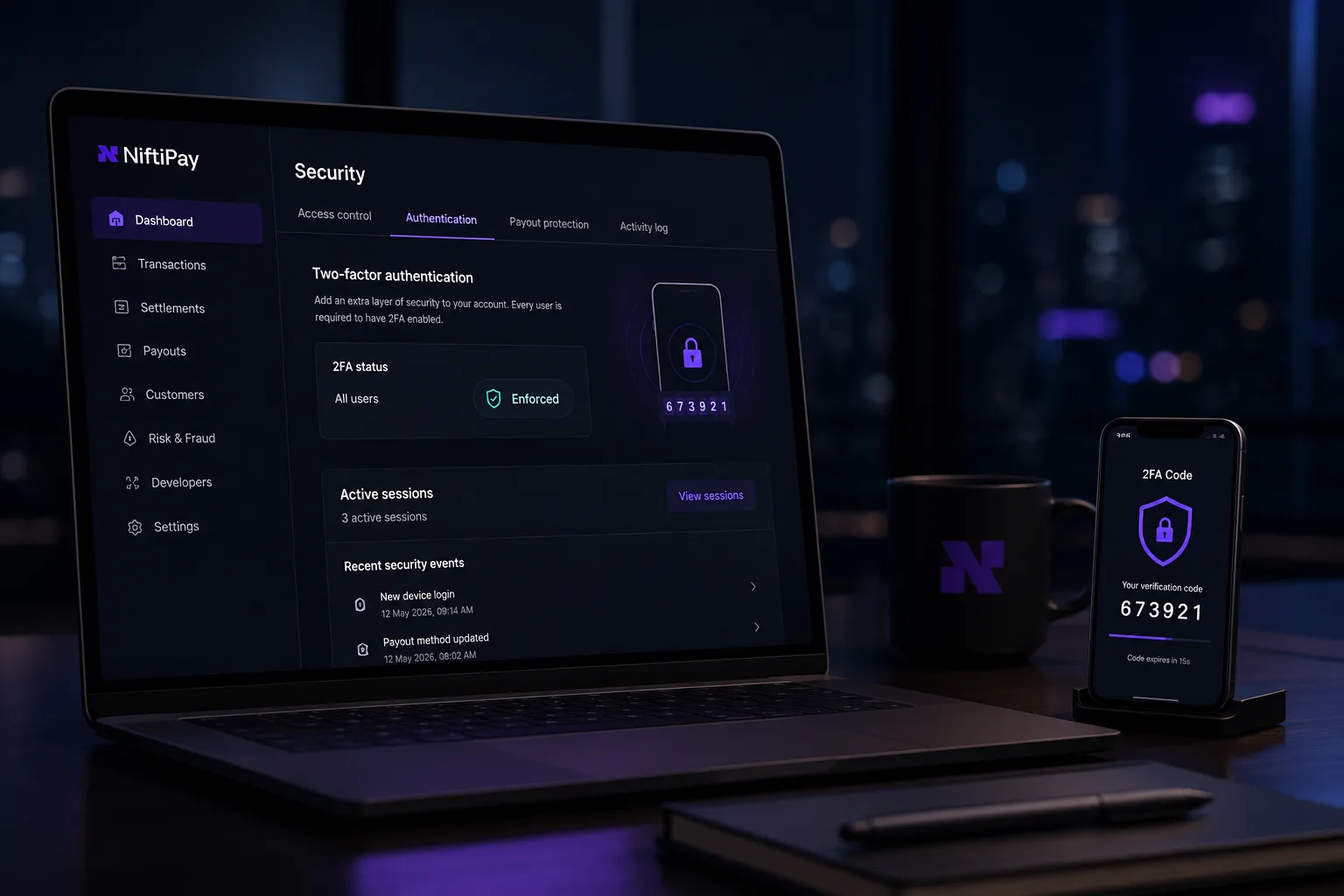
Strong payment gateway security controls protect more than the transactions running through your checkout. They protect who can log in, who can move money, and who can change where funds are sent. For most merchants, the account behind the gateway is the asset most worth defending.
Payment security is often framed as fraud prevention at the point of sale. That matters, but it is only one layer. The other sits inside your merchant account: user access, login security, payout permissions and withdrawal protection. A clean transaction flow means little if a shared login can change your settlement bank account. This guide explains the operational payment gateway security controls that finance teams, operations managers and founders should expect.
What are payment gateway security controls?
Payment gateway security controls are the rules and mechanisms that govern access to your payment account and the sensitive actions inside it. They cover how users authenticate, what each user is allowed to do, how payouts are approved, and how changes to critical settings are reviewed.
Think of them in two groups. The first is transactional security: encryption, tokenisation and fraud screening on payments. The second, and the focus here, is operational account security: login protection, role separation, withdrawal approval and activity visibility. A capable gateway treats both as part of the same payment gateway security posture.
Why merchant account access needs stronger protection
Most account compromises are not sophisticated. They start with a weak password, a shared login passed around the team, or an admin account that was never removed after someone left. When everyone uses the same credentials, you lose the ability to know who did what.
The common weak points are predictable:
- Shared logins that make individual actions impossible to attribute.
- Weak or reused passwords exposed in unrelated data breaches.
- Unrestricted admin access where every user can change payout details.
- Staff turnover with no process to revoke access promptly.
- No role separation, so a support agent has the same powers as a finance lead.
None of these require an attacker to break encryption. They simply exploit gaps in how access is managed. This is exactly where account-level controls earn their place.
2FA and account access controls
Two-factor authentication (2FA) is the single most effective account-level control available to most merchants. By requiring a second factor — typically a code from an authenticator app — a stolen password alone is no longer enough to log in. The UK’s National Cyber Security Centre recommends 2FA on any account that holds money or sensitive data.
A strong 2FA payment gateway pairs that with role-based access controls. Instead of one access level for everyone, each user is assigned a role that matches their job:
- Finance can view settlements and request payouts.
- Operations can manage transactions and refunds.
- Developers can manage API keys but not move funds.
- Support can view transaction status without editing payout details.
These account access controls reduce the blast radius of any single compromised login. If a support account is phished, the attacker still cannot change your bank details or trigger a withdrawal.
Withdrawal protection and secure payout operations
Withdrawal protection is where account security becomes financial security. Moving funds and changing payout destinations are the highest-risk actions in any payment account, so they deserve the strongest controls.
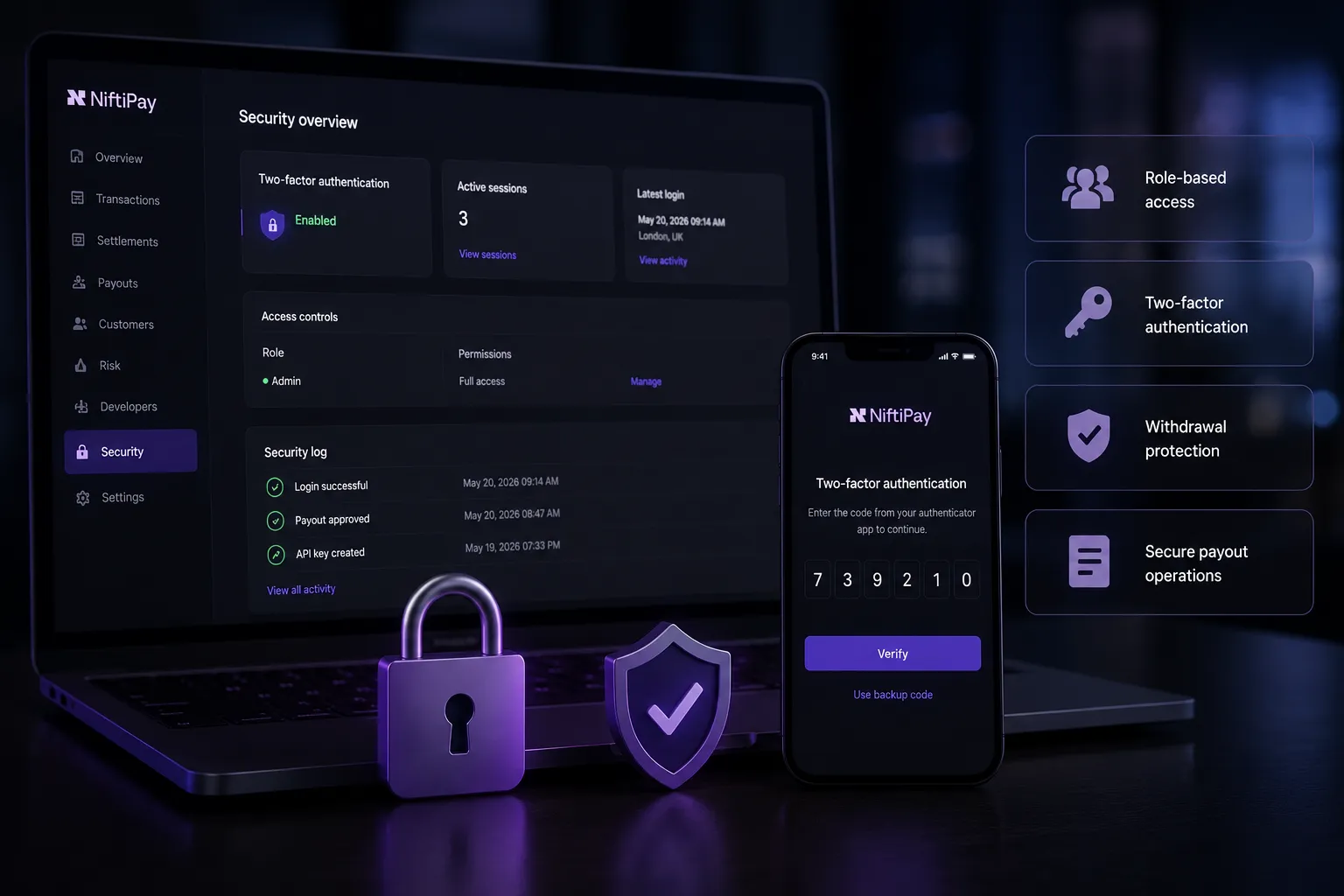
Practical secure payout operations usually combine several steps:
- Payout approvals so a withdrawal requested by one user is confirmed by another.
- Destination change reviews when a bank account or crypto wallet address is added or edited.
- Cooling-off windows on new payout destinations before large amounts can be sent.
- Notifications to finance leads whenever payout settings change.
The goal is simple: no single action, by one person, should be able to silently redirect your money. Pairing withdrawal protection with reliable settlement tracking gives finance teams confidence that funds arrive where they are meant to.
Security controls for high-risk and complex commerce
High-risk and complex merchants often need stronger internal controls than a single-product store. Higher volume, multiple payment methods and larger teams all widen the surface controls have to cover.
A marketplace settling to many vendors, or a subscription business across several regions, may have a dozen people touching the payment account. The more hands involved, the more important role separation and payout approvals become. These controls sit alongside — but are distinct from — the documentation work in our high-risk payment compliance checklist, which covers underwriting evidence rather than day-to-day access. Getting access right early also eases the onboarding checklist.
Operational visibility: logs, alerts and payment status
Controls only work if you can see them working. Operational visibility means you can answer, at any time, who logged in, what changed, and where each payment stands.
The visibility worth expecting includes:
- Activity logs recording logins, role changes and payout edits.
- Alerts on sensitive events such as a new payout destination.
- Payment status tracking across pending, approved, failed and settled states.
A clear payment status API and dependable webhooks let your own systems stay in sync, so reconciliation and support are based on facts rather than guesswork.
What to look for in payment gateway security controls
When you evaluate a provider, use this checklist to compare their merchant account security against what your operation actually needs:
- 2FA or strong authentication on every account, not just admins.
- Role-based account access with permissions matched to each job.
- Secure payout operations with multi-step approval for withdrawals.
- Withdrawal protection on new bank or wallet destinations.
- Clear payment status visibility across the full transaction lifecycle.
- Audit-friendly account activity logs you can review and export.
- An access review process to revoke users when roles change.
- Developer and API security, including scoped, revocable API keys.
Which security controls protect a merchant account most?
If you remember one thing, make it this: the controls below are what separate a payment account that can be quietly drained from one that simply cannot. Use the table as a quick reference when you compare providers.
| Security control | What it protects | Why it matters |
|---|---|---|
| Two-factor authentication (2FA) | Login access | A stolen password alone can no longer get in. |
| Role-based access | User permissions | Each person can only do what their job requires. |
| Withdrawal protection | Payouts and destinations | Funds cannot move or be redirected without review. |
| Activity logs and alerts | Operational visibility | Every sensitive action is traceable in real time. |
| Scoped API keys | Developer access | Technical access stays separate from moving money. |
Evaluating a provider’s controls versus reading a provider’s security page
The controls above are the ones a merchant should be able to verify in any payment provider, whoever it is: how access is granted and revoked, how second-factor authentication is enforced, how withdrawal destinations are protected, what is logged and who is alerted.
That is a different exercise from reading what one provider does. For Niftipay specifically — account controls, API credential handling, webhook controls, infrastructure monitoring and the split of responsibility between provider and merchant — the detail is on the Niftipay security page, and further security information can be requested during qualification and onboarding.
Use this article to build the question list. Use a provider’s own documentation to check the answers.
How Niftipay supports secure payment operations
Niftipay is built as payment infrastructure for complex commerce, where access, visibility and control matter. For businesses handling card, crypto and stablecoin payments across multiple teams and regions, account-level security is part of the platform rather than a bolt-on.
That means structured access for different roles, careful handling of secure payout operations, and the operational visibility finance teams rely on to keep a clean ledger. The aim is straightforward: protect the transaction and protect the account that controls it.
Frequently asked questions
What are payment gateway security controls?
They are the controls that protect access to your merchant account and the sensitive actions inside it — login security, user permissions, payout approvals and withdrawal protection — alongside the encryption and fraud screening applied to transactions.
Does 2FA stop account takeover?
2FA significantly reduces the risk of account takeover because a stolen password alone is no longer enough to log in. It does not remove every risk, so it works best combined with role-based access and withdrawal protection.
What is withdrawal protection?
Withdrawal protection is a set of steps — such as payout approvals, destination change reviews and cooling-off windows — that prevent a single user from silently moving funds or redirecting payouts to a new account.
Why do high-risk merchants need stronger access controls?
High-risk and complex merchants usually have higher volumes, more payment methods and larger teams. More people touching the account means role separation and payout approvals matter more for reducing operational risk.
How do I check a gateway’s security controls?
Review whether it offers 2FA, role-based access, secure payout operations, withdrawal protection, clear payment status visibility, audit-friendly logs and scoped API keys. Match those controls against how your team actually operates.
The real test of payment security
Picture the worst Monday morning: a finance lead opens the dashboard and a payout has already left for an account no one recognises. No alert, no second approval, no log to trace it. The card payments were perfectly encrypted — and it made no difference at all.
That scenario is the honest test of any payment platform. Not how it behaves when everything is calm, but who can act, what they can move, and whether you would even notice. The gateways worth trusting are the ones that make that Monday morning impossible by design — where access is earned, withdrawals are reviewed, and every sensitive action leaves a trace.
So when you weigh up a provider, look past the checkout. Ask what stands between a stolen password and your settlement account. If the answer is “quite a lot”, you have found a partner that protects the transaction and the business behind it.