
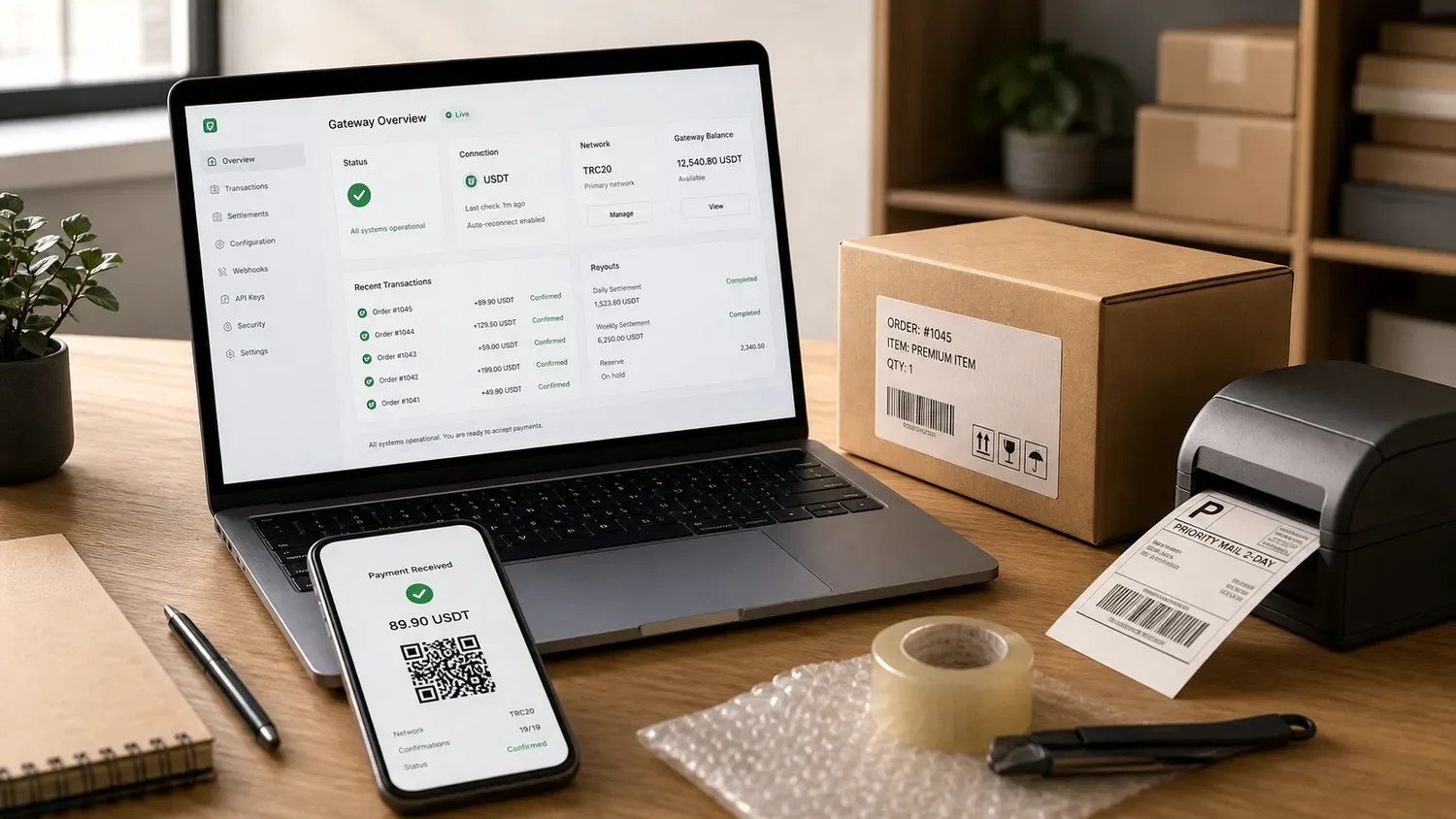
A USDT payment gateway for high-risk businesses can shorten approval timelines, cut FX exposure and open a stablecoin route alongside cards — but the value of that route depends on what sits behind it. This USDT payment gateway checklist walks through the seven areas every merchant should pressure-test before going live — KYC, settlement, fees, fallback routing and uptime. The seven checks below are the ones we run with operators before the first production transaction.
For online merchants in regulated, restricted or volatile sectors, payment infrastructure is rarely a one-vendor decision. A USDT payment gateway gives operators a way to accept USDT payments without the chargeback exposure and rolling reserves typical of card processing — yet the wrong setup means missed settlements, frozen balances and reconciliation work that can take weeks to unwind. The checks that follow reflect what we audit before approving a merchant for production traffic on any Tether payment gateway.
This guide is the pre-launch checklist. For the wider case for stablecoin settlement — why high-risk merchants are adopting USDT, and how it works alongside cards — see our guide to USDT payment gateways for high-risk businesses.
What is a USDT payment gateway for high-risk businesses?
A USDT payment gateway for high-risk businesses is a payment layer that accepts Tether (USDT) on networks such as TRON (TRC-20), Ethereum (ERC-20) or Solana, and settles to the merchant in USDT, fiat, or both. For high-risk verticals — gambling, adult content, dating subscriptions, forex, crypto exchanges, nutraceuticals — this route avoids the card-scheme underwriting bottleneck while keeping settlement value pegged to the US dollar.
It is not a substitute for a card processor in every case. It is a complement that absorbs the traffic cards reject, shortens settlement, and reduces FX friction across borders.
Why high-risk merchants are adding USDT in 2026
Three drivers are pushing merchants toward a crypto payment gateway for high-risk merchants this year: tighter card-scheme rules on certain MCCs, longer underwriting timelines, and customer demand for stablecoin checkout in Latin America, MENA, Southeast Asia and the CIS region.
USDT clears in minutes on TRC-20 at network fees typically under one US dollar per transaction, and it does not bounce back through chargeback windows. For finance teams, the appeal is reconciliation: every transaction is a hash, every wallet is a ledger entry, and there is no representment dispute to staff.
The 7 checks before going live with a USDT payment gateway
Before the first live transaction, we walk merchants through the seven checks below. Each one closes a failure mode we have seen go wrong in production.
1. KYC, KYB and licensing alignment
Confirm that the gateway’s KYB policy matches your jurisdiction and licence. A USDT payment processor that skips beneficial-owner verification is a liability — both for on-chain analytics flags and for banking partners on the off-ramp side. Ask which compliance layer the provider relies on (Chainalysis, Elliptic or internal tooling) and how flagged inflows are handled.
2. Settlement currency and timing
Decide before integration whether you settle in USDT, fiat, or a split between the two. Same-day USDT settlement is standard. Fiat settlement depends on the off-ramp partner and ranges from T+0 to T+3. Read the cut-off times in the contract — a 4 PM UTC cut-off means anything later books the next business day.
3. Fee transparency
A clean fee schedule lists four lines: gateway fee (typically 0.5–1.5%), network fee (paid by payer or merchant), conversion spread if settling in fiat, and any minimum monthly. Hidden costs usually live in the conversion spread. Ask for a full breakdown on a sample 1,000 USDT transaction across every settlement currency you plan to use.
4. Multi-network support and fallback
A gateway that only supports ERC-20 will price out small payers on gas. TRC-20 should be primary for retail traffic; ERC-20 and Solana are acceptable secondaries. Confirm the provider has automated fallback if a network congests — otherwise checkout abandonment spikes during gas events.
5. Webhook reliability and uptime SLA
Anything below 99.9% monthly uptime is a no-go on a production gateway. Webhooks must include retries with exponential backoff, signed payloads, and a replay endpoint. Test the dashboard’s transaction search before you sign — a search-by-hash that lags thirty minutes will cost your support team time every day.
6. Risk and AML monitoring
Stablecoin flows are public. Treat the merchant deposit address as a public-facing asset and confirm the provider screens inbound transactions against sanctions lists, mixers and known illicit clusters in real time. The provider should reject — not just flag — inflows from sanctioned addresses.
7. Off-ramp redundancy
The single biggest hidden risk in a Tether payment gateway is the banking off-ramp. A provider with one banking partner is one banking incident away from a frozen merchant balance. Ask how many off-ramp partners the provider operates across, and in which jurisdictions they are licensed.
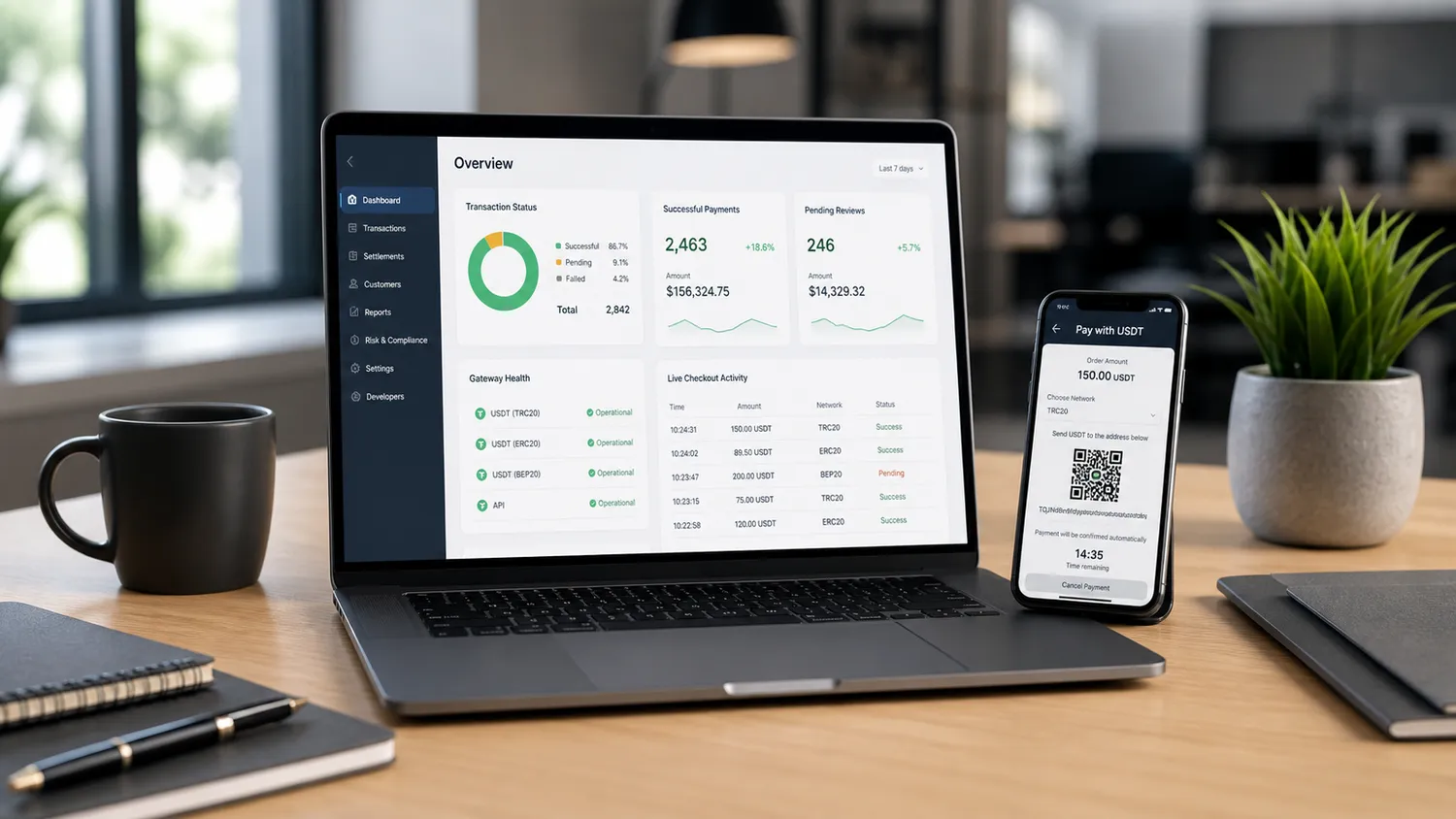
Pricing benchmarks for 2026
Typical pricing across credible providers in 2026 sits in the following ranges:
| Component | Standard range |
|---|---|
| Gateway processing fee | 0.5% – 1.5% |
| TRC-20 network fee per transaction | < 1 USDT (often payer-paid) |
| Fiat conversion spread | 0.3% – 0.8% |
| Settlement timing (USDT) | T+0 minutes |
| Settlement timing (EUR / GBP / USD) | T+0 to T+3 business days |
Anything materially above these ranges usually points to opaque markup or a reseller margin layered on top of an underlying provider. For a wider comparison, see our breakdown of the best payment processor for stablecoin payments.
Card processor or USDT gateway — or both?
For most operators the answer is both. Cards handle domestic and trusted geographies; the USDT route catches the geographies and cardholder profiles where issuer banks decline. We covered the side-by-side trade-offs in high-risk merchant account vs crypto payment gateway — the short version is that the two setups complement rather than compete, and the merchants with the strongest gross-approval numbers in 2026 run them in parallel.
Key takeaways
- A USDT payment gateway for high-risk businesses is a complement to cards, not a replacement.
- KYC, KYB and AML alignment with your licence are non-negotiable — verify before integration.
- Same-day USDT settlement is standard; fiat off-ramp timing is the most common contractual surprise.
- Multi-network support (TRC-20 primary, ERC-20 and Solana secondary) keeps checkout costs in line.
- Off-ramp redundancy is the most overlooked single-point-of-failure risk.
FAQ
Is USDT a high-risk-only payment method?
No. USDT is used across mainstream e-commerce, B2B settlement and remittance. It is particularly valuable for high-risk verticals because settlement does not depend on card-network underwriting decisions or chargeback windows. Tether’s transparency reports publish reserve and circulation data merchants can reference for due diligence.
Do I need a high-risk merchant account in addition to a USDT gateway?
Most operators run both. Cards handle domestic and trusted geographies; a USDT payment processor absorbs the traffic cards reject. The combined gross-approval rate is consistently higher than either route on its own.
How is gateway settlement different from a plain crypto wallet?
A gateway adds invoicing, expiry, FX conversion, AML screening, webhook accounting and an off-ramp to fiat. A raw wallet does none of those and shifts compliance risk back onto the merchant.
Can customers pay USDT without already owning crypto?
Some gateways embed an on-ramp at checkout (card-to-USDT in one flow). Others require the payer to hold USDT in advance. Confirm which model the provider supports before integration since it materially changes conversion rate.
What happens if the network congests at checkout?
A production-grade gateway falls back to an alternate network (TRC-20 to ERC-20 to Solana) automatically and quotes a fresh fee. If the provider does not offer fallback, plan for revenue loss during gas spikes on Ethereum.
Before the first transaction
Niftipay runs this exact seven-point review with the operators we onboard across iGaming, forex, crypto exchanges, adult and dating subscriptions, and nutraceuticals — every production go-live we have approved has cleared each point in writing first. The work behind a production-grade USDT payment processor is mostly invisible from the outside, which is why we publish the gate criteria openly: a merchant who can answer all seven for their current provider already knows whether they are ready for live traffic.
If you would like a side-by-side review of an existing setup against this checklist before any commercial discussion, our team can walk through it with your finance and compliance leads. Audits are free and take roughly thirty minutes.