
Marketplace payment processing for high-risk platforms is the operational backbone behind every transaction a multi-seller site routes from buyer to seller. Unlike a single-merchant gateway, it has to onboard third-party sellers, split funds at settlement, hold reserves against disputes, and keep pace with sanctions and AML rules — all without breaking the buyer experience. Platforms in adult content, gaming, crypto on-ramps, dating, CBD, forex and digital subscriptions are now expected to do this within weeks of launch, not quarters.
What does marketplace payment processing for high-risk platforms involve?
The risk profile rarely comes from the technology stack. It comes from chargeback exposure, the regulatory category of the goods or services sold, and the fact that the platform is responsible for vendors it does not directly employ. Card networks treat platforms as the merchant of record when they collect funds before forwarding them — a model called payment facilitation — which means the platform inherits liability for every seller it admits.
Acquiring banks score this by chargeback ratio, refund rate, average ticket size and seller geography. A site that lists CBD vendors in the UK and crypto OTC desks in the EU is, in card-network terms, two high-risk pipelines under one storefront. Any decent marketplace payment processor has to underwrite both, then settle them through acquiring rails that will accept the volume.
How does seller onboarding work in practice?
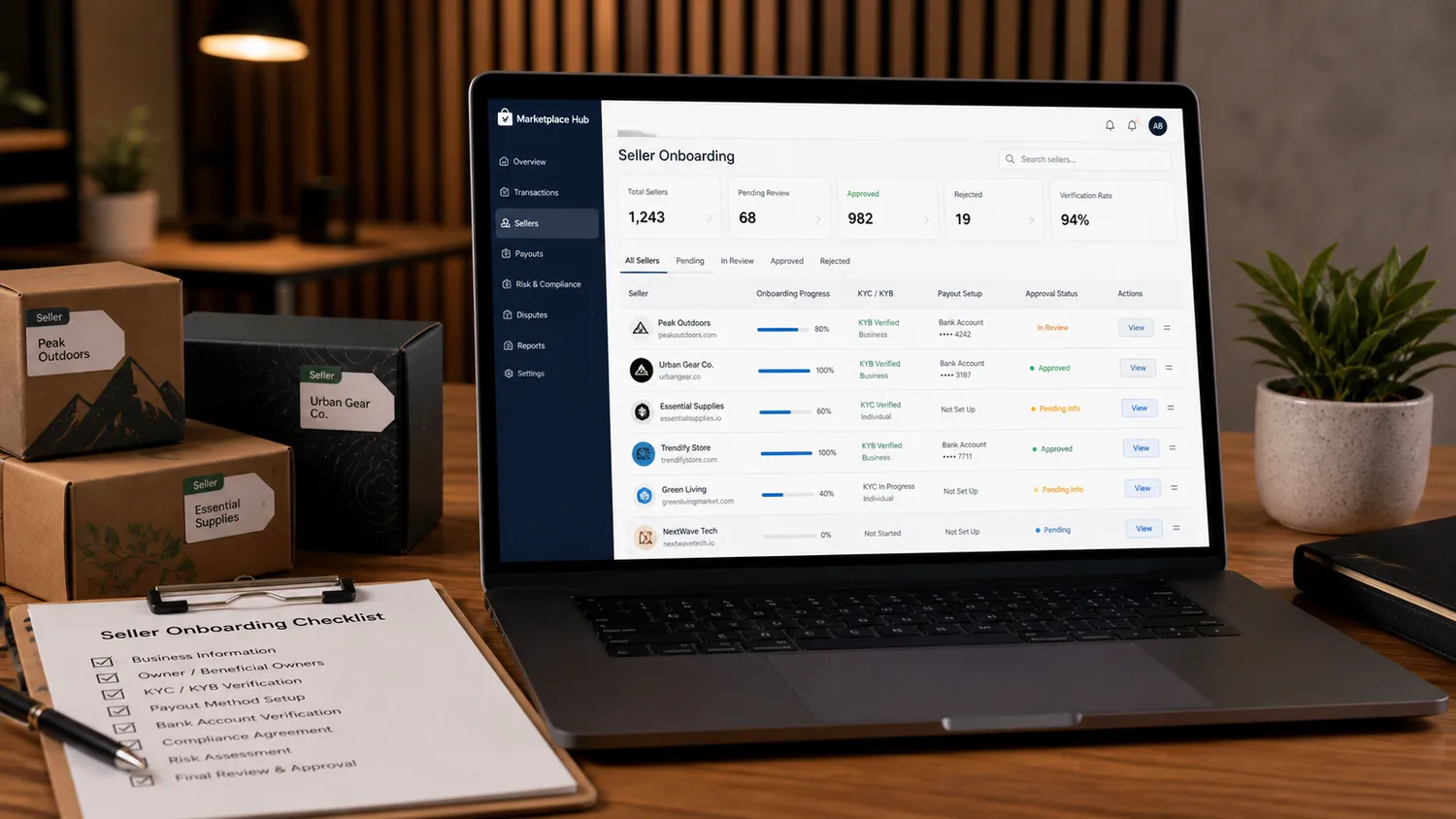
Seller onboarding is where most marketplaces lose weeks. Each merchant needs Know Your Business (KYB) and Know Your Customer (KYC) checks before the first payout. For corporate sellers that means UBO disclosure, registry extracts and sanctions screening; for sole traders, government ID, proof of address and a selfie liveness check.

The control set typically lives across six trays — onboarding, KYB/KYC, payouts, risk scoring, reserves and disputes — each with its own SLA before a seller can transact at full volume. Useful onboarding looks like this:
- Tiered limits — new sellers transact up to a low cap until KYB clears.
- Document expiry tracking — passports and registry extracts re-checked before they lapse.
- PEP and sanctions monitoring — ongoing, not one-time at signup.
- Per-seller underwriting memo — stored for the acquirer’s audits, not just internal use.
How do seller payouts actually move?
Once a sale clears, the platform receives the gross amount, deducts its commission, fees and any reserve hold, and sends the net to the seller. The mechanics differ by setup:
- Split payments — the acquirer splits funds at authorisation, paying platform and seller in one settlement cycle.
- Aggregator payouts — the platform receives consolidated funds, then issues SEPA / Faster Payments / SWIFT transfers to sellers on its own schedule.
- Stablecoin rails — USDT or USDC payouts to sellers in jurisdictions where local banking is slow or expensive.
Seller payouts on a high-risk marketplace are rarely T+1. Reserves of 5% to 15% are common, held for 90 to 180 days against chargebacks. The platform decides whether to absorb that float or pass it through — a commercial choice, not a technical one. The dynamics mirror any other high-risk payment fee structure, just multiplied across every seller.
Which risk controls keep the marketplace clean?
Risk controls run in three layers: pre-transaction (3-D Secure, device fingerprinting, velocity rules), post-transaction (chargeback alerts via Ethoca and Verifi, refund automation), and post-settlement (reserves, payout holds, seller suspension). Sharper platforms add a fourth layer: behavioural seller scoring that flags merchants whose dispute rate is rising before it crosses the acquirer’s threshold.

Signals worth wiring into the dashboard:
- Chargeback ratio per seller, weekly and trailing 60 days.
- Refund-to-sale ratio (above 5% is a warning).
- First-time buyer share per seller (sudden surges often signal stuffed transactions).
- Geographic concentration of the seller’s customers vs. their declared market.
Card networks publish the thresholds: Visa’s acquirer risk standards define excessive-dispute status, and acquirers require platforms to keep every seller under it. FATF guidance on virtual assets covers the AML obligations for any platform listing crypto sellers.
Key takeaways
- Marketplaces are underwritten as a portfolio of sellers, not a single merchant — every onboarded vendor changes the risk picture.
- KYB/KYC, sanctions screening and document expiry tracking belong inside the platform’s own product, not bolted on after launch.
- Reserves of 5–15% against chargebacks are standard for high-risk marketplace payments, especially in adult, gaming and crypto verticals.
- Risk controls have to operate per seller, not just per transaction.
- A multi-processor setup is normal: one acquirer rarely covers every category a marketplace lists.
FAQ
Is a marketplace classified as a payment facilitator?
If the platform collects funds before passing them to sellers, yes — under Visa and Mastercard rules that makes it a payment facilitator (PayFac), subject to acquirer registration, gross monthly volume caps and ongoing seller monitoring.
How long does seller onboarding take?
Sole traders with clean documents can be onboarded in minutes via automated KYC. Corporate sellers in regulated categories — crypto OTC, adult content, licensed CBD — take 2 to 10 business days because of UBO disclosure and sanctions checks.
What reserves should a marketplace expect?
Acquirers typically hold 5–15% rolling reserves on high-risk marketplace volume for 90–180 days. Reserves can be reduced once the platform has six or more months of clean chargeback history.
Can a single processor cover an entire marketplace?
For low-risk marketplaces, yes. Platforms that mix verticals — adult, gaming, crypto, CBD — generally need a multi-processor setup to spread liability and avoid a single decline cascade.
Niftipay specialises in marketplace merchant payments for high-risk verticals, combining card acquiring, SEPA payouts and stablecoin settlement under one onboarding flow. Platforms ready to discuss seller onboarding, payouts or reserve structuring can request a marketplace-specific underwriting review instead of a generic gateway quote.