

Payment retry logic for high-risk subscriptions is the difference between a recoverable card decline and a cancelled customer. In adult, nutraceutical, gaming, dating and crypto verticals, recurring revenue leaks through soft declines, expired cards and risk-based blocks every single cycle. The right retry schedule, paired with dunning messages and backup payment processing, recovers a measurable share of that revenue without pushing the chargeback ratio into review territory.
This piece breaks down how a modern subscription retry logic should behave when the underlying business is classified as high-risk: when to retry, when to stop, how to communicate with the cardholder, and where a crypto fallback fits inside a subscription payment gateway.
Why do recurring payments fail in high-risk verticals?
High-risk recurring payments fail for reasons that traditional SaaS billing stacks rarely model. Issuers apply tighter risk scoring to MCC codes tagged as adult, gambling, supplements or financial services. Acquirers throttle volume to keep their portfolio inside Visa and Mastercard monitoring thresholds. On top of that, cardholders use prepaid and one-time cards more frequently than the e-commerce average, and balance-driven soft declines spike around the 1st and the 15th of each month.
Soft declines vs hard declines
Not every decline is worth retrying. A correct retry policy starts by classifying the response code from the issuer.
| Decline type | Examples | Retry? |
|---|---|---|
| Soft decline | Insufficient funds, do-not-honor, issuer unavailable | Yes, with delay |
| Hard decline | Stolen card, account closed, invalid card number | No — stop immediately |
| Risk decline | Suspected fraud, velocity block | Reroute, do not hammer |
| Expiry / re-issuance | Card expired, expired track data | Account updater first, then retry |
What is payment retry logic for high-risk subscriptions?
Payment retry logic for high-risk subscriptions is a rules engine that decides if, when and how to reattempt a failed recurring charge. It reads the decline code, the merchant category, the cardholder history and the current acquirer load, then picks the retry window that maximises recovery probability while keeping the chargeback ratio safe. In a high-risk context the engine also has to choose where to retry — same acquirer, a different one, or an alternative rail entirely.
Static “retry in 3 days, then in 5, then give up” rules belong to low-risk SaaS. High-risk merchants need adaptive scheduling that responds to issuer behaviour and to the merchant’s own monitoring metrics.
How does a smart subscription retry logic schedule work?
A defensible payment retry schedule for high-risk recurring billing usually layers three signals: time since the original decline, the response code family, and the cardholder’s payday pattern. The goal is not to maximise attempts but to maximise successful attempts per cycle.
A sample payment retry schedule
| Attempt | Delay from initial decline | Action |
|---|---|---|
| 1 | +24 hours | Same acquirer, off-peak hour, send dunning email #1 |
| 2 | +72 hours | Account updater check, then retry on same MID |
| 3 | +5 days (next payday window) | Switch to backup acquirer, send SMS dunning |
| 4 | +8 days | Offer crypto fallback or alternative method in-app |
| 5 | +12 days | Pause subscription, final dunning, request manual update |
Attempts beyond five rarely pay off and usually attract scrutiny. Card networks track aggressive retry behaviour, and Visa’s VAMP framework explicitly flags merchants whose retry-to-approval ratio drifts outside healthy bands.
How dunning messages recover failed recurring payments
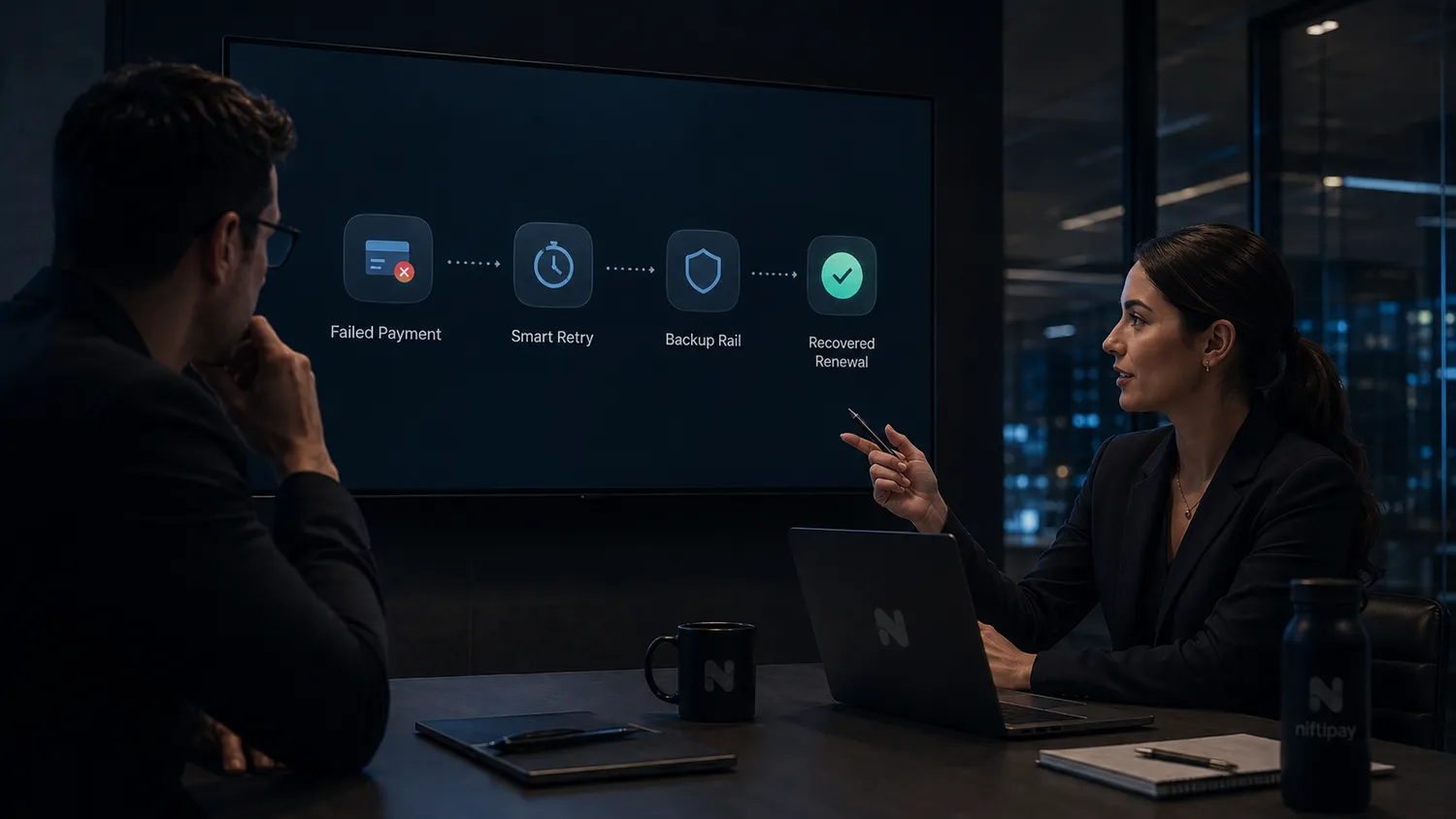
Dunning messages are not generic “your payment failed” emails. In high-risk subscription billing they are a recovery channel as important as the retry engine itself. A working sequence speaks to the decline reason rather than the merchant’s frustration: insufficient funds gets a “your bank may have flagged the charge, try again after payday” tone, while expired-card gets a one-click update flow.
- Channel mix: email, SMS and in-app — SMS lifts response rates by roughly 20–30% in adult and dating verticals.
- Timing: first message inside the first hour after the soft decline, second message paired with the next retry attempt.
- Soft vs hard tone: soft for the first two attempts, firmer once the account is at risk of suspension.
- Update path: always include a hosted card-update link — friction kills recovery faster than the decline did.
For terminology and history of the practice, the Wikipedia entry on dunning is a useful primer before adapting the tone of voice to a high-risk audience.
Backup payment processing and card decline recovery
Single-MID setups are the silent killer of high-risk subscription revenue. The moment that acquirer raises its risk score on the portfolio, every recurring charge inherits the penalty. Backup payment processing routes the retry to a secondary acquirer when the primary trips a threshold, keeping the customer billed without forcing them to act.
For deeper coverage of the topology behind this, see our piece on recurring billing for high-risk businesses and the operational notes inside reducing chargebacks in high-risk industries.
Why a crypto-enabled subscription payment gateway matters
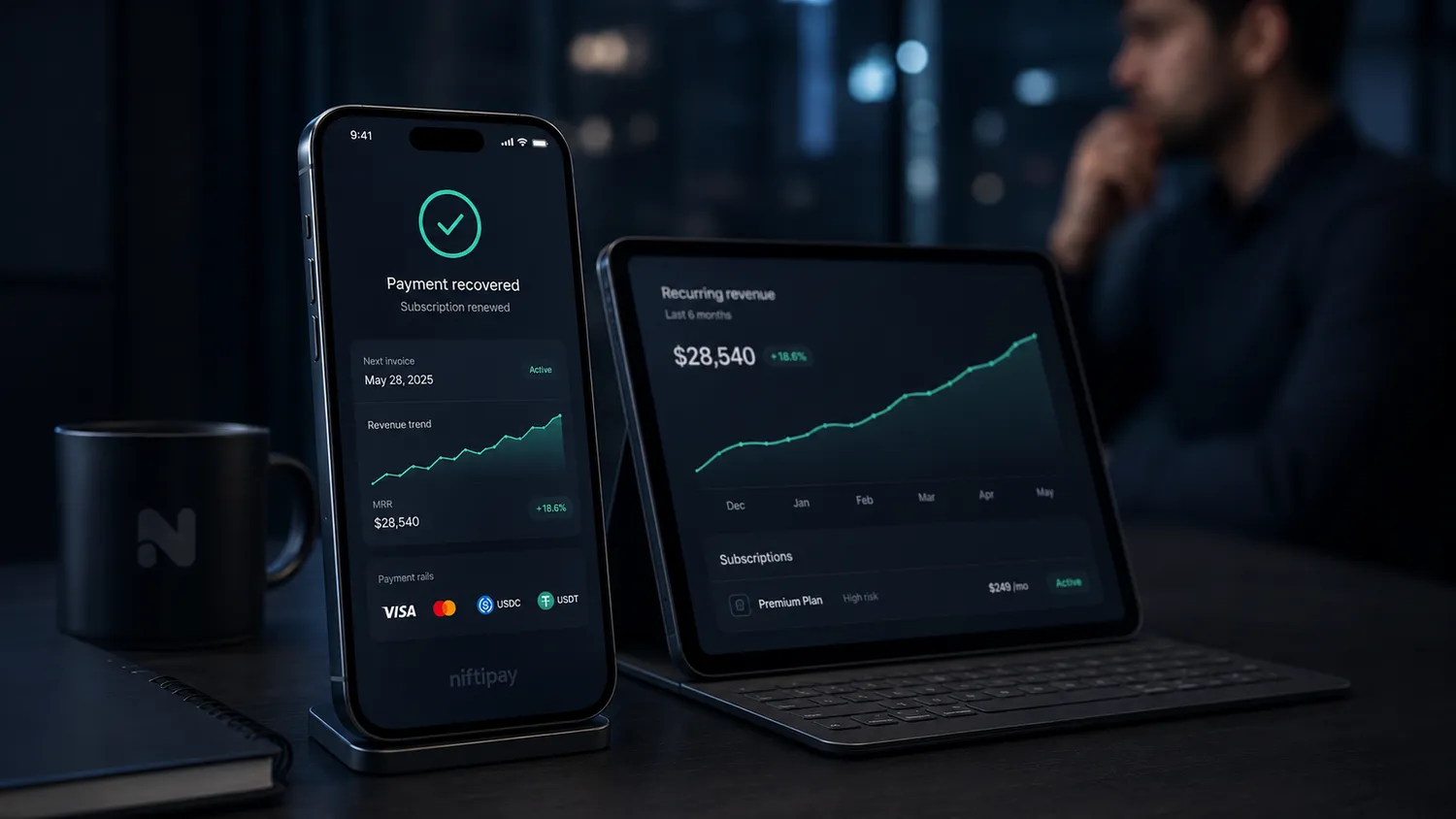
Crypto payments for subscriptions are no longer a niche workaround. For high-risk merchants they act as a clean retry destination when card rails are saturated: the cardholder receives a one-tap link to settle in stablecoin, the merchant keeps the customer active, and the chargeback risk on that specific charge drops to effectively zero. Stablecoin rails settle inside minutes and do not carry the issuer-side risk scoring that drives most recurring declines.
An adult payment gateway for subscription businesses built with crypto fallback gives subscribers a way out of card-decline loops without changing plans or cancelling.
Reducing recurring billing chargebacks at scale
Aggressive retries plus weak dunning equals chargebacks. Every retry inside 24 hours of the previous decline raises the probability that the cardholder will dispute the charge as “unrecognised” or “not authorised”. A disciplined payment retry logic protects the chargeback ratio in three ways: it spaces attempts, it documents the cardholder’s notification trail, and it parks the subscription instead of forcing yet another retry when the signal is hopeless.
- Cap retries at five per billing cycle.
- Suspend, never delete, after the final failed attempt — easier to revive than to re-acquire.
- Log every dunning touchpoint with timestamp; this is the evidence pack if a chargeback is later contested.
- Track recovery rate per decline code, not per merchant — that is the metric the acquirer cares about.
How Niftipay fits into a high-risk subscription stack
Niftipay is the acceptance layer, not the billing engine. Niftipay Card Payments processes each charge as an individual transaction and does not support subscriptions, recurring billing or card-on-file, so retry schedules, dunning sequences and the subscription state itself stay inside the billing platform the merchant already runs. What Niftipay adds is the rail underneath: card, crypto and stablecoin acceptance in one structured payment layer, so a merchant working a failed renewal can present a fresh payment for the customer to complete instead of depending on a single card route.
Frequently asked questions about payment retry logic
How many times should I retry a failed subscription charge?
Between three and five attempts spread over 8 to 12 days. Beyond that, recovery rates collapse and chargeback risk climbs sharply, especially in high-risk MCCs.
Will payment retries trigger more chargebacks?
Only if the retries are stacked too close together or if dunning is missing. Spacing attempts, sending a clear notice before each retry, and stopping after hard declines keeps the dispute rate flat.
Do I need a backup acquirer for subscription billing?
For high-risk verticals, yes. A single MID concentrates risk and turns one acquirer review into a full revenue freeze. A backup acquirer keeps retry logic effective when the primary tightens scoring.
Where does crypto fit into a subscription payment gateway?
As a fallback at the moment of card decline. Offering the cardholder a one-tap stablecoin payment recovers revenue that card rails would have lost, with no chargeback exposure on that specific transaction.
What metric should I track to know if retry logic is working?
Recovery rate per decline code, segmented by retry attempt. A healthy high-risk programme recovers 25–45% of soft declines without raising the chargeback ratio above acquirer thresholds.
Recurring revenue is a system, not a single transaction. Treat every failed payment as a recoverable event, route it through retry logic that respects the decline code, talk to the cardholder before the next attempt, and keep crypto as the rail that does not close. The merchants who do this stop losing customers to their own billing stack.