
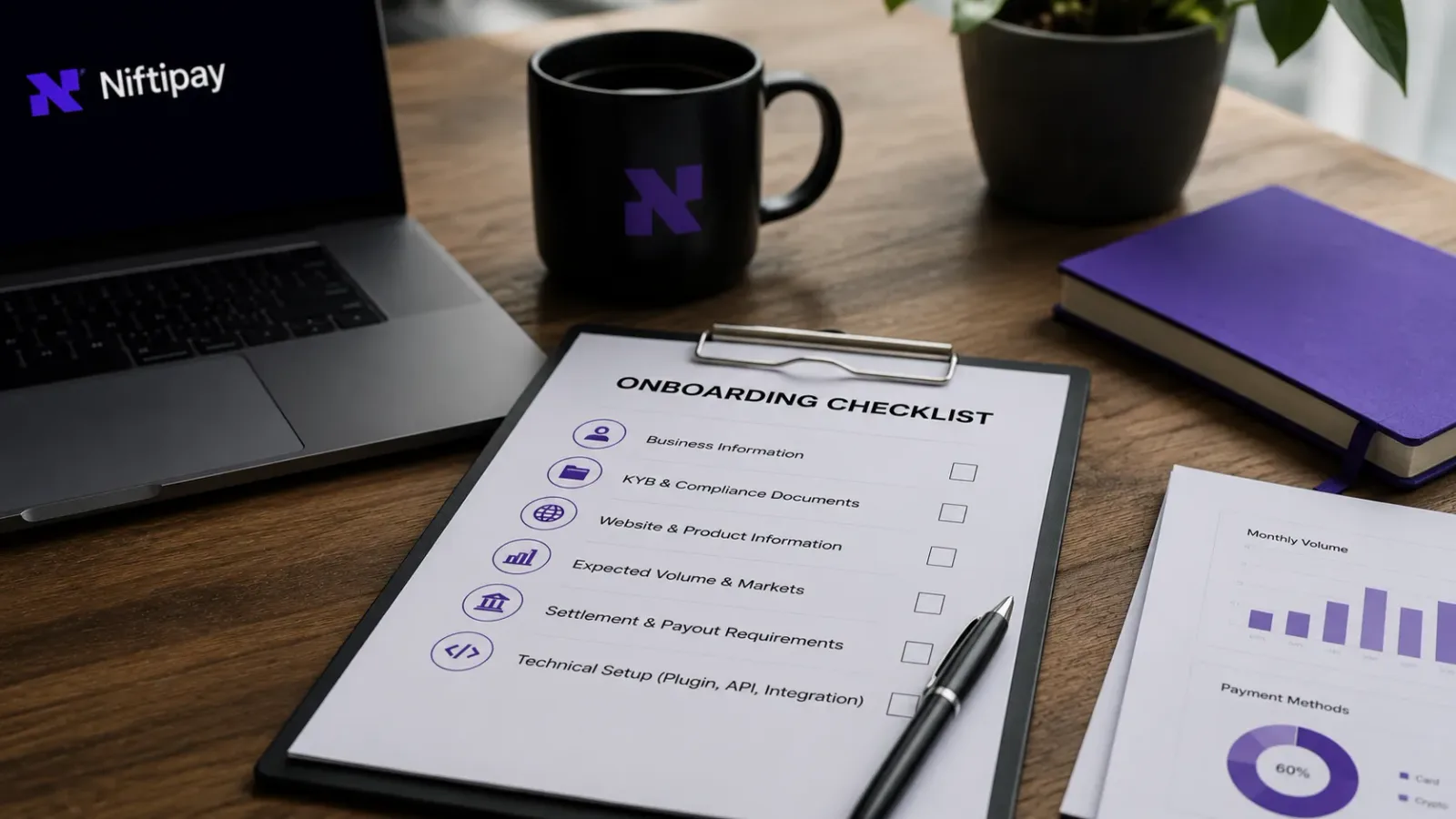
High-risk merchants often lose days during onboarding because a document is missing, a policy page is incomplete or the business model is not explained clearly. A payment gateway onboarding checklist fixes that: it lets you gather everything a provider will ask for before you apply, so the review moves quickly instead of stalling on follow-up requests. This guide walks through exactly what to prepare.
Approval is never guaranteed, and it is never based on one thing. It rests on your business model, risk profile, compliance documents, website quality, payment methods, expected volume, target markets and technical setup. Prepare each of these well and you give yourself the best possible chance of a smooth qualification.
Why onboarding matters for high-risk merchants
High-risk merchant onboarding asks for more detail than a standard payment account because the provider is underwriting real exposure. Before any funds move, they need to know who you are, what you sell and how likely disputes or fraud are in your sector.
That review usually spans several checks at once:
- Risk review — your sector, model and dispute exposure.
- KYB and business verification — confirming the company and its owners are real and legitimate.
- Product review — what you actually sell and how.
- Website checks — whether your site meets basic trust and policy standards.
- Payment provider approval — the final decision, built on all of the above.
Every item you supply up front removes a reason for the process to pause.
Business information to prepare
Start with the core facts about your company. These are the first things a provider matches against official records, so accuracy matters more than speed.
- Registered company name and registration or incorporation number.
- Trading name, if it differs from the legal entity.
- Directors and beneficial owners, with their details.
- Contact information and registered business address.
- Operating regions and the countries you sell into.
- A clear description of your business model and how you take payment.
KYB and compliance documents

A KYB payment gateway check verifies your business the way KYC verifies an individual. Expect to provide documents that prove the company exists, who controls it and where it operates. Preparing scanned copies in advance is the single biggest time-saver in the whole application.
- Business registration documents — incorporation certificate or equivalent.
- ID documents for directors and beneficial owners.
- Proof of address for the business and, where required, its owners.
- Ownership information — shareholding structure and ultimate beneficial owners.
- Licences, if your sector requires them.
- Policies and supporting compliance documents, such as AML procedures where relevant.
These checks follow the same know your customer principles used across regulated finance, and clean documentation signals a well-run business.
Website and product information
The provider needs to understand what you sell and how customers experience your checkout. Your website is treated as evidence, so it should be live, complete and honest about your offering.
- A working website URL with products or services visible.
- Clear pricing and what the customer receives.
- Refund and cancellation policy.
- Terms and conditions and a privacy policy.
- Delivery or service information, including timelines.
- Visible customer support and contact details.
If you are adding payments to an existing site, our guide to a payment gateway for existing websites shows what a review-ready checkout looks like.
Expected volume and target markets
Providers price and approve partly on scale and geography, so give realistic numbers rather than optimistic ones. Over-stated projections that your processing never matches can cause problems later.
- Expected monthly processing volume.
- Average transaction value.
- Currencies you need to accept.
- Customer countries and primary markets.
- Growth expectations over the next few months.
These figures shape your merchant account application and feed directly into your rate. For how that pricing is built, see our breakdown of high-risk payment gateway pricing.
Settlement and payout requirements
Onboarding is also where you set expectations for how you get paid. Knowing your preferences in advance keeps the conversation efficient.
- Payout frequency — daily, weekly or a custom schedule.
- Settlement expectations and acceptable timelines.
- Reserve requirements you are prepared to work with.
- Bank details for fiat payouts.
- Crypto or stablecoin payout needs, if relevant to your model.
- Operational cash flow — how payout timing affects your business.
To see how funds move from checkout to your account, our checkout to settlement flow guide maps each stage.
Technical setup: plugin, API or custom integration
How you connect payments affects both timeline and effort. Know which route fits your team before you apply, so setup can start as soon as you are approved.
- Plugin — fastest for common platforms; see our high-risk WooCommerce payment gateway guide.
- API — more control and custom flows, as covered in our iGaming payment gateway integration guide.
- Custom integration — for bespoke checkouts and platforms.
Be ready to state your website platform, checkout flow, developer availability and the payment methods you need — card, crypto, stablecoin or a mix.
Payment gateway onboarding checklist
Use this payment gateway application checklist as a final pass before you submit. If every line is ready, you are prepared to apply.
- Business details
- Company documents
- Ownership and director details
- KYB documents
- Website URL
- Product/service information
- Refund and terms pages
- Target markets
- Expected volume
- Average order value
- Payment methods needed
- Settlement expectations
- Technical setup requirements
How Niftipay helps merchants prepare for onboarding
Niftipay is payment infrastructure for businesses that already have a sales channel and need card, crypto or stablecoin payment options through one structured layer. If you have a live website and a clear model, onboarding is about getting your setup review-ready rather than starting from scratch.
The path is straightforward: create your account, complete compliance with the documents above, connect your plugin or API, and configure processing around your markets, methods and settlement needs. Preparation on your side keeps each of those steps moving.
Payment gateway onboarding checklist FAQs
What is a payment gateway onboarding checklist?
A payment gateway onboarding checklist is the set of business details, documents and information you gather before applying for a payment account. It covers company data, KYB and compliance documents, website and product information, expected volume, target markets, settlement preferences and technical setup, so the provider can review your application without repeated follow-ups.
What documents do high-risk merchants need for onboarding?
Typically business registration documents, ID for directors and beneficial owners, proof of address, ownership and shareholding information, any sector licences, and supporting policies such as AML procedures. A live website with clear refund, terms and privacy pages is usually expected alongside the paperwork.
What is KYB for a payment gateway?
KYB, or know your business, is the verification process a payment provider uses to confirm a company is real, legitimate and controlled by the people it claims. It is the business equivalent of KYC and is a standard part of high-risk onboarding, drawing on official registration records and identity documents.
How can merchants improve payment provider approval chances?
Submit complete, accurate KYB documents, keep your website and policy pages up to date, describe your business model honestly, and give realistic volume and market figures. Clear preparation across every checklist item reduces friction, though no provider can promise guaranteed approval.
What should I prepare before a merchant account application?
Prepare your business and ownership details, KYB and compliance documents, a review-ready website, product and pricing information, expected volume and average order value, target markets, preferred payment methods, settlement expectations and your technical setup route. Working through a payment gateway onboarding checklist first is the most reliable way to be ready.