
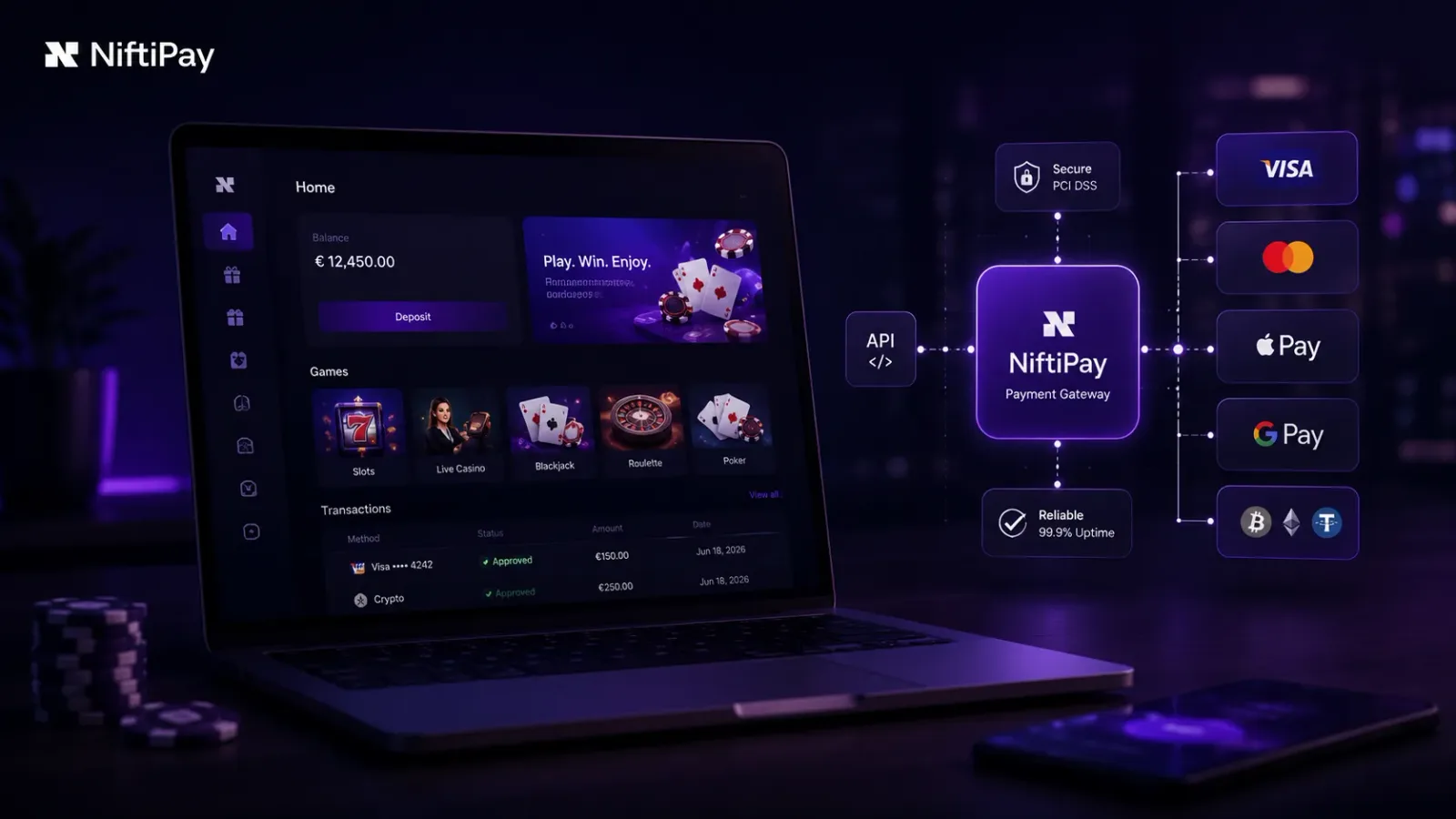
Adding a payment gateway to an iGaming platform is not the same job as wiring a checkout into an online store. iGaming payment gateway integration services need to account for deposits and withdrawals, high transaction frequency, fraud and chargeback exposure, and player verification before a single live payment runs. This guide sets out the practical checks — API, approval, payment method coverage, settlement, payout and reconciliation — that operators and technical teams should work through before going live.
It is written for iGaming platforms, high-risk merchants, payment managers and technical teams who already have a platform in place and are evaluating a new or upgraded payment layer. It is not an introduction to iGaming payments in general — it is a readiness guide for the integration itself.
Why iGaming payment integration is more complex than standard ecommerce
A standard ecommerce store processes a payment once, ships a product, and closes the transaction. An iGaming payment platform has to manage ongoing player balances, repeat deposits, withdrawal requests and a payment relationship that can run for months. That difference shapes almost every part of the integration.
- Deposits and withdrawals both need to be supported reliably, not just inbound payments — withdrawal or payout flow is often the weaker part of a platform’s payment setup.
- Transaction frequency is typically higher than ecommerce, with the same player depositing and withdrawing repeatedly rather than making a single purchase.
- Player account balances need to reconcile against deposits, withdrawals, bets and wins across the payment layer and the platform’s internal ledger.
- Chargeback and fraud risk tends to run higher than retail ecommerce, which affects underwriting, reserves and the controls a provider expects to see.
- Jurisdiction and operator risk profile vary widely — requirements can vary by jurisdiction and risk profile, and providers usually review this before quoting terms.
- Payment method restrictions apply in some markets and card networks, which can limit which payment methods are available for certain operator types.
- KYC/KYB expectations are usually more detailed than a standard merchant onboarding, covering both the business and, in some flows, the end player. Know Your Customer checks sit alongside broader anti-fraud and compliance processes.
- AML and compliance readiness is something operators may need to consider at a business level; this article does not provide legal advice, and requirements should be confirmed with qualified counsel.
- Payout timing affects player experience directly — slow or unclear payout timing is one of the most common operational complaints in iGaming.
- Reconciliation has to tie together player accounts, transactions and multiple payment methods, not just a single settlement batch.
None of this means iGaming payments are unworkable — it means the checks need to happen before integration starts, not after launch.
API and platform compatibility checks before integration
Once the business-level requirements are understood, the technical evaluation of the iGaming payment API can begin. This is where most integration delays actually happen — not at the underwriting stage, but in the weeks after a provider is chosen, when the platform and the API turn out not to line up as expected.
Before committing to a payment gateway integration for iGaming, technical teams should check:
- API documentation quality — is it current, does it cover error codes, and does it include working request/response examples?
- Hosted checkout vs embedded payment flow — hosted checkout is usually faster to launch; an embedded flow gives more control over player experience but needs more development time and awareness of PCI DSS scope.
- Deposit flow — how deposits are initiated, confirmed and reflected in the player’s balance.
- Withdrawal or payout flow — how withdrawal requests are submitted, approved and paid out, and whether manual review steps are supported.
- Transaction status updates — how the platform is notified when a payment moves from pending to approved, failed or settled.
- Webhook support — which events are pushed automatically rather than requiring the platform to poll for status.
- Redirect handling — how players are returned to the platform after 3-D Secure or an external payment step.
- API authentication — key management, rotation and how credentials are scoped by environment.
- Sandbox or testing environment — whether a full sandbox exists to test deposits, withdrawals, failures and edge cases before going live.
- Error handling — clear, structured error responses that the platform can act on rather than generic failure messages.
- Idempotency — protection against duplicate deposits or payouts caused by retries or network timeouts.
- Payment status visibility — whether operations and support teams can see transaction status without asking a developer to check logs.
- Platform compatibility with the existing iGaming system, including how player accounts, wallets and game engines already talk to each other.
- Developer support during integration — realistic response times, not just a general support inbox.
Two of these are worth a closer look before choosing a provider: payment gateway webhooks, which determine how quickly the platform knows a payment has changed state, and a payment status API, which determines how easily that state is surfaced to operations and support teams.
Payment method coverage for iGaming platforms
Most iGaming operators need more than one payment method live at the same time. Card declines, regional payment preferences and player trust all affect which methods actually get used, so an integrated payment gateway for iGaming platforms usually needs to support more than a single rail from day one.
- Card payments remain the default for most players, but decline rates and network restrictions can vary by region and business category.
- Crypto payments can widen deposit and withdrawal options, particularly for players in markets with limited card or banking access.
- Stablecoin payments are increasingly used for settlement and payout because their value is designed to track a reference currency, though this depends on the stablecoin issuer and does not remove counterparty or regulatory considerations.
- Alternative payment methods — bank transfers, e-wallets and local payment rails — help cover players who don’t use cards or crypto.
- Local or regional payment preferences differ by market; a method that dominates in one country may barely be used in another.
- Deposit and withdrawal expectations should be checked per method, since not every payment method supports both directions equally well.
- Backup payment routes reduce the impact of a single method or provider having downtime or a temporary approval issue.
- Customer preference and operational flexibility both improve when players have a genuine choice rather than one forced route.
It’s worth being clear about what this coverage does and doesn’t do: adding crypto or stablecoin options does not remove risk or guarantee approval, and payment method availability still depends on the operator’s risk profile and the provider’s underwriting. This is part of why an iGaming payment provider integration is usually evaluated method by method rather than as a single yes/no decision. Some operators combine card and crypto acceptance under a card and crypto payment gateway to reduce the number of separate providers they manage, while others look at broader alternative payment methods to cover players who don’t use either.
Approval checks and operator risk profile
Approval for iGaming payment infrastructure is not a formality. Providers typically review the operator as a business before reviewing the integration itself, and approval depends on how well-prepared that review is.
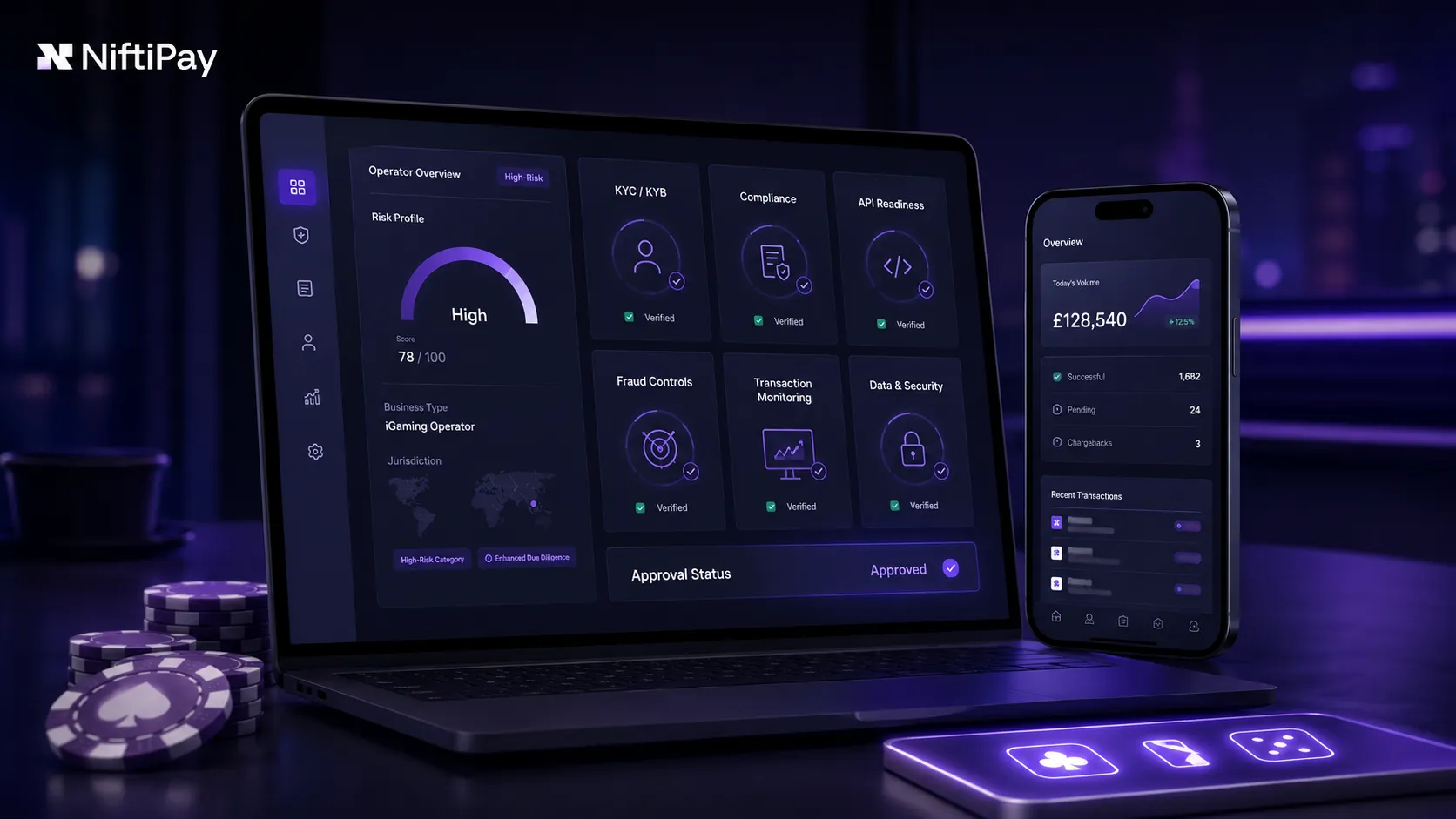
Operators should expect providers to look at:
- Company and ownership details, including corporate structure and beneficial ownership.
- Licence or operating jurisdiction, where relevant to the operator’s model.
- Website or platform transparency — clear terms, contact information and a working product.
- Player terms and conditions, including how deposits, withdrawals and disputes are handled.
- Responsible gaming information, where applicable to the operator’s offering.
- KYC/KYB readiness — documentation prepared in advance moves underwriting along faster.
- Expected processing volume and average transaction value, which shape risk and reserve terms.
- Chargeback exposure and existing fraud controls already in place on the platform.
- Deposit and withdrawal model — how player funds move in and out, and how withdrawals are approved.
- Supported countries and any related payment method requirements.
- Refund and dispute processes — how player complaints and payment disputes are actually handled today.
- Previous merchant account history, including any prior terminations or restrictions.
- Technical readiness — whether the platform can actually support the API and webhook requirements covered above.
Providers may review all of this before quoting terms, and approval is never guaranteed — it depends on the operator’s model, documentation and risk profile. Access, authentication and withdrawal protection also come under scrutiny at this stage; payment gateway security controls such as 2FA and withdrawal approval limits are typically part of what a provider checks before approval, not something added afterwards.
Settlement, payout and reconciliation needs
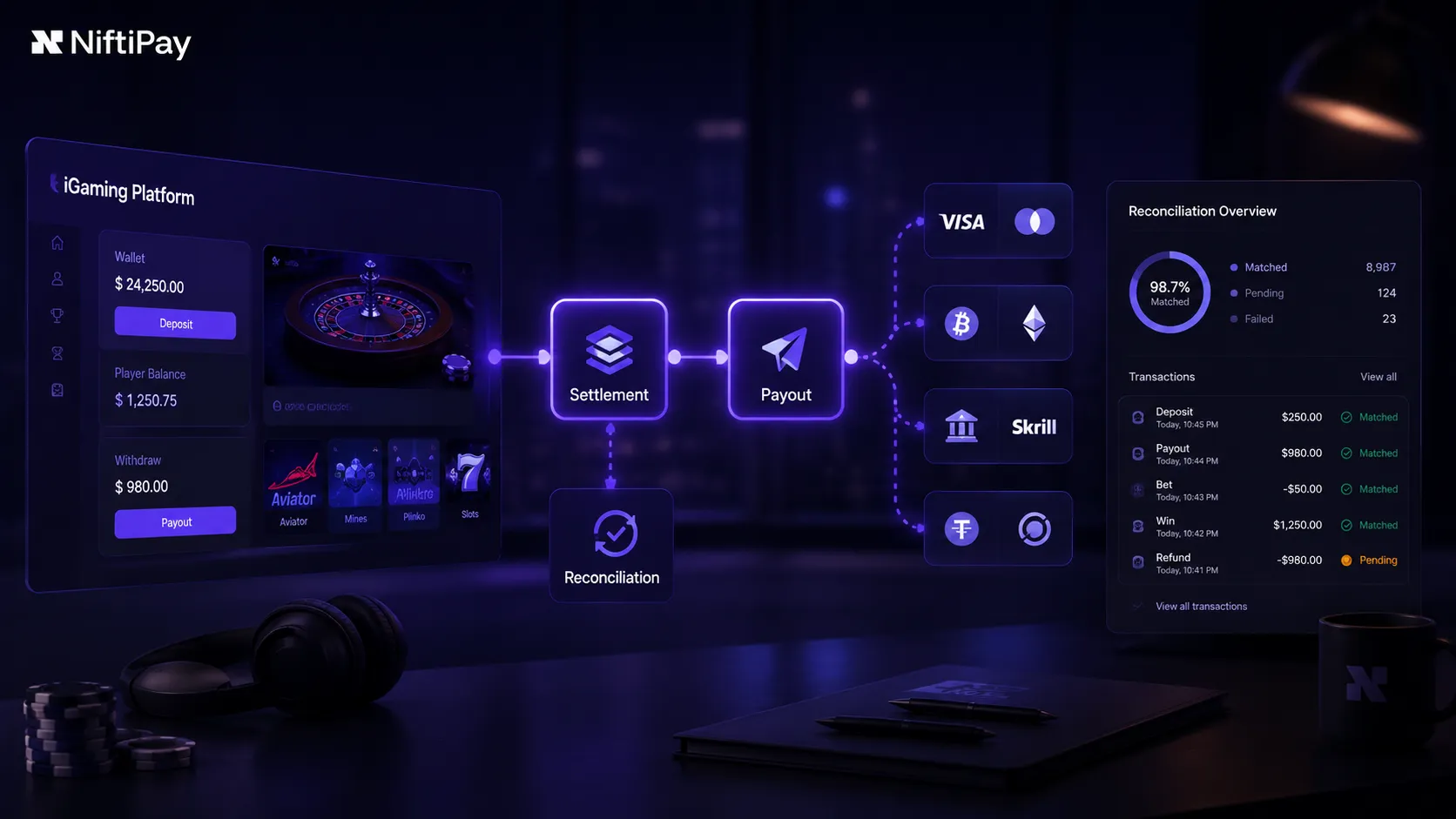
Integration doesn’t end when a payment is accepted. For an iGaming payment platform, settlement, payout and reconciliation are where day-to-day operational problems usually surface if they weren’t checked beforehand.
- Settlement timing — how long funds take to settle, and how consistent that timing is.
- Payout frequency — how often merchant payouts run, separate from individual player withdrawal timing.
- Payout currency — whether payouts arrive in the operator’s operating currency or require conversion.
- Reserves, where applicable, and how they’re calculated against processing volume and risk category.
- Transaction reporting — whether reports are detailed enough for finance to close the books without manual cross-checking.
- Reconciliation between deposits, withdrawals and balances — matching what the payment provider reports against what the platform’s ledger shows.
- Failed, pending and approved transaction states — visibility into all three, not just successful payments.
- Refund and chargeback visibility — seeing disputes as they happen rather than finding out at month-end.
- Internal finance and operations reporting — whether the data coming out of the payment layer actually fits how finance teams already work.
Reconciliation matters more for high-risk and iGaming operators than for standard ecommerce because of transaction volume and the number of states a single player’s funds can move through — deposit, bet, win, withdrawal, refund. Mapping the full settlement and payout flow before go-live makes it far easier to catch mismatches early rather than during a live dispute.
What to prepare before going live
The checklist below is meant to be worked through with both technical and operations teams in the room — not signed off by one side and handed to the other.
| Checklist item | Why it matters |
|---|---|
| Confirm approved payment methods | Avoids launching with methods that weren’t actually part of underwriting. |
| Check API credentials and permissions | Wrong scope or environment mix-ups are a common last-minute blocker. |
| Test sandbox transactions | Confirms the integration works before real player funds are involved. |
| Test failed and pending payment states | Most integration bugs show up in edge cases, not successful payments. |
| Verify webhook handling | Missed or duplicate webhook events cause balance and status mismatches. |
| Test deposit and payout flows end to end | Confirms both directions work, not just the deposit side. |
| Confirm settlement reporting | Finance needs this before launch, not discovered after the first payout. |
| Confirm reconciliation process | Defines how deposits, withdrawals and balances will be matched day to day. |
| Prepare KYC/KYB documentation | Keeps onboarding and any future reviews moving without delay. |
| Review chargeback and dispute processes | Sets expectations before a dispute actually happens. |
| Confirm support escalation process | Player-facing payment issues need a clear internal path, fast. |
| Align finance, operations and technical teams | Prevents each team assuming another team owns a given check. |
| Document what happens when a transaction fails | Gives support a clear answer instead of guessing per case. |
| Ensure support can see payment status clearly | Reduces escalations caused by support lacking visibility. |
When to speak to Niftipay about iGaming payment infrastructure
Niftipay is payment infrastructure for operators that already have a platform, not a platform builder. It may help iGaming operators who fit one or more of the following, subject to qualification, jurisdiction and risk profile:
- The operator already has an iGaming platform or technical sales channel in place.
- The business needs payment infrastructure rather than a rebuild of its existing platform.
- Card, crypto, stablecoin or alternative payment options are needed alongside each other.
- The technical team needs an API-led integration rather than a plug-in checkout.
- The operator wants to understand approval requirements before going live, not after a rejection.
- Settlement, payout and reconciliation visibility are a priority, not an afterthought.
- The business falls into a high-risk or otherwise complex category for standard providers.
Niftipay can support these operators depending on their model, jurisdiction, risk profile and approval requirements — it does not guarantee approval, settlement timing, lower fees or availability in every market. For operators weighing up their overall payment infrastructure for complex operators, that broader review is often a useful starting point alongside the checks in this guide, and it sits alongside our iGaming payment gateway overview for operators still comparing options at a higher level.
FAQs
What are iGaming payment gateway integration services?
iGaming payment gateway integration services cover the technical and commercial work needed to connect an iGaming platform to a payment provider — API integration, approval checks, payment method setup, settlement and payout configuration, and reconciliation. They are distinct from simply adding a checkout button, since deposits, withdrawals and player balances all need to be handled reliably.
For operators, this usually means working through provider documentation, testing environments and underwriting requirements in parallel, rather than treating integration as a single step at the end of onboarding.
What should an iGaming platform check before integrating a payment gateway?
At minimum, operators should check API documentation and sandbox availability, webhook and transaction status support, which payment methods are actually approved for their business type, and how settlement, payout and reconciliation will work day to day.
It also helps to confirm KYC/KYB documentation is ready and that finance, operations and technical teams agree on what happens when a transaction fails, before that situation happens with a live player.
Why is iGaming payment approval more complex than standard ecommerce?
iGaming involves ongoing player balances, repeat deposits and withdrawals, higher transaction frequency and typically higher chargeback and fraud exposure than a standard online store. Providers usually review the operator’s business model, jurisdiction and risk profile more closely as a result.
Approval depends on the specific operator, its documentation and its risk category — requirements can vary by jurisdiction and provider, and approval is never guaranteed in advance.
Can iGaming platforms accept card, crypto and alternative payments?
Many iGaming platforms use more than one payment method, including cards, crypto, stablecoins and alternative payment methods such as bank transfers or e-wallets, depending on approval and the markets they operate in.
Availability depends on underwriting, jurisdiction and the specific payment methods a provider supports for that operator category — adding crypto or stablecoin options does not remove risk or guarantee approval on its own.
What settlement and payout checks matter before going live?
Before going live, operators should confirm settlement timing, payout frequency and currency, and whether reserves apply. Reconciliation between deposits, withdrawals and account balances should also be mapped out in advance.
Visibility into failed, pending and approved transaction states matters just as much as visibility into successful payments, since that’s usually where reconciliation and support issues actually originate.