

Want to accept Bitcoin payments as a UK business — online or in person — without turning into a crypto expert? You can: use a crypto payment processor (gateway) that handles wallets, checkout, settlements and compliance for you. Many UK merchants accept ETH, USDT, and other coins with low fees and instant or near-instant settlement. Below I explain the steps, recommend providers, cover point-of-sale (POS) options, and highlight UK regulatory points you must know.
Why UK businesses accept crypto
- Lower processing fees than many card providers (often 0.5–1%). NOWPayments
- No chargebacks (fraud/dispute rules differ from cards). coinbase.com
- Fast cross-border payments and multi-currency reach without big FX markups. coinbase.com
- New customer segments: crypto users often spend more on digital goods and services. Rapyd
Quick checklist before you start (UK essentials)
- Decide which coins you’ll accept (BTC, ETH, USDT/USDC are common).
- Choose a crypto payment processor that supports UK merchants and offers fiat settlement if you don’t want to hold crypto.
- Confirm AML/KYC and registration responsibilities — in most cases the gateway manages this, but confirm the provider’s FCA stance.
- Plan checkout UX: embedded checkout, hosted page, or invoice links.
- Test refunds, accounting, and reconciliation workflows.
Step-by-step: How to accept Bitcoin & Ethereum payments (online)
— 1) Pick a crypto payment processor (gateway)
Good UK-friendly options: Coinbase Commerce, NOWPayments, BitPay, CoinsPaid (choose based on fees, supported coins and plugin availability). Coinbase Commerce and others have easy plugins for Shopify, WooCommerce and custom APIs.
— 2) Create an account and complete provider KYC
Gateways will require business details and usually perform AML/KYC checks. Using a reputable provider means they’ll take on much of the regulatory burden — still, keep records for accounting.
— 3) Choose settlement method: fiat vs keep crypto
- Instant fiat settlement: the gateway converts crypto to GBP (avoids volatility).
- Hold crypto: you control exposure (but need treasury/accounting processes). Coinbase Business and others offer both models.
— 4) Integrate checkout
- Plugins: Install Shopify/WooCommerce plugin (fast).
- Hosted checkout: Good if you want the gateway to handle card data / PCI scope.
- API integration: For full control (requires dev time).
— 5) Test the payment flow
Use the provider’s sandbox, test different coins (BTC, ETH, USDT), and simulate refunds or partial refunds so your accounting knows how to handle them.
How to accept USDT payments UK business (stablecoin specifics)
Why USDT/USDC? Stablecoins peg to fiat and eliminate price volatility, making them very practical for merchants. Providers like NOWPayments and others support USDT and offer conversion or settlement options. If you accept USDT, you can either:
- Receive USDT and convert to GBP automatically, or
- Hold USDT in your crypto account (requires treasury rules).
Practical tip: For everyday retailers, auto-convert to GBP to avoid volatility bookkeeping and simpler refunds.
How to accept Ethereum payments UK (gas and UX tips)
- Ethereum (ETH) has higher gas fees on mainnet; many merchants accept layer-2 solutions or ERC-20 stablecoins to lower fees. Providers often offer routing to cheaper networks or stablecoin alternatives.
- Use provider features that show the exact amount and network to customers to avoid wrong-network payments.
Point of sale crypto payments UK — in-store & events
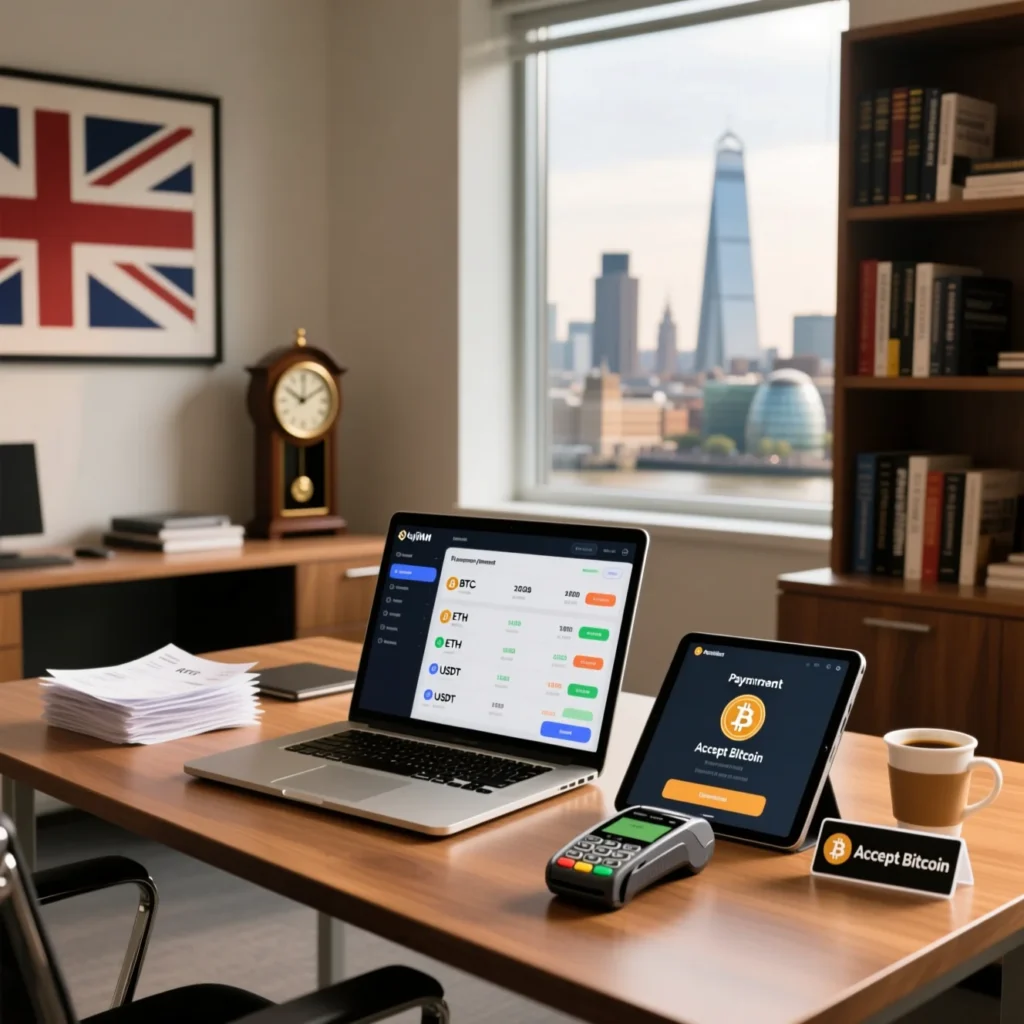
If you have a physical shop, you can accept crypto via:
- Mobile QR codes / invoice links generated by the gateway; or
- Dedicated crypto POS terminals (BitPay and other providers offer retail POS systems).
Real example: A small London café added QR-based BTC/USDT payments and promoted a 2% discount for crypto users. Within two months they had repeat crypto customers and saved on card terminal fees.
Choosing the right UK business crypto payment processor
Compare providers on these dimensions:
- Supported coins (BTC, ETH, USDT, USDC)
- Fiat settlement options (GBP payout frequency)
- Fees (processing, conversion, withdrawal)
- POS support (if you have a shop) — BitPay and CoinsPaid offer in-store systems.
- Compliance / FCA approach (ensure the provider operates with required AML controls) — FCA guidance and registration expectations are evolving; use providers who publish compliance info.
Top gateways frequently used by UK merchants: Coinbase Commerce / Coinbase Business, BitPay, NOWPayments, CoinsPaid, CoinGate. Each has different strengths (plugins, fiat settlement, POS).
Accounting, refunds & tax
- Invoices & VAT: Record GBP equivalence at time of sale for VAT reporting. If you take crypto and keep it, track gains/losses separately.
- Refunds: If the provider auto-converts crypto to fiat, refunds are easier; if not, volatility can make refunds costly. Test provider refund flows before going live.
- Bookkeeping: Use tools/integrations that export CSVs or sync with accounting software. Many gateways provide invoices and transaction reports.
UK regulation: what merchants must know
The FCA requires registration for crypto firms that provide exchange, custody or other crypto services; merchants using third-party gateways typically rely on the provider’s registration and AML controls. Still, keep clear KYC records for larger transactions and choose providers transparent about their UK compliance stance. The FCA has recently been publishing guidance and consultations on applying handbook rules to crypto businesses — keep an eye on updates.
Safety note: Use reputable providers; enforcement actions (e.g., past fines) remind us to prefer compliant gateways.
Common pitfalls and how to avoid them
- Wrong network payments: Display network name (ERC-20 vs BSC) clearly to customers.
- High gas fees on ETH mainnet: Offer stablecoins or L2 options. CoinsPaid
- Ignoring tax/VAT: Keep GBP records at sale time.
- Choosing a non-compliant provider: Verify AML/KYC and UK presence.
Final checklist
- Choose provider (Coinbase Commerce, NOWPayments, BitPay, CoinsPaid).
- Complete KYC for business account.
- Decide fiat or crypto settlement.
- Integrate plugin/API and test sandbox.
- Train staff for POS and refunds.
- Add clear checkout instructions (network, coin, refund policy).
- Monitor transactions and reconcile monthly.
Accepting Bitcoin, Ethereum and USDT payments in the UK is easier than many merchants think. Pick a reputable UK business crypto payment processor, decide whether to auto-convert to GBP, integrate via plugin or API, test thoroughly, and keep records for VAT and accounting. For in-store sales, use QR or a crypto POS terminal to offer a smooth checkout.